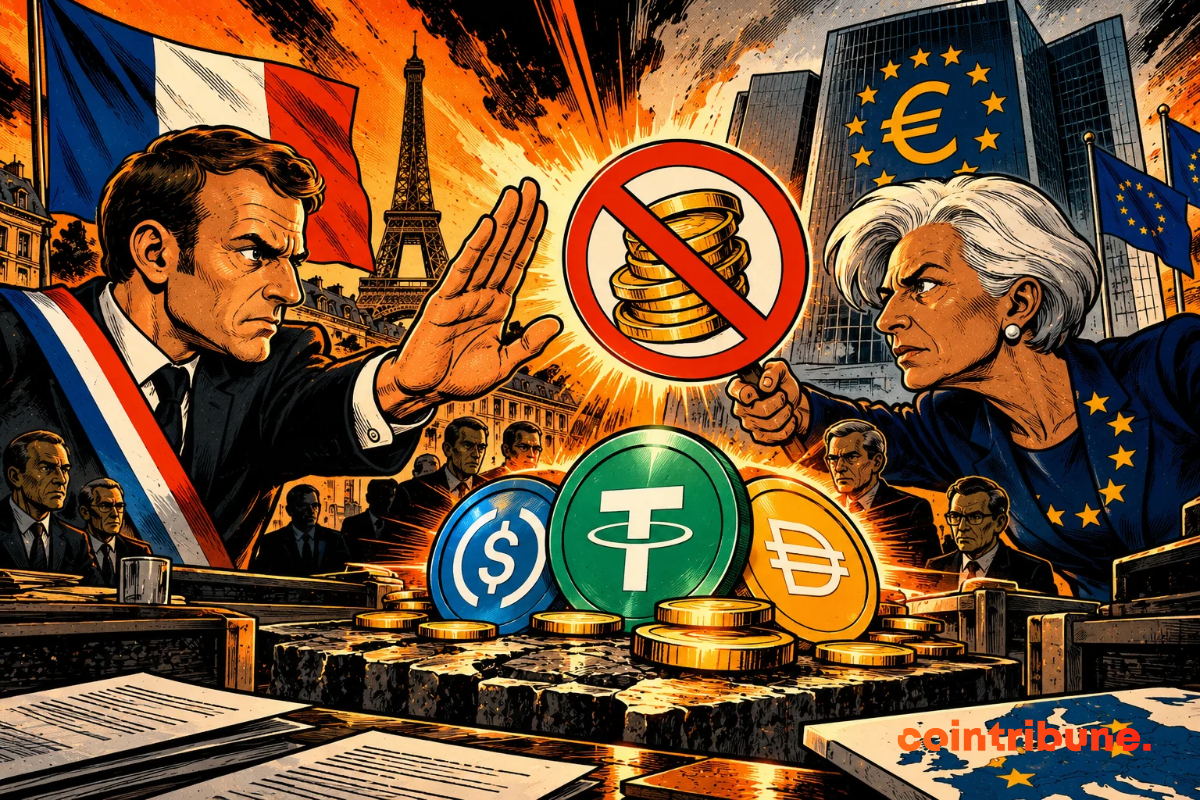
France proposes to conditionally authorize rewards paid to stablecoin holders by platforms, despite opposition from the European Central Bank. Behind this technical disagreement lies above all Europe’s capacity to develop stablecoins in euros capable of competing with their dollar-backed competitors.
In brief
- France proposes to authorize rewards on stablecoins when paid by platforms, under certain conditions.
- The ECB is defending a broader ban to prevent stablecoins from becoming savings products.
- European authorities fear that these rewards will lead to a flight of bank deposits.
- Paris wants to strengthen the competitiveness of euro stablecoins against their dollar-backed competitors.
- No changes to MiCA have yet been adopted. The European Commission must present its report by June 2027.
Paris distinguishes rewards from banking interests
The Directorate General of the Treasury, the AMF, the Banque de France and the ACPR presented a common position as part of the revision of the MiCA regulation. These four authorities support maintaining the ban on stablecoin issuers from directly remunerating holders.
However, they offer different treatment when the reward comes from a third party, such as an exchange platform. According to them, these mechanisms “should be regulated rather than banned outright, since they tend to grow in all cases”.
The authorization would be accompanied by several safeguards:
- The platform should clearly explain the origin and conditions of the reward;
- No guaranteed return could be promised to users;
- The product should not be presented as a savings solution;
- Authorities should monitor its effects on bank deposits.
This distinction aims to separate two models. In the first, the issuer pays for the simple holding of its stablecoin, which brings the token closer to a deposit. In the second, a company offers a trading advantage, cashback or fee reduction without changing the functioning of the stablecoin itself.
French authorities estimate that these rewards reduce the cost of holding e-money tokens and can promote continuously available financial services. They also warn that a stricter European framework than that of its competitors would weaken stablecoins denominated in euros.
The ECB fears a transformation of stablecoins into savings
The European System of Central Banks, which brings together the ECB and national central banks, defends a broader reading of the ban. He wants this to also cover indirect rewards, fee reductions and certain loyalty programs.
Its position is based on the legal function of these assets. “Electronic money is intended to be used to make payments and not as a means of saving”, asserts the document sent to the European Commission. Regular remuneration would therefore risk blurring the line between stablecoin, investment and bank deposit.
The ECB also fears a shift in deposits. If users earn a return by holding stablecoins on a platform, they could move some of their money out of traditional bank accounts. Establishments would then have less stable resources to finance credit.
The French opposition must, however, be nuanced. The Banque de France co-signed the national proposal while belonging to the European system which defends a broader ban. It is therefore not a question of a head-on conflict between Paris and Frankfurt, but of a disagreement on the exact scope of the rule.
France is not asking for complete liberalization either. It wishes to clarify staking as well as crypto lending and borrowing, with responsibilities assigned to intermediaries and obligations adapted to risks.
The real issue concerns the competitiveness of the private digital euro
The easing defended by Paris is part of a broader strategy. French authorities want to accelerate the development of euro stablecoins and tokenized bank deposits, particularly for cross-border payments and financial markets running on blockchain.
Rewards are an acquisition tool here. Against the already widely used dollar stablecoins, a euro token lacking cashback, discounts or indirect remuneration could struggle to attract users. The question is therefore not only to protect the banks, but to determine whether the Union can build a competitive offer without reproducing the risks of a savings product.
Paris is also asking to explicitly prohibit approved European providers from offering stablecoins that do not comply with MiCA. The proposal thus combines a limited opening to rewards with a tougher approach against tokens operating outside the European framework.
No changes have been adopted yet. The Commission’s consultation closed on 30 September 2026 and the positions received must now be considered. The Commission must submit its report on MiCA to the European Parliament and the Council no later than June 30, 2027, with possible legislative proposals.
For users, rewards therefore remain subject to current rules. The debate will above all determine whether MiCA should prevent any remuneration linked to stablecoins or only that which directly transforms these payment tokens into savings products.
Maximize your Tremplin.io experience with our ‘Read to Earn’ program! For every article you read, earn points and access exclusive rewards. Sign up now and start earning benefits.