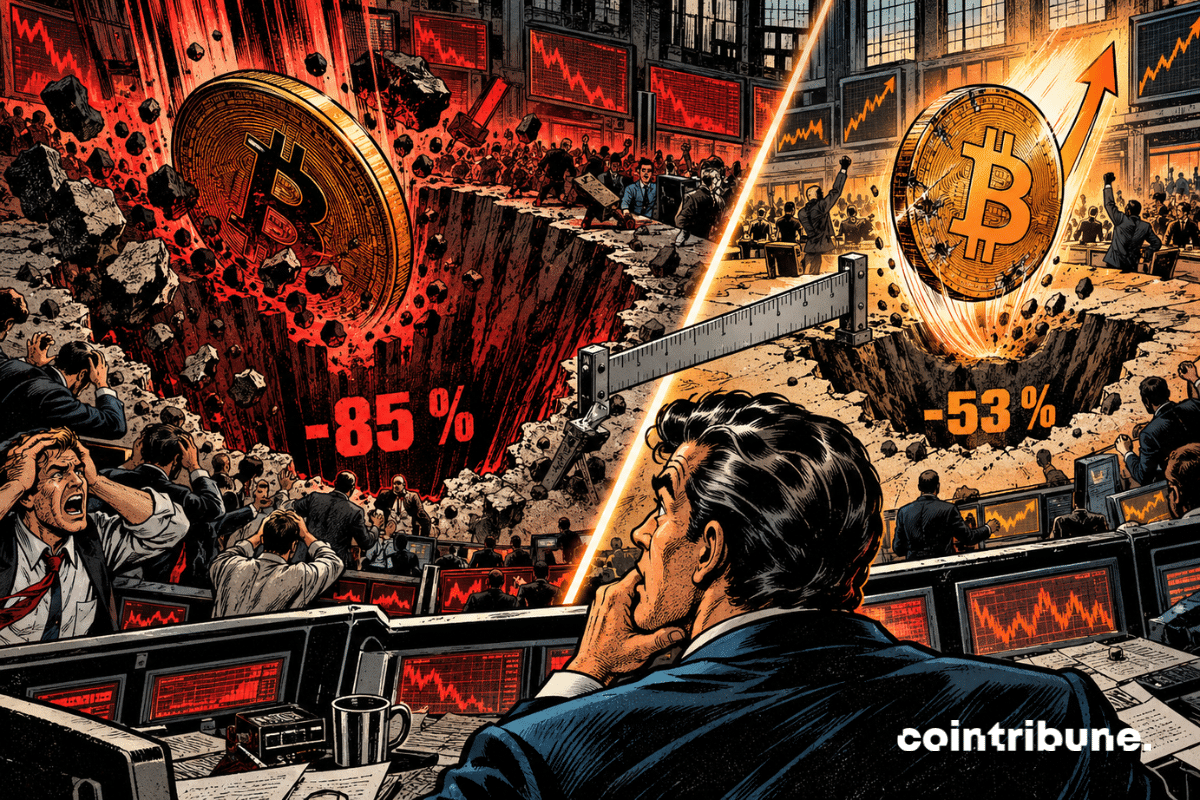
Bitcoin’s major corrections are losing momentum. They went from around 85% in the first cycles to 84%, then 77% and almost 53% in the current cycle. Data compiled by Galaxy Research shows this gradual compression, although the bottom of the 2025-2026 cycle is not yet definitively confirmed.
In brief
- Bitcoin’s big pullbacks went from around 85% to 53%.
- The increases between troughs and peaks also decrease sharply.
- The four-year cycle remains visible, but its amplitude is narrowing.
Bitcoin experiences increasingly shallow corrections
The story begins with a fairly clear series. In 2014, bitcoin lost around 85% from its peak. After the arrival of futures and Wall Street in 2017, the next drop reached another 84%. The 2020-2021 market welcomes Strategy, Tesla and new institutional investors. Bitcoin then corrects by around 77%.
The current cycle stops at around -53% for the moment. We already noted in February that on-chain signals remained consistent with the four-year cycle, despite a different market structure. Between -85% and -53%, the gap reached 32 percentage points. Proportionally, the current correction is almost 38% less profound than that of the first major cycle considered.
Change does not come from a single event. Bitcoin spot ETFs, companies accumulating BTC in treasury, and a broadening investor base have added buyers absent from the early rounds. This does not prevent declines. For now, they just stop higher.
Bitcoin rallies are also shrinking
The counterpart appears when we look at the bullish phases.
Bitcoin.com records increases of approximately 580x, 130x, 22x then 8x between cycle lows and subsequent highs. The decrease is spectacular. The multiple between the first and fourth episodes was divided by more than 72.
A bitcoin that falls less violently therefore also produces, so far, less extreme increases. This development is in line with the debate opened in recent months on the maturity of the market. Michael Saylor believes that the traditional four-year cycle is losing its weight with the arrival of institutional capital and ETFs.
The phenomenon, however, remains difficult to attribute precisely. ETFs can cushion some sales through steady demand. They do not allow us to demonstrate, on their own, why the amplitude decreases.
Halving also plays a less mechanical role than in the early days of Bitcoin. Each halving still decreases the issuance of new BTC, but this new supply now represents a much smaller fraction of a market that has become considerably larger. Less new rarity to absorb. Much more capital already present.
The four-year cycle has not yet disappeared
The compression of movements is not enough to bury the historical cycle. Galaxy Research notes that the previous sequences continue to follow a similar chronology: trough, halving, peak, then new correction. The three completed cycles also placed their low point approximately 12 to 13 months after the peak.
The current cycle remains incomplete. This is an important limit to the -53% figure. If bitcoin sets a new low, this correction will mechanically become deeper. The percentage should therefore be read as a snapshot of the market at this stage, not as a definitive assessment.
At the same time, the institutional presence remains very real. US Bitcoin ETFs attracted another $101.15 million on September 2, after a strong session of withdrawals. The 2026 market thus resembles the first cycles less in terms of its amplitude, but still retains part of their rhythm. Corrections go from 85% to 53%. The rallies are also slowing down. To know if this compression has become structural, we will first need to know the true bottom of the current cycle.
Maximize your Tremplin.io experience with our ‘Read to Earn’ program! For every article you read, earn points and access exclusive rewards. Sign up now and start earning benefits.