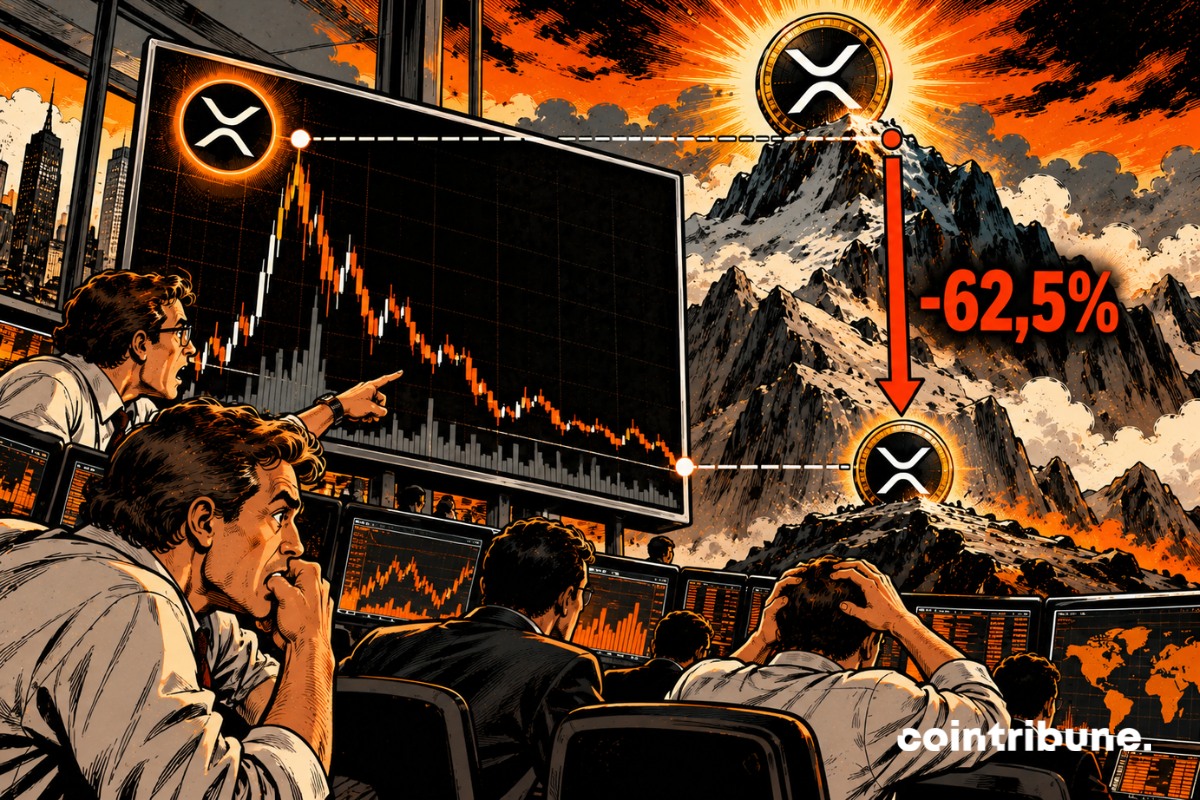
XRP is trading around $1.33, or 62.5% below its January 2018 peak, while bitcoin and Ether have largely exceeded their levels from that time. This underperformance does not mean that all its holders have lost money: it mainly concerns those who bought near the peaks, while the increase in supply has diluted the value represented by each token.
In brief
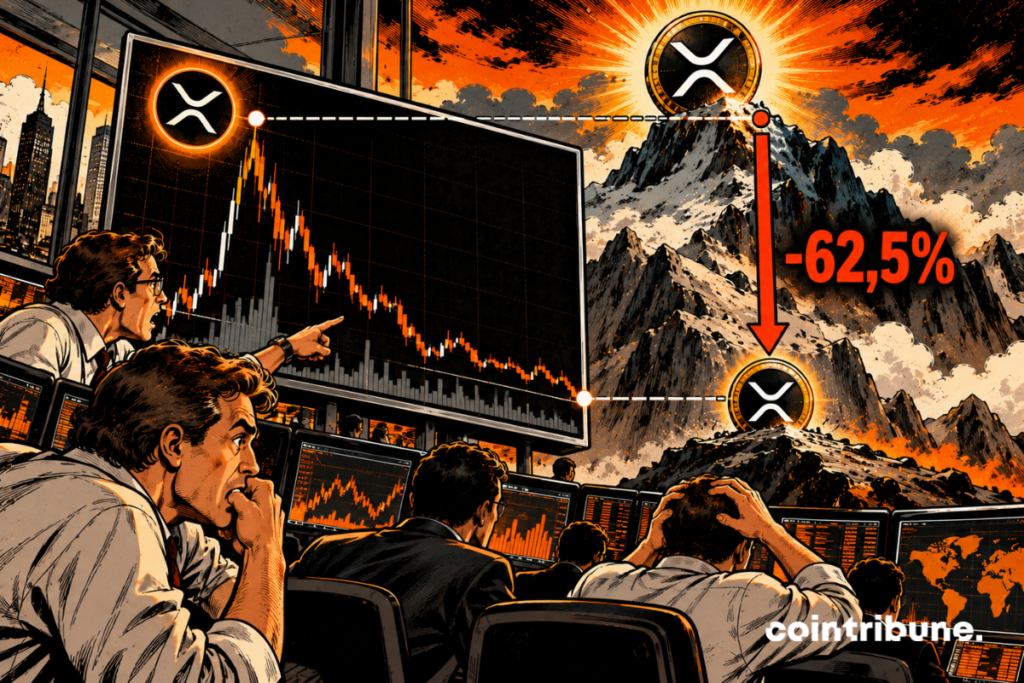
- XRP is trading around $1.33, 62.5% below its January 2018 high.
- Unlike bitcoin and ether, XRP struggles to maintain its gains over the long term.
- Circulating supply has increased by 63% since 2017, weighing on the value of each token.
- Limited institutional demand and still modest adoption of XRP are holding back its progress.
- A sustainable rise in XRP will depend on demand capable of absorbing the new units put into circulation.
XRP remains far from its January 2018 peak
While its capitalization has just fallen by $117 billion, the path of XRP depends heavily on the date chosen to measure its performance. An investor who entered at a low price was able to realize a significant capital gain, but someone who bought during the euphoria of early 2018 remains largely at a loss almost nine years later.
Multiple numbers illustrate this offset:
- XRP is moving around $1.33;
- Its January 2018 high was near $3.55;
- The token therefore remains approximately 62.5% below this level;
- It briefly reached $3.66 in July 2025 before falling again;
- Its circulating supply has increased from 38.7 to 63.1 billion XRP since 2017.
The situation contrasts with that of bitcoin and Ether. Despite their decline since the records of 2025, both assets remain well above their peaks of the 2017 cycle. Investors who have maintained their positions since this period therefore display, on average, significantly superior performance.
However, it would be excessive to assert that XRP has not enriched any holder. Purchases made during market troughs, particularly below $0.30, generated high returns. The comparison mainly concerns a strategy of buying at the top of 2017-2018 followed by holding without arbitrage.
The brief record of July 2025 also shows that some investors have found a profitable exit window. Its temporary nature, however, highlights the inability of XRP to sustainably maintain a valuation higher than its former peak.
The increase in supply dilutes the value of each token
XRP has a hard cap of 100 billion units, all created when the XRP Ledger launched. The protocol therefore does not issue new tokens through mining or staking. The supply available on the market, however, continues to increase as Ripple releases and distributes a portion of the XRP held in escrow.
Nicolai Sondergaard, analyst at Nansen, explains:
The circulating supply increased by 63%, from 38.7 billion in 2017 to 63.1 billion, while the total value of XRP only fell by around 3%. More XRP in circulation means that each token represents a smaller share of an almost identical total value.
This distinction between unit price and capitalization is essential. If market capitalization remained stable while supply increased by 63%, the theoretical price of each XRP would decrease by approximately 39%. The price may therefore remain well below its old record even if the overall value attributed to the network approaches it.
Oliver Carding, marketing manager of Tesseract Group, believes that performance appears less bad when measured by capitalization. “In value terms, XRP has recovered”he says. This collective recovery, however, does not benefit old holders in the same way, as it is distributed among more tokens.
In the 90 days leading up to October 10, approximately 898 million XRP reportedly joined the circulating supply. At the same time, transaction fees only destroyed around 44,800 XRP. The burn mechanism therefore remains too weak to compensate for the distributions.
Institutional demand and use still insufficient
The increase in supply alone does not explain the delay of XRP. Institutional demand remains much weaker than that observed for bitcoin and Ether. ETFs linked to these two assets have attracted several billion dollars, while XRP products have more modest assets and flows.
Trading activity also declined after periods of euphoria. A decline in volumes limits market depth and reduces XRP’s ability to absorb new units released into circulation without price pressure.
The positioning of XRP also played a role. Ripple is developing its use in international payments and strengthening its ecosystem with the stablecoin RLUSD. The token has, however, benefited less from successive major trends in the sector, such as decentralized finance, NFTs, staking or applications linked to artificial intelligence.
Finally, the long legal dispute between Ripple and the Securities and Exchange Commission has fueled regulatory uncertainty for several years. Even after the favorable progress obtained by the company, this period slowed access to the American market and weakened the confidence of certain investors.
XRP therefore does not suffer from a single weakness, but from a combination of dilution of supply, lower demand and limited adoption of the token itself. A sustainable rise would require purchases to absorb future distributions, instead of depending solely on speculative episodes.
Maximize your Tremplin.io experience with our ‘Read to Earn’ program! For every article you read, earn points and access exclusive rewards. Sign up now and start earning benefits.