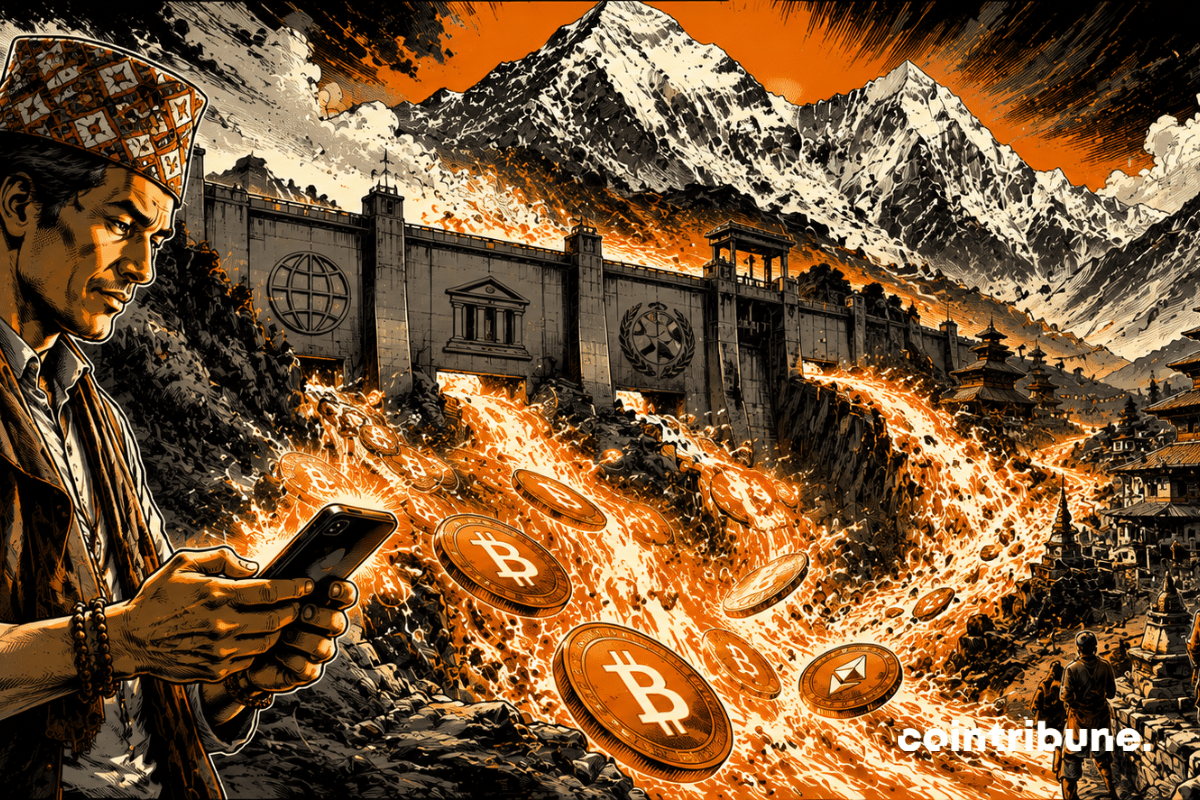
Despite a legal ban in effect since 2021, crypto flows in Nepal briefly exceeded 13% of GDP that same year. In a report published on June 10, 2026, the International Monetary Fund (IMF) sounds the alarm and asks the authorities in Kathmandu to put in place a regulatory framework consistent with international standards. How will the authorities manage this fait accompli?
In brief
- Crypto flows in Nepal exceeded $2.6 billion in 2021, or more than 13% of GDP, despite a total ban on crypto transactions enacted the same year.
- In 2024, these flows still represented around 8% of GDP, with stablecoins making up the largest share.
- The IMF calls for an action plan against money laundering and asks Nepal to come off the gray list of the Financial Action Task Force (FATF).
Why do cryptos thrive where they are banned?
The IMF's observation hardly surprises sector observers. Cross-border crypto flows in Nepal represented around 5% of GDP at the start of 2025, behind Vietnam which has a record level of 26%. However, the Nepalese ban has been formally total since 2021. The central bank had declared trade, mining and all related activities illegal.
This paradox is partly explained by the use cases that are most resistant to restrictions. “ From a business perspective, it makes sense to introduce regulation » to protect consumers and investors, underlines Musheer Ahmed, founder of Finstep Asia, contacted by Decrypt.
Indeed, funds transfers and peer-to-peer commerce constitute precisely the two pillars that neither laws nor borders can easily block.
Furthermore, stablecoins have gradually taken first place in these flows, a phenomenon that is also found in other countries with strict capital controls. This “sandwich of stablecoins”, as Ahmed puts it, has established itself where bitcoin remains too volatile for current transactions.
The IMF and Bitcoin, pressure that is intensifying on a global scale
The report is part of a broader IMF strategy towards countries adopting cryptos, whether banning or encouraging. El Salvador paid the price at the end of 2024: to obtain funding of $1.4 billion, Bukele had to officially give up his daily bitcoin purchases.
Officially only, on-chain data shows that Salvadoran government wallets continue to grow by around 1 BTC per day.
Nepal is also going through a turbulent political period.. Protests by Generation Z toppled the Oli government last September, after authorities banned 26 social media platforms. In response, tens of thousands of Nepalis downloaded Bitchat, Jack Dorsey's decentralized application, which works via Bluetooth without an internet connection. China has since demanded its removal from the App Store.
In short, the IMF report on Nepal illustrates a reality that regulators are slow to accept: the ban shifts flows, it does not eliminate them. Stablecoins are growing, crypto remittances are holding up, and the FATF is still waiting. For Kathmandu, the choice is no longer really between prohibiting and regulating, but rather between regulating now or regulating later, in a much more degraded context.
Maximize your Tremplin.io experience with our 'Read to Earn' program! For every article you read, earn points and access exclusive rewards. Sign up now and start earning benefits.