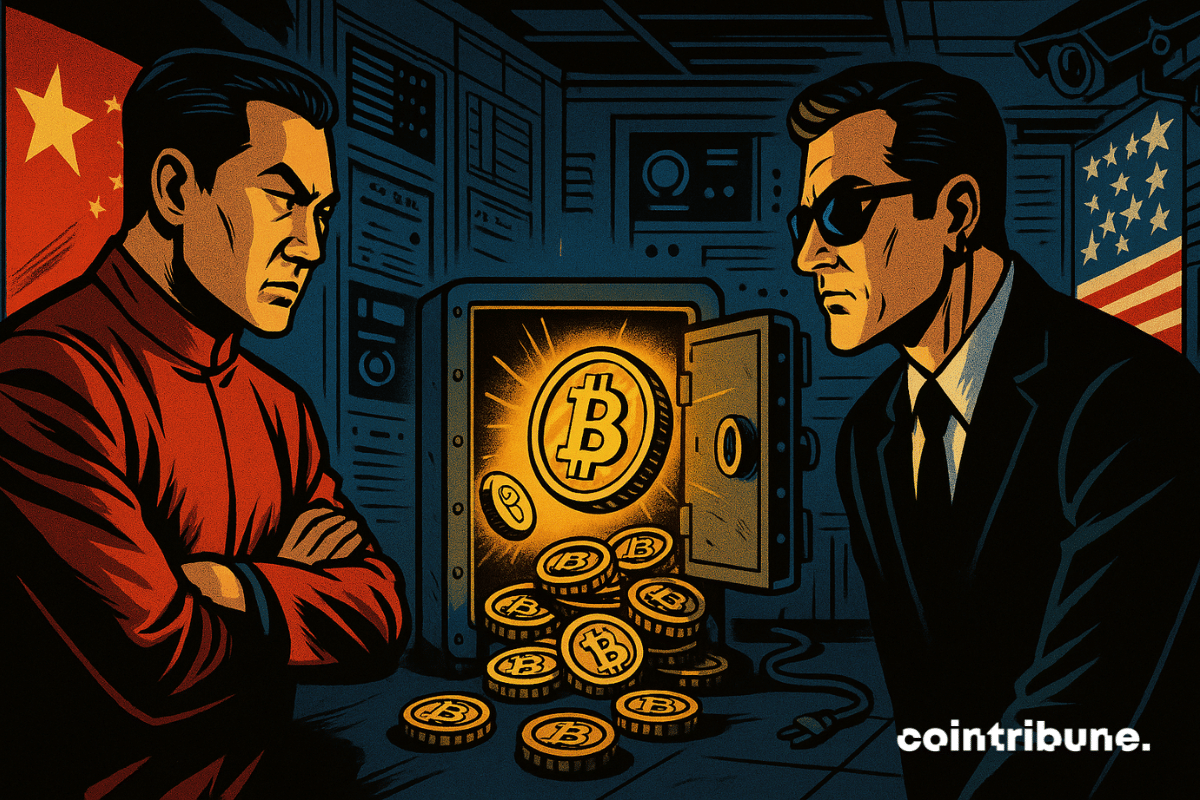
As states strengthen their control over cryptocurrencies, an old theft of bitcoins resurfaces amid geopolitical rivalry. LuBian, a Chinese mining pool, reportedly lost more than 127,000 BTC in 2020. Remained discreet for years, the affair has suddenly resurfaced, because Beijing now accuses the United States of having seized these funds, now valued at more than $14 billion, via an intelligence operation. The suspicion of state confiscation reignites tensions between two superpowers.
In brief
- China is relaunching a forgotten affair: a theft of 127,272 BTC that occurred in 2020 and went unnoticed for a long time.
- Beijing accuses the United States of secretly seizing these funds through its intelligence agencies.
- The hack allegedly exploited a major cryptographic flaw in LuBian's security system.
- The stolen bitcoins allegedly lay dormant for nearly 5 years before being transferred to an address linked to the DOJ.
Beijing accuses the United States of seizing funds from a massive hack
China's National Computer Virus Emergency Response Center (CVERC), a government body, said that “United States intelligence organizations” are believed to be responsible for a large-scale hack targeting LuBian, a Chinese company active in bitcoin mining.
According to their technical reportthe hack allowed the exfiltration of 127,272 bitcoins, an astronomical sum transferred to wallets now identified as linked to American entities. The report states that “the United States Department of Justice currently holds these bitcoins”which, if proven, positions this affair between cybercrime and geopolitical issues.
THE factual elements at the heart of this accusation are the following:
- The hacked volume: 127,272 BTC transferred from addresses linked to LuBian, or around $15 billion at present;
- The technical origin: the hack occurred in December 2020, according to several consistent reports;
- The public revelation: the affair was made visible last August thanks to research by Arkham Intelligence;
- The official accusation: China claims that “American intelligence organizations” carried out the hacking operation;
- BTC would now be under the control of the United States Department of Justice
;
- Beijing considers the seizure to be a confiscation of private assets and questions the legitimacy of the legal framework invoked by Washington.
This accumulation of facts gives the affair an unprecedented scale in the field of cryptos, not only by the amount involved, but also by the diplomatic dimension that it could entail.
A cryptographic flaw exploited and a five-year silence
Beyond the political accusations, the technical investigation reveals that the hacking is due to a critical flaw in LuBian's internal security. The platform would have generated private keys with too low an entropy, limiting security to only 32 bits, a serious error in the world of encryption.
This vulnerability would have allowed a malicious actor to access LuBian wallets, without leaving an immediate trace. Once the funds were moved, they would have remained dormant, spread across several addresses, for almost five years. It was precisely this prolonged inactivity that aroused the suspicions of Arkham Intelligence.
The chronology is intriguing. How could such a volume of bitcoins, representing at the time 6% of the global hashrate of the Bitcoin network, disappear without alerting the authorities or the markets? And why were these assets suddenly linked to a US DOJ seizure in 2023, without prior official communication? The available documents do not resolve these questions, but highlight a persistent opacity, both on the part of mining specialists and judicial authorities.
If CVERC's statements were to be corroborated, this affair could reignite diplomatic tensions, but also redefine transparency protocols around crypto seizures. Confidence in the traceability of bitcoin, often touted as absolute, is here called into question by a series of discreet actions, technical flaws and prolonged silences. From a simple hack, the LuBian affair turns into a life-size test for the global regulation of cryptos.
Maximize your Tremplin.io experience with our 'Read to Earn' program! For every article you read, earn points and access exclusive rewards. Sign up now and start earning benefits.