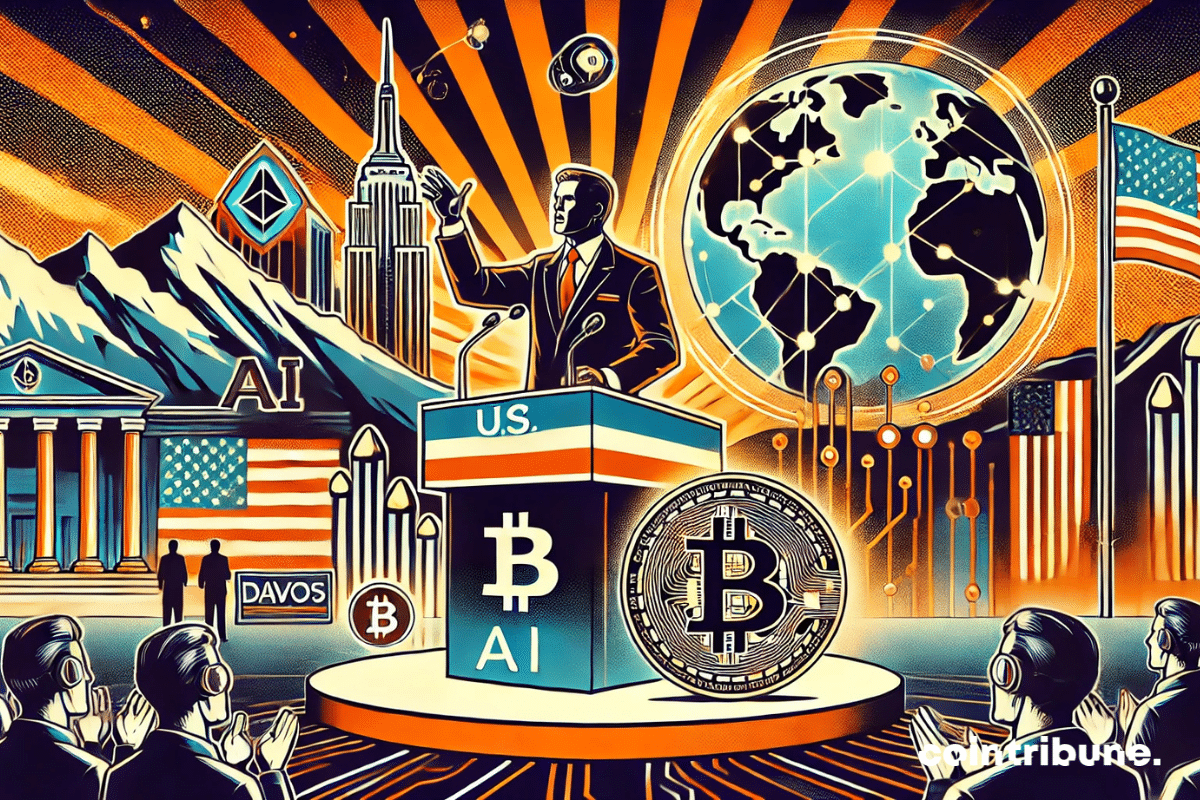
While artificial intelligence and cryptos are shaking up the global economy, Donald Trump took advantage of the World Economic Forum in Davos to outline an ambitious vision. The American president has declared his intention to make the United States the world leader in these strategic technologies. This announcement is part of a broader desire to reindustrialize the country by drawing on its vast energy resources. However, these promises raise many questions, both on their implementation and on the future economic and geopolitical implications.
Donald Trump's promises at Davos
On January 23, 2025, during his virtual speech at the World Economic Forum in Davos, Donald Trump said: “The United States will become the world capital of artificial intelligence and cryptos.” This declaration is a continuation of the commitments he made during his presidential campaign in 2024. The American president also highlighted the country's vast energy resources, which he considers an essential lever to achieve this objective. Indeed, “American oil and gas production could reduce the costs of almost all goods and services,” he said. declaredwhich would thus contribute to making the United States an essential manufacturing power.
However, despite this stated ambition, gray areas remain regarding the realization of these promises. Indeed, Trump spoke of the need to further deregulate the energy sector to accelerate this transition, but he did not propose any specific measures to support the development of artificial intelligence, blockchain or cryptos. This lack of a detailed plan raises questions among observers and players in these industries, who doubt the ability of the United States to position itself as a world leader without a clear and coherent strategy.
Enduring skepticism in the face of controversial initiatives
Among Donald Trump's recent initiatives, the launch of the “TRUMP” token has sparked a lively debate. This crypto, perceived by some as a simple promotional tool, has been the subject of numerous criticisms. Observers have called it a “cash grab” and expressed concerns about its potential use as a lever of influence by foreign actors. The controversy underscores the challenges the Trump administration may face in gaining the trust of investors and regulators.
At the same time, other aspects of its technological policy continue to fuel doubts. Although the president respected his promise to pardon Ross Ulbrichtfounder of Silk Road, this decision is seen by some as a strategic move intended to appeal to the libertarian electorate. Furthermore, the absence of a global strategy to govern the development of cryptos and artificial intelligence raises questions. Without a clear regulatory framework, these sectors risk lacking the necessary conditions to thrive sustainably.
Despite these challenges, Trump's announcement reflects a clear desire to capture the economic opportunities offered by these emerging technologies. However, without a concrete approach and structured policies, his declarations could remain mere promises. Experts also warn of the possible consequences of this deregulation, particularly on the stability of financial markets and the environmental impact of increased exploitation of energy resources.
The Trump administration's future choices will play a key role in making this ambitious vision a reality. However, adopting clear regulatory measures and establishing international partnerships could position the United States at the forefront of technological advances in blockchain and artificial intelligence. Conversely, the absence of a coherent strategy could pave the way for other nations, better prepared to exploit the potential of these sectors. To turn these promises into reality, a solid political framework will be required, but also coordination between public and private actors.
Maximize your Tremplin.io experience with our 'Read to Earn' program! For every article you read, earn points and access exclusive rewards. Sign up now and start earning benefits.