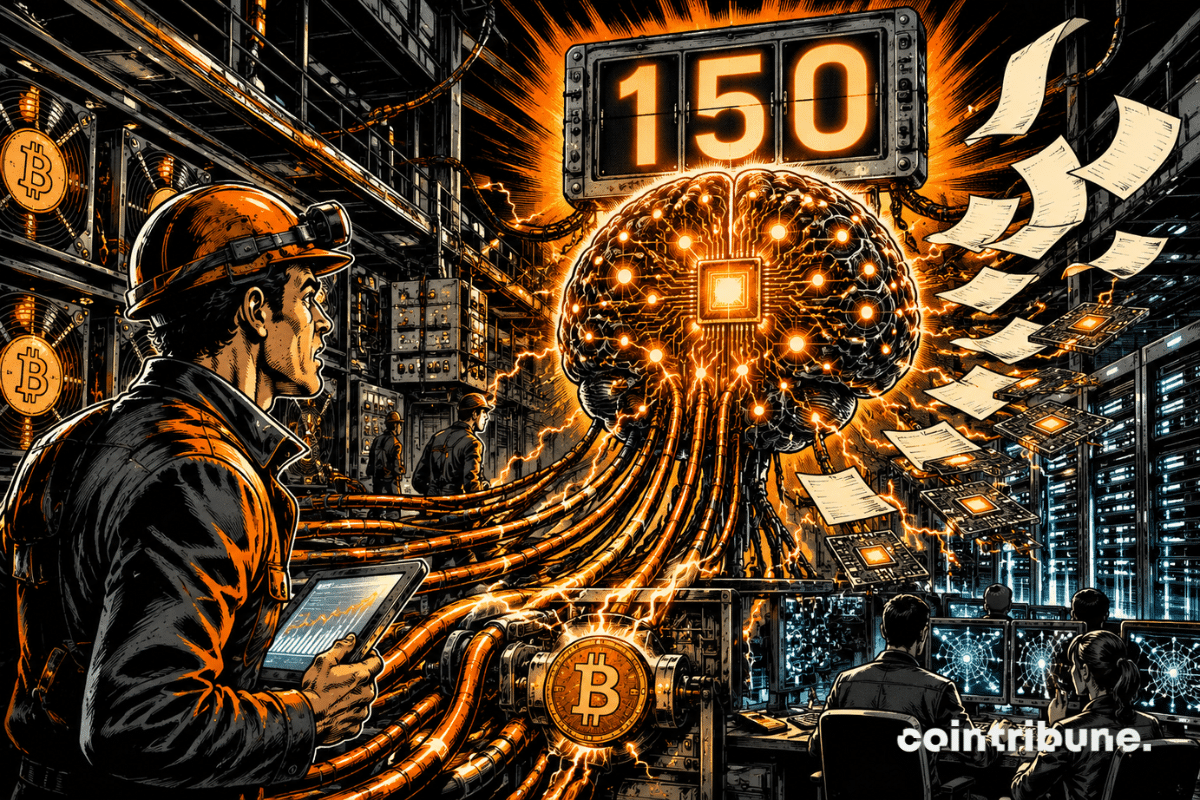
Bitcoin miners have already signed the equivalent of $150 billion in artificial intelligence-related contracts, according to Bernstein. These agreements cover more than 7.5 gigawatts of electrical capacity and extend over several years. Behind this massive figure, the mining sector is changing its profession: it now sells its megawatts to data centers as much as it produces BTC.
In brief
- Bitcoin miners’ AI contracts are worth around $150 billion over several years.
- These agreements cover more than 7.5 gigawatts of electrical capacity.
- Diversification improves revenue visibility, but creates new financial and industrial risks.
Bitcoin miners’ electricity attracts AI giants
Bitcoin mining companies have an asset that has become rare: sites already connected to powerful electricity networks. This positioning explains why miners are benefiting from the rise of AI, while technology groups are struggling to quickly secure new energy capacities. Building an AI data center from scratch requires land, permits, power lines, cooling systems and sometimes several years of waiting.
Miners have already done some of this work to run their ASIC machines. Hyperscalers and cloud operators therefore sometimes prefer to rent this infrastructure or enter into long-term agreements. For them, a few months saved on the calendar can be worth several billion dollars.
The figure put forward by Bernstein must be read precisely. It does not correspond to the income already received by minors. It represents the estimated value of contracts concluded over periods which can reach ten, fifteen or twenty years. This distinction avoids transforming a real industrial trend into an instant jackpot. The companies concerned will still have to construct the buildings, install the equipment, finance the work and respect high availability commitments.
The economic model of bitcoin mining is changing
Halving regularly reduces the amount of bitcoin paid to miners for each validated block. At the same time, competition is increasing and old machines are becoming less profitable. Diversification towards AI therefore looks less like a whim and more like an industrial response. However, some agreements give an idea of the scale. Hut 8 signed a fifteen-year lease valued at $9.8 billion. TeraWulf has reportedly concluded a twenty-year contract likely to generate nearly 19 billion. IREN also announced several billion dollars in cloud deals.
These contracts provide rare visibility in mining. Bitcoin revenue depends on the BTC price, hashrate, electricity cost and halvings. AI contracts promise more predictable payments, provided sites are delivered on time.
Several groups already no longer present themselves solely as producers of BTC. They talk about digital infrastructure, high performance computing, cloud and data centers. Their value now depends as much on their megawatts as on their bitcoin reserves.
This change attracts Wall Street, but it also raises questions. Miners’ shift to AI requires a lot of capital. Some companies may need to take on debt, issue new shares or sell some of their BTC to finance the work. The risk of dilution then becomes real for shareholders. A contract announced at several billions may impress, but its profitability depends on the cost of construction, financing and the solidity of the client.
AI can also weaken network security
This change offers a new source of income, but it creates a delicate trade-off. A megawatt dedicated to GPUs is no longer available for bitcoin mining. If AI becomes much more profitable, some operators could permanently reduce their mining activity.
A significant drop in network power could temporarily slow hashrate growth. The protocol would then adjust its difficulty, but the geographic and economic distribution of miners could change.
The sector must also avoid becoming dependent on a few technology clients. A twenty-year contract seems solid. However, a breakdown, delay or failure to pay could leave expensive infrastructure without an immediate outlet.
The $150 billion therefore signals a profound transformation, not a guaranteed victory. Miners have a concrete energy advantage. They will now have to prove that they know how to build and operate data centers as well as they know how to secure Bitcoin. This promise already explains why miner stocks now react to AI news as much as they do to BTC movements.
Maximize your Tremplin.io experience with our ‘Read to Earn’ program! For every article you read, earn points and access exclusive rewards. Sign up now and start earning benefits.