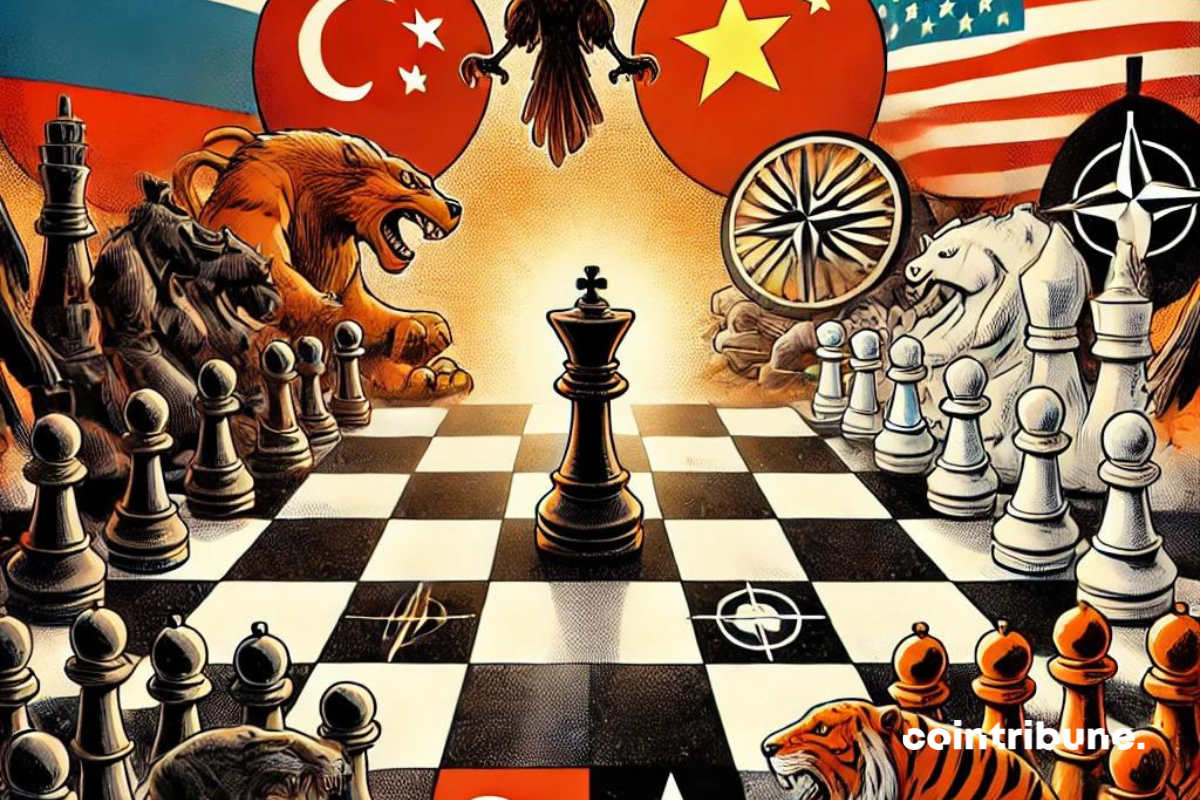
Turkey, a key NATO member, has shaken up the global geopolitical order with a surprising bid to join the BRICS bloc, an economic and political alliance dominated by Russia and China. The move is a decisive step in Ankara’s diplomatic strategy, which has traditionally been anchored in strong Western alliances. Turkish President Recep Tayyip Erdoğan appears determined to redefine his country’s position on the international stage, seeking partnerships beyond its historical alliances with the West.
Ankara turns to new alliances: a strategy of geopolitical repositioning
Turkey's official request to join BRICS is a strong signal to Western partners. This decision, formalized on September 2, 2024, reflects a clear desire to diversify Ankara's alliances in a context of growing frustrations with the West. According to President Erdoğan, ” Turkey can become a strong, prosperous, prestigious and efficient country if it improves its relations with both the East and the West. “This statement highlights a balancing strategy. It aims to navigate between rival powers without compromising national interests. The Turkish president also said that “any method other than this would not benefit Turkey, but would harm it.”
The move to join the BRICS, a group that includes emerging economies such as Russia, China, India, Brazil and South Africa, is seen as a response to the economic and diplomatic challenges Turkey faces. The BRICS bloc represents an alternative to the Western-dominated world order, providing Ankara with a platform to increase its influence. The move comes after decades of frustration over Turkey’s bid to join the European Union and sometimes strained relations with the United States.
A redefinition of the balance of global power?
Turkey’s potential membership in BRICS could have implications for the global balance of power. By joining the bloc, Turkey would strengthen its position as a key player in an increasingly multipolar world. BRICS, already seen as a counterweight to the US-led G7, would see its influence expand even further with the inclusion of Turkey, a country with a key geostrategic position between Europe and Asia. By seeking to cultivate relations with all parties in a multipolar world, Turkey appears to want to maximize its diplomatic and economic options while remaining an active member of NATO.
However, this move could also cause friction within NATO and complicate relations with Turkey’s Western allies. While some may see this as a way for Ankara to assert its independence and gain influence on the international stage, others may perceive it as a signal of disengagement from the Western world order. Analysts such as Sinan Ülgen point out that “the geopolitical center of gravity seems to be shifting away from the most developed economies.” That is why Turkey wants to be at the forefront of this change.
By joining the BRICS, Turkey appears to be charting a new course in its foreign policy, one that could redefine its role on the world stage. This strategic move illustrates Ankara’s desire to increase its strategic autonomy and benefit from the BRICS’ major development projects while continuing to play a key role in traditional alliances such as NATO.
Maximize your Tremplin.io experience with our 'Read to Earn' program! For every article you read, earn points and access exclusive rewards. Sign up now and start earning benefits.