

Gold has just experienced a historic fall of 10% in just six days, a rare phenomenon that has only been observed ten times in 45 years. Meanwhile, bitcoin shows unexpected resistance, reigniting the debate on the role of safe haven assets. Why this divergence? Is this a sign of a turning point for investors?

In brief
- Gold records a historic fall of 10% in 6 days, a rare phenomenon observed only 10 times in 45 years.
- Bitcoin displays unexpected resistance in the face of the fall in gold, reigniting the debate on its role as a new safe haven asset.
Gold in free fall: a historic correction with major consequences
The days when bitcoin revived its correlation with gold seem to be over. In the space of a few days, gold lost 10% of its value, falling below the symbolic mark of $4,000 per ounce after reaching a peak of $4,380 in mid-October 2025. This brutal decline is reminiscent of past corrections, where gold took on average two months to recover, with an average return of 8.39%. In India, gold futures contracts also fell by 2.35%, reflecting a global trend.
Historical data shows that this fall is not an isolated case. Over the last ten similar occurrences, gold has always rebounded in the following two months, but with varying performance. Some rebounds reached 17.21%, while others barely exceeded 2%.
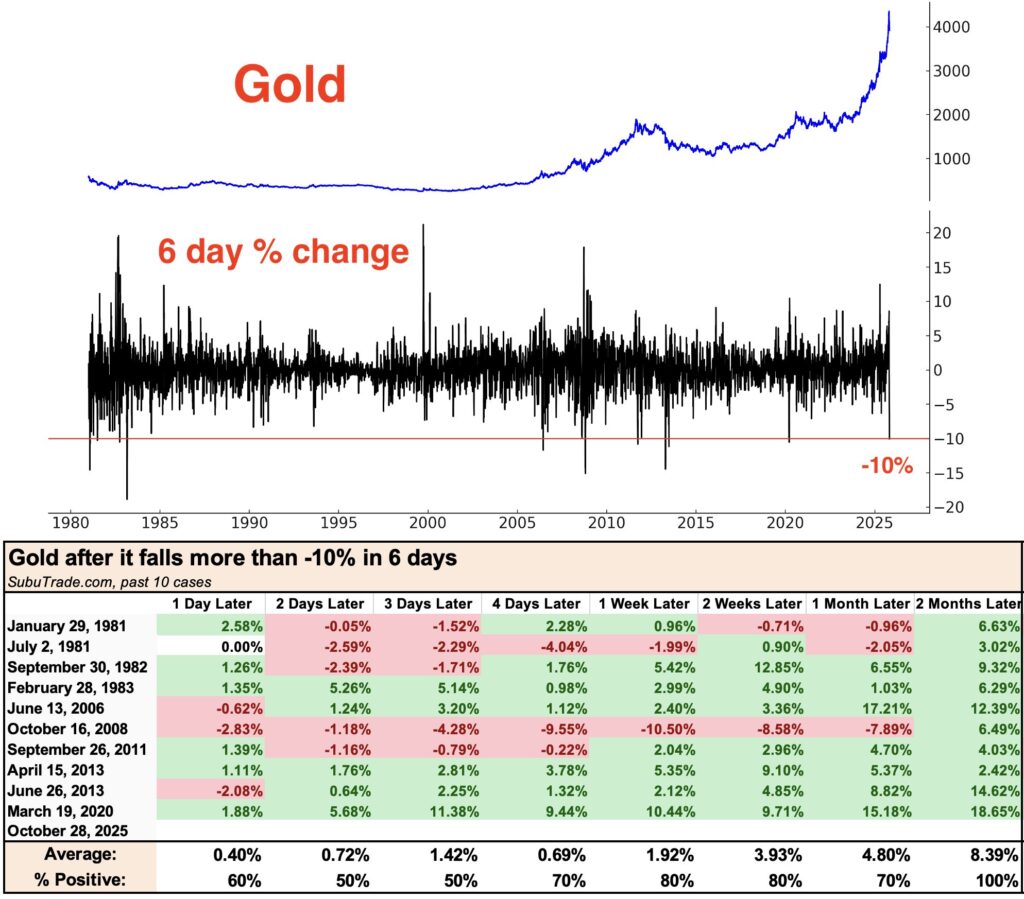
This volatility raises questions about the stability of gold as a safe haven asset.
Why is gold collapsing? 3 key reasons behind the debacle
The fall in gold can be explained by several factors. First, an easing of geopolitical and trade tensions has reduced demand for this safe haven asset. Indeed, the negotiations between the United States and China which will take place today could lead to an agreement. This reassured the markets and reduced the attraction of gold.
Then, the strengthening of the dollar played a crucial role. A stronger U.S. currency makes gold more expensive for international investors, which has naturally reduced demand. This dynamic is amplified by the uncertainties surrounding the monetary policy of the Fed, which lowered its rates by 0.25%, without guaranteeing further cuts.
Finally, this fall can be seen as profit taking after a record year. Gold had experienced a meteoric rise of +60% since the start of 2025, reaching an all-time high of $4,380 per ounce in mid-October. Investors therefore take advantage of this opportunity to realize their gains, which increases the downward pressure.
Bitcoin resists: towards a shift towards safe haven assets?
While gold collapses, bitcoin shows remarkable resistancewith an increase of 2% over the week. This divergence suggests a shift in perception among investors, who may be turning to cryptocurrencies as an alternative to traditional assets.
Unlike gold, whose demand is often linked to geopolitical tensions, BTC is increasingly influenced by structural factors, such as institutional adoption and planned scarcity. If gold generally takes 2 months to recover after a 10% fall, bitcoin could attract capital seeking faster returns. This dynamic could then accelerate a rotation of investments from precious metals to cryptos.
The fall in gold and the resistance of BTC raise a fundamental question: are cryptos replacing traditional assets as safe havens? While gold remains a historical pillar, bitcoin proves that it can play a similar, even complementary, role. The coming months will be decisive in determining whether this trend continues.
Maximize your Tremplin.io experience with our 'Read to Earn' program! For every article you read, earn points and access exclusive rewards. Sign up now and start earning benefits.


