
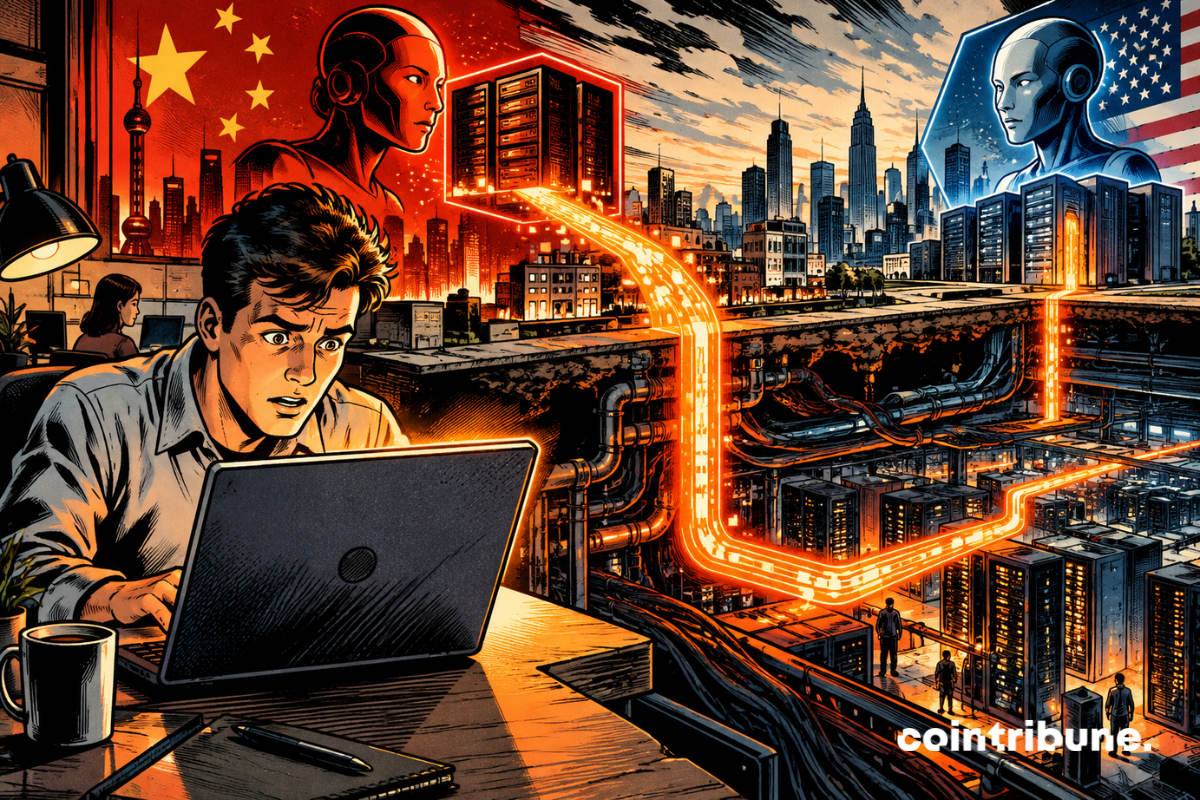
Thunderclap in the technology sector! Chinese authorities are scrutinizing two of its AI champions: DeepSeek and Moonshot AI (the AI company behind Kimi). The latter are suspected of having redirected millions of requests to the AI model Claude from the American firm Anthropic. All this, without notifying their users. For users, this battle between AI models now exceeds technological competition. Above all, it raises an important question: what happens to their data when a query changes model without them knowing it?
In brief
- China investigates DeepSeek and Moonshot for leaking data to AI Claude.
- Anthropic accuses Moonshot of 23 million trades through 5,380 fictitious accounts.
- DeepSeek reportedly generated 12.1 million suspicious trades in 14 days in July.
- Seven AI companies initially targeted, only two remain under investigation today.
- The investigation comes just before the September 24 Trump-Xi summit.
The shadow of a massive data transfer shakes the AI ecosystem
The Cyberspace Administration of China (CAC) has just opened an investigation into DeepSeek and Moonshot AI. The Chinese Internet regulator wants to know if sensitive data (notably police, military or linked to public companies) ended up on American servers via the Claude AI. Officials visited the offices of the two AI companies to interview managers and employees.
Reported by The Informationthe procedure comes after the publication of a 154-page intelligence report by Anthropic on September 10, 2026. The document accuses seven AI companies of “illicit distillation”. In the list are:
- Alibaba;
- Moonshot;
- DeepSeek;
- Zhipu;
- MiniMax;
- SenseTime;
- Xiaomi.
How the AI Claude was allegedly siphoned off by 5,380 fictitious accounts
In his intelligence reportAnthropic claims that Moonshot routed more than 23 million trades to Claude through 5,380 fraudulent accounts. DeepSeek, for its part, reportedly generated more than 12.1 million exchanges in just fourteen days in July. In total, this represents over 35 million conversations potentially used to feed competing AI without authorization.
Certainly, this practice is nothing new in the AI sector. It is common to train a model on the outputs of another AI model. What poses a problem according to Anthropic is the use of fictitious accounts to circumvent usage limits. In this same context, the AI company has been denouncing since the beginning of 2026 the plundering of its technology by Chinese start-ups which would resell Claude’s answers at a lower cost.
An immediate shock wave on the financial markets and tech
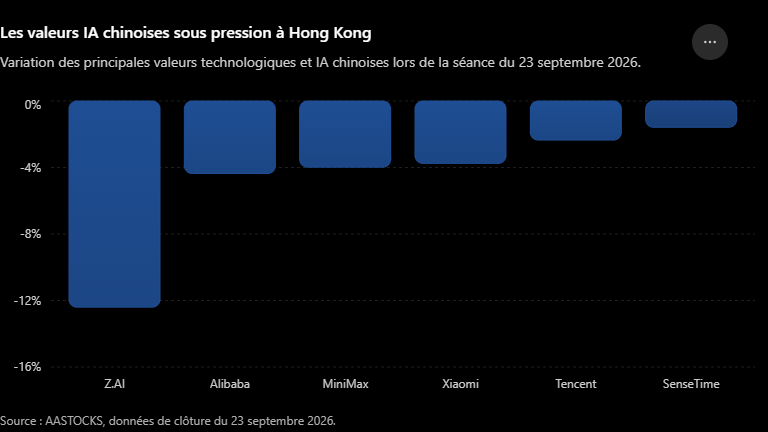
The announcement of this procedure immediately cast an icy chill on the tech sector. As soon as the Asian stock markets open, AI-related stocks have plunged precipitously. And for good reason? Investors now fear heavy administrative sanctions or an outright cut of network access for the two targeted AI firms.
The American giant Anthropic was quick to react. It plans to now apply strict rules on the use of its programming interfaces.
For some, the schedule couldn’t be worse. DeepSeek is due to present its assessment of the risks of AI to the United Nations Security Council this week, alongside Anthropic boss Dario Amodei. The session falls the day before the September 24 summit between Donald Trump and Xi Jinping. Obviously, the AI file is on the agenda.
Moonshot AI is no better off. On September 3, 2026, the IA company filed a confidential application for an IPO in Hong Kong. It is targeting $3 billion for a valuation of $50 billion. All regulatory investigation disclosed must appear in the prospectus before listing can proceed.
Of course, no sanctions have yet been imposed. That being said, a procedure opened by Beijing seriously complicates the future for these two heavyweights of Chinese AI.
Towards a global tightening of digital regulation of AI?
By orchestrating this legal offensive, the Chinese government is sending a clear signal to all of its technological champions: data sovereignty takes precedence over the speed of development.
This AI scandal could also encourage regulators around the world to impose strict monitoring of user requests. Several experts believe that this reinforced digital regulation will slow down innovation in the short term. On the other hand, it will help to clean up the practices of certain companies. Financial markets are already integrating this increased regulatory risk into the valuation of startups.
It remains to be seen how AI developers will adapt their infrastructures to prove the legitimate origin of their training data.
In any case, this investigation into AI exposes (once again!) the excesses of a frantic technological race where the rules of ethics are sometimes trampled. As governments intensify their controls, the real question is whether the artificial intelligence of tomorrow will be able to reconcile algorithmic power and absolute respect for privacy.
Maximize your Tremplin.io experience with our ‘Read to Earn’ program! For every article you read, earn points and access exclusive rewards. Sign up now and start earning benefits.


