The Office of the Comptroller of the Currency has just opened a historic door to five major players in the crypto sector. Ripple, Circle, Paxos, BitGo and Fidelity Digital Assets have been given a conditional green light to operate as national fiat banks. A breakthrough that is redrawing the contours of American finance.
In brief
- The American banking regulator (OCC) has conditionally approved the banking charter applications of five major crypto companies.
- BitGo, Fidelity Digital Assets and Paxos are transforming their existing trust companies into national banks.
- Circle and Ripple obtain new charters to become federal trust banks.
- These approvals will allow the custody of digital assets and, in certain cases, the issuance of stablecoins.
Paxos Circle and Ripple enter the fiat banking circle
The Office of the Comptroller of the Currency (OCC) released a series of approvals this Friday that marks a turning point. BitGo, Fidelity Digital Assets and Paxos have obtained permission to transform their state trust companies into national banks. Circle and Ripple start directly with a new federal banking charter.
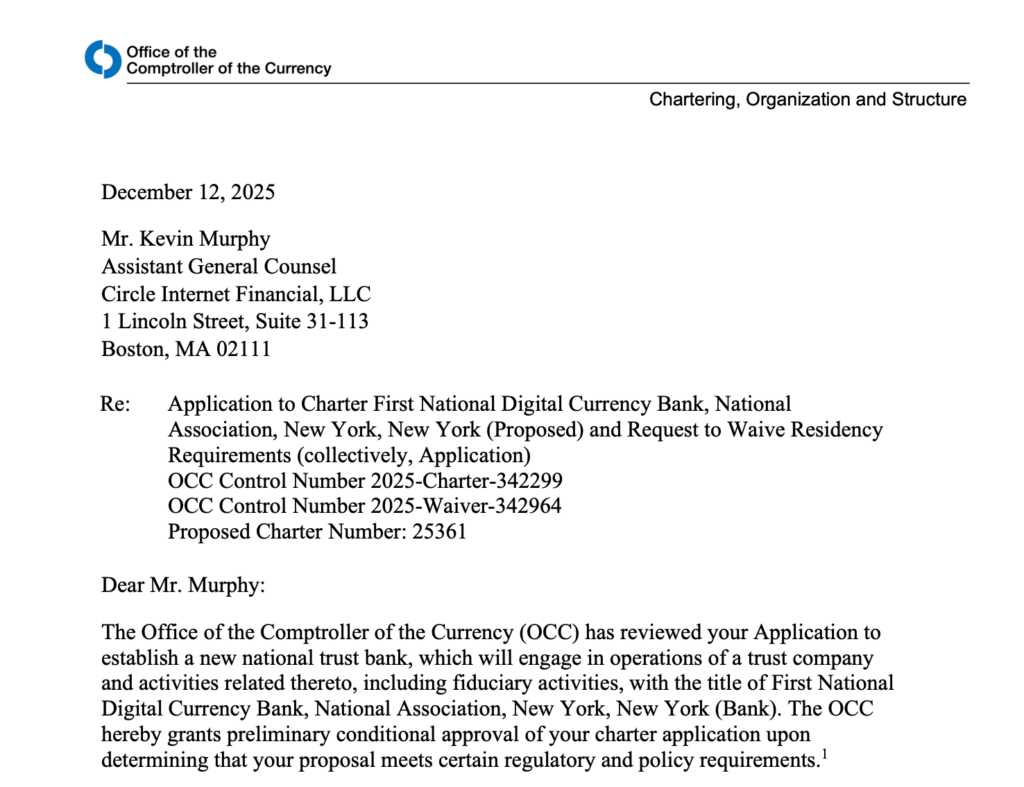
This decision radically transforms the status of these crypto players who until now operated in a more vague regulatory zone.
For BitGo, Fidelity Digital Assets and Paxos, this isa rise in rank. These three companies already operate trust companies at the state level. Their new federal charter gives them enhanced legitimacy and direct supervision from the OCC. Circle and Ripple are starting from scratch with entirely new demands.
“ The arrival of new players in the federal banking sector is a good thing for consumers, the banking sector and the economy said Jonathan Gould, Comptroller of the Currency. Its message is clear: financial innovation deserves its place in the traditional banking ecosystem.
These approvals are not simple administrative formalities. They will allow companies to offer digital asset custody services under strict federal supervision.
Paxos has confirmed that its regulated platform will allow businesses to “issue, custody, exchange and settle digital assets with clarity and confidence”. The company notably retains the right to issue stablecoins, these cryptocurrencies indexed to the dollar.
Divergent strategies to conquer Wall Street
The ambitions of the five companies do not stop at obtaining a banking license. BitGo is actively preparing its IPO. The Securities and Exchange Commission (SEC) is currently reviewing its September filing.
The company is aiming for a listing on the New York Stock Exchange and claims about $90 billion in assets under management. A valuation which reflects the growing maturity of the sector.
Circle has already reached this milestone. The issuer of the stablecoin USDC went public last May on the NYSE. This dual role – trust bank and listed company – could become a model for other players in the sector.
Conversely, Ripple takes a different stance. Monica Long, the company's president, ruled out any idea of an IPO in November. Paxos has not communicated any intentions in this direction either.
One detail attracts attention in the approval letters: Ripple will not be able to issue its stablecoin RLUSD with this banking charter. This restriction contrasts with the rights granted to Paxos and raises questions about the different regulatory approaches applied by different companies.
The movement goes far beyond these five pioneers. Coinbase, the largest US exchange, filed its own application in October. The company clarifies, however, that it has “no intention of becoming a bank” in the traditional sense. This nuance illustrates the varied strategies of crypto players in the face of regulation.
The OCC thus opens the doors to a new chapter for the crypto industry. By integrating these companies into the federal banking system, the regulator recognizes the enduring place of digital assets in modern finance. It remains to be seen whether this regulatory confidence will accelerate the long-awaited institutional adoption.
Maximize your Tremplin.io experience with our 'Read to Earn' program! For every article you read, earn points and access exclusive rewards. Sign up now and start earning benefits.