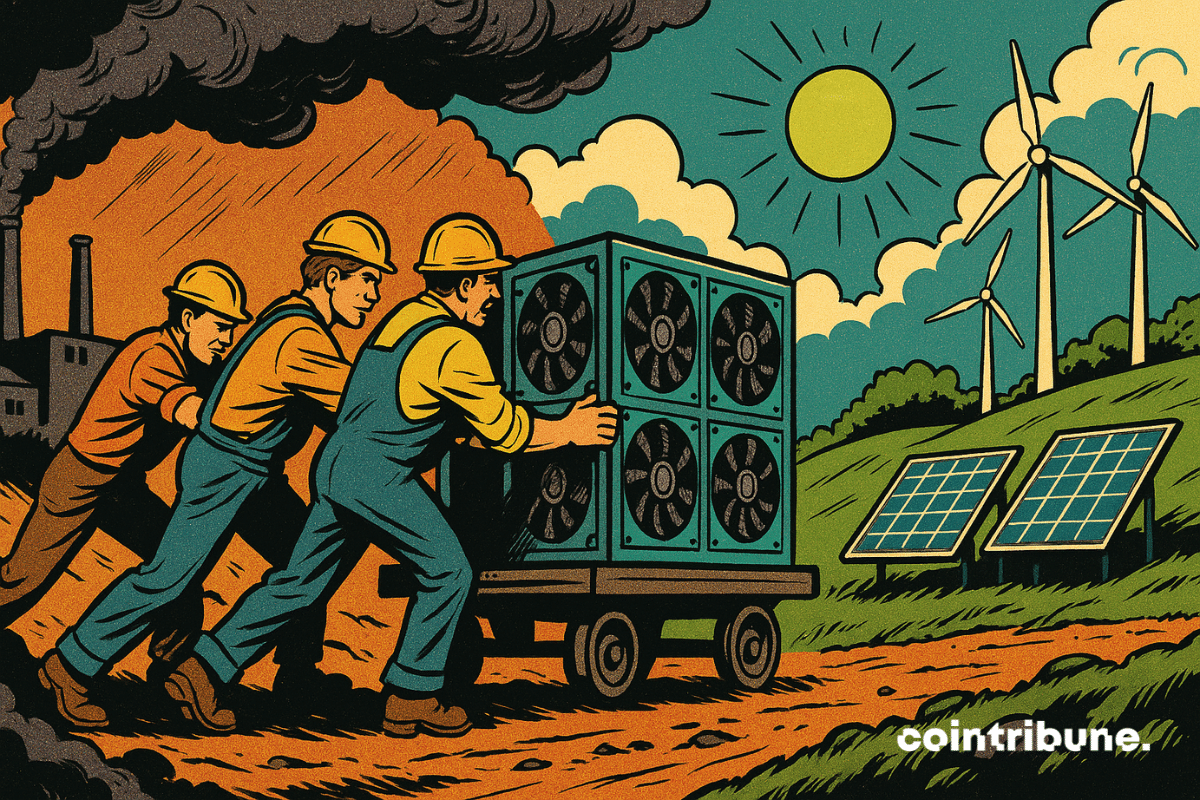
As the Bitcoin network crosses the zetahash threshold, the profitability of mining companies collapses. The hash price has fallen below $40 per PH/s/day, a critical level that threatens the viability of many players. Faced with this paradox, companies in the sector are reorienting their strategies towards renewable energies. However, behind the ecological argument, a logic of economic survival dominates, revealing a profound change in the energy model of mining.
In brief
- The profitability of Bitcoin mining is collapsing, with the hash price falling below the critical threshold of $40 per PH/s/day.
- This drop comes as the global hashrate reaches an all-time high of 1,000 petahashes (1 zetahash).
- The combination of lower post-halving rewards, increased competition and rising energy costs is weighing heavily on margins.
- To survive, more and more miners are adopting renewable energy sources: solar, hydroelectric or wind.
The hash price below the break-even point
While it takes 1200 days to make a machine profitable, “the hash price fell to around $39.4 per PH/s/day”, precise Hashrate Index, highlighting a critical situation for the mining industry.
This level is lower than the equilibrium point estimated for the majority of operators, set at 40 dollars. Clearly, a large proportion of mining companies today operate at a loss or on extremely compressed margins.
The phenomenon results from several converging factors: the recent reduction in mining rewards after the halving, combined with an intensification of competition, has mechanically eroded profits. The Bitcoin network, more secure than ever, has never been so energy intensive.
Several structural elements contribute to this historic decline in profitability:
- A continued rise in the hashrate, which crossed the symbolic zetahash mark (1,000 petahashes) last April, forcing mining specialists to invest ever more in computing power;
- A reduction in rewards following the last halving, mechanically reducing income per block;
- Sharply increasing energy costs, particularly in certain regions where cheap electricity is becoming scarce;
- Growing competitive pressure, which pushes for permanent technological sophistication, with more expensive and energy-consuming equipment.
This combination of factors has led some operators to withdraw. In November, Tether officially ceased mining operations in Uruguay, citing “rising energy costs” as the main reason. In this context, maintaining profitability becomes a tightrope walk.
The green shift in mining: necessity more than virtue
Faced with this contraction in margins, several players have initiated an accelerated transition towards renewable energy sources.
Sangha Renewables has commissioned a 20-megawatt solar installation in Ector Countyin Texas. For its part, Phoenix Group launched a 30 MW mining site powered by hydroelectricity in Ethiopia in November. This dynamic is part of a general movement where green energy is becoming a lever for economic survival, much more than an ethical choice.
Some players are also exploring innovative technological solutions to optimize their energy consumption. Hardware manufacturer Canaan has announced the development of an adaptive ASIC, capable of modulating its consumption via artificial intelligence algorithms.
At the same time, the company deployed a mining installation on a wind farm site in Texas, in partnership with Soluna, a specialized digital infrastructure company. These efforts reflect a desire to control costs in the long term, in a context where energy has become the most critical variable in the mining economic model.
Ultimately, this reconfiguration of the energy landscape could profoundly modify the geography of mining. Regions with abundant renewable resources, notably East Africa, certain areas of Texas or Latin America, could gain in attractiveness, while jurisdictions with expensive energy risk seeing operators flee.
While bitcoin mining is experiencing its worst period in around fifteen years, the current pressure on margins acts as a catalyst for structural evolution, where only mining companies capable of combining technological innovation and strategic energy arbitrage will do well.
Maximize your Tremplin.io experience with our 'Read to Earn' program! For every article you read, earn points and access exclusive rewards. Sign up now and start earning benefits.