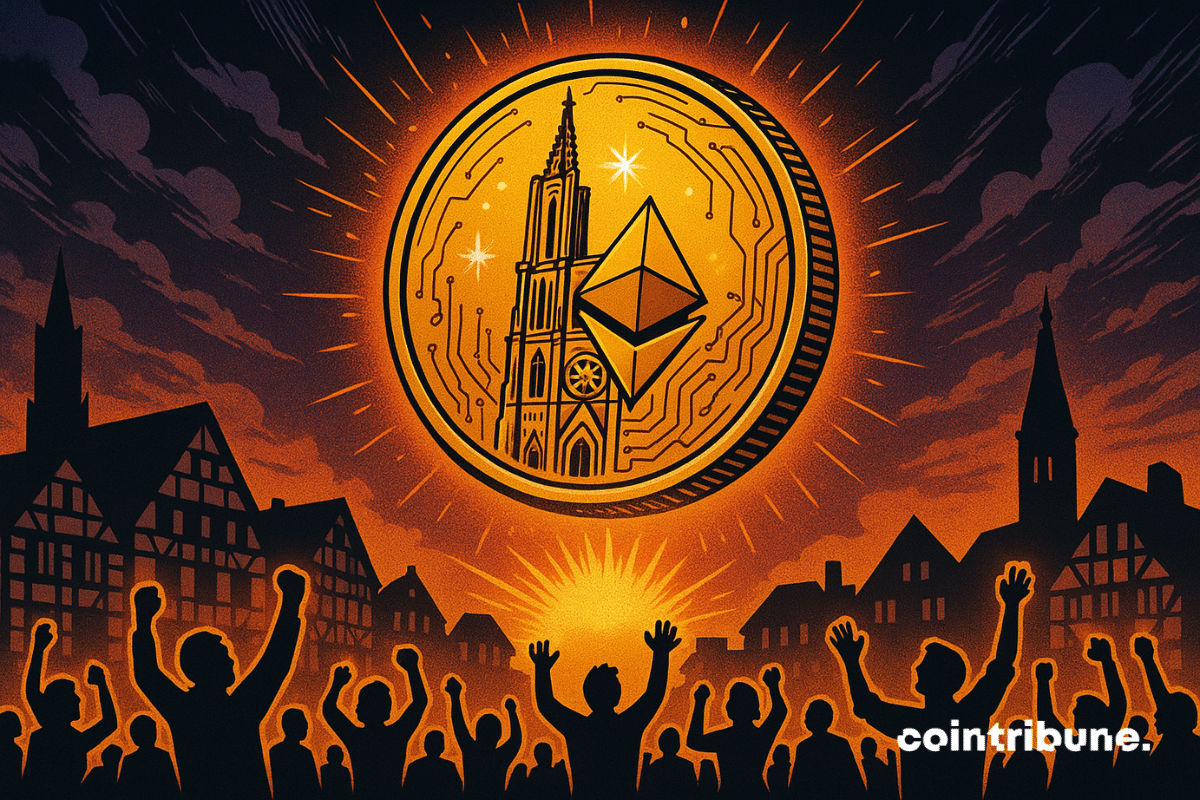
Strasbourg could soon become the first big French city to acquire a municipal crypto. This was a militant circles of the web3 yesterday between today in the local public debate. The municipal council has adopted an unprecedented motion: studying the feasibility of a local digital currency. The objective is to examine new economic, social and technological pathways. An unprecedented initiative for a large French metropolis, which explores digital levers in the service of the local economy and citizen participation.

In short
- Strasbourg adopted a motion to study the creation of a local crypto, a first in a big French city.
- Carried by the elected Caroline Zorn (Pirate Party), this initiative aims to explore the economic, social and technological impacts of such a project.
- The motion proposes to consult the citizens and to analyze several options, without imposing a technical solution at this stage.
- Some elected officials are concerned about the complexity of the project and its environmental and operational implications.
A motion to initiate reflection
While 90 % of Cannes traders went to the crypto this summer, the city of Strasbourg has adopted During a city council meeting this Monday, September 29, a motion entitled “Let's think about a local cryptocurrency in Strasbourg”.
Presented by Caroline Zorn, municipal councilor, lawyer and spokesperson for the Pirate Party, this motion does not yet launch a concrete project, but engages the community in an exploratory phase. The objective is to analyze the impacts that a municipal crypto could have on the local economy, tourism, or the daily lives of the inhabitants.
Here are the main elements highlighted in the motion:
- A potential economic lever: A crypto could energize local trade and support short circuits;
- A local innovation tool: it would experience digital uses within the community, with local governance;
- A project with a citizen dimension: public consultations are planned to associate the Strasbourg with reflection;
- Paying for the environment: Caroline Zorn cites Bitcoin as an example for her potential, according to her, “Lower the price of energy”despite the criticisms often addressed to its carbon footprint;
- An opening to the uses of the web3: without prejudging the technology used, the motion leaves the door open to different options, including a local stable.
The municipal opposition, however, expressed reserves. Céline Geissman, opposition advisor, raised environmental concerns often linked to cryptos, while highlighting the technical gap that such a project could represent for a community.
“Some elected officials do not even receive their emails,” she saidpointing to the operational limits of such an ambitious technological turn. Despite these criticisms, the motion was adopted in 19 votes against 12 abstentions, marking the start of a study approach, without specific calendar at this stage.
Issues, uncertainty and perspectives of a local crypto
If the motion does not prejudge any precise technical solution, it opens a large field of questions. On X (formerly Twitter), Caroline Zorn detailed the blurred, but deliberately open reflection contours: “Do you need a local cryptocurrency?” Should you promote Bitcoin at the local level? Mine? Have a stablecoin leaning against Bretzel…? To have “.
She insists that the first concerned, citizens, are still largely ignorant of what these technologies can bring them: “In any case, we are going to talk about it with people who currently know nothing about what it can bring”.
This participatory approach suggests that the municipality wishes to build the project from the field, by consulting experts, but also by popularizing concepts with the general public.
Technically, many gray areas remain. What infrastructure to use? What governance is considering? What guarantees in terms of safety, inclusiveness and transparency?
Legally, the room for maneuvering a local community is restricted. Monetary law is supervised at European level, and the Banque de France closely follows the experiments relating to digital currencies, without forgetting the efforts in progress around a possible digital euro, which could compete or complicate any attempt at parallel initiative.
Beyond these obstacles, the Strasbourg project could however open an unprecedented dialogue space between local institutions, web players and citizens. By betting on an active pedagogy and an exploratory approach, the municipality tests the receptivity of its territory to alternative forms of economic organization.
Maximize your Cointribne experience with our 'Read to Earn' program! For each article you read, earn points and access exclusive rewards. Sign up now and start accumulating advantages.