
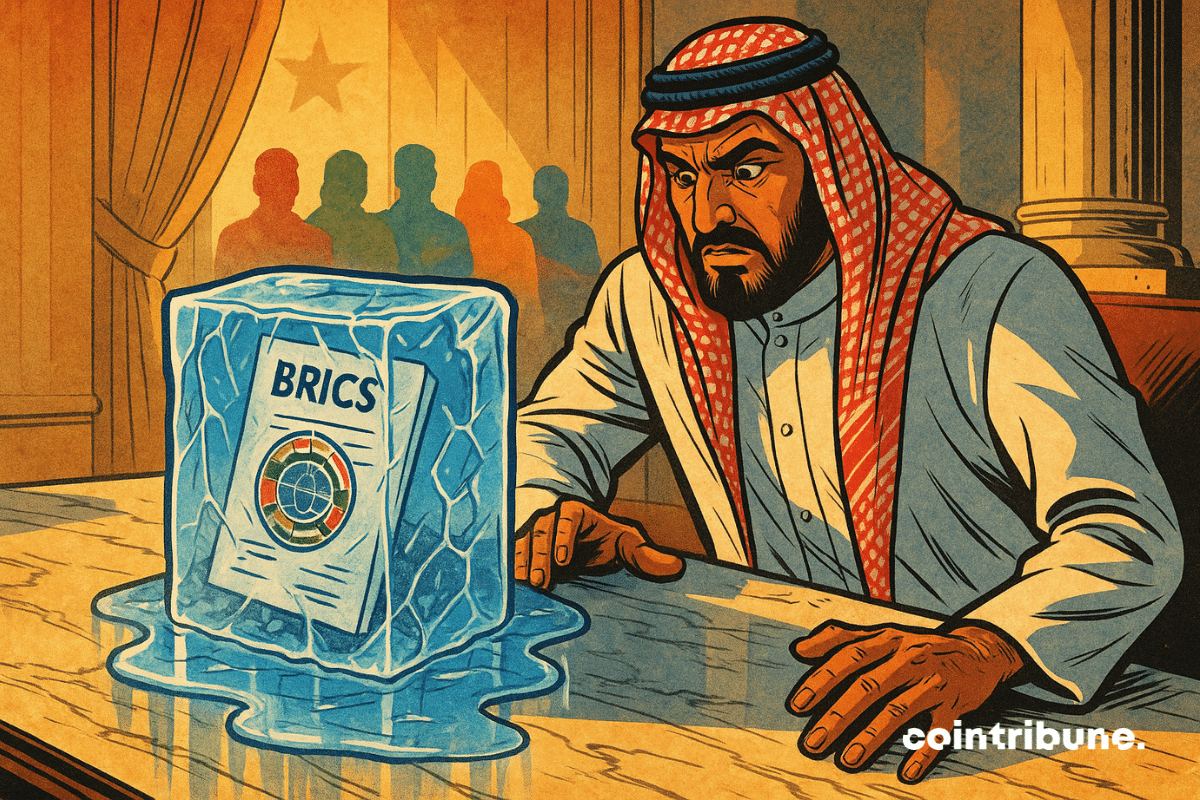
In a world where geopolitical fracture lines move quickly, Saudi Arabia plays a delicate score between two rival blocks. Solicited by the BRICS, but still closely linked to the United States, Riyadhimates, suspending his official membership despite opening signals. While Beijing seduces with its economic promises and Washington agitates the pricing threat, the Kingdom wages its options. Does this tactical vagueness mask an already acted strategic orientation or prepare a major rebalancing on the global chessboard?
In short
- Saudi Arabia is at the heart of a strategic confrontation between the BRICS and the United States.
- Despite an official invitation to join the BRICS, Riyadh has still not confirmed his membership.
- Donald Trump threatened the members of the block with a 150 % tax if they launch an alternative currency to the dollar.
- This strategic neutrality could, however, become untenable as global tensions increase.
A climate of confrontation: growing tensions between the Brics and Washington
The last months have seen a series of open tensions between the United States and the Bloc Block countries, in a business war between Washington and Beijing, intensify. These tensions have resulted in radical economic measures.
President Donald Trump thus warned that “The BRICS block would face a 150 % customs tax for its attempts to create a competing currency in the US dollar”.
This declaration is in a broader offensive: the United States has imposed customs duties that can reach China that “Until 245 %” On certain products, which has exacerbated an already well -established strategic rivalry.
Behind these punitive sanctions, a clear will of Washington is taking shape to preserve the hegemony of the dollar in world exchanges, faced with a coalition which militates for dedollarization. The BRICS, through their joint currency project and their enlargement strategy, appear as a systemic threat to the American authorities. Several key elements illustrate this rise in tensions:
- An active trade war: the customs prices imposed on China reached up to 245 %, targeting in particular sensitive technological sectors;
- Open pressure on the BRICS: the common currency project envisaged by the block sparked an immediate reaction from the United States, in the form of massive tariff threats;
- An ill -perceived enlargement: the new invitations launched by the BRICS to countries like Saudi Arabia are interpreted in Washington as acts of strategic alignment;
- An increasing economic polarization: the current global climate pushes each regional power to clarify its alliances, at the risk of causing deep ruptures.
In this context, the countries courted by the BRICS, in particular those with a historic partnership with the United States, are taken in a dynamic where each decision, or even each non-decision become a political act with a heavy consequences.
Riyadic balancing: between diplomatic silence and geostrategic calculations
While Saudi Arabia had initially accepted the invitation of the BRICS to join the block as part of its enlargement, it has still not proceeded to formal integration. Despite his presence at a BRICS meeting last week, “The country has not yet officially joined the alliance”.
This voluntary delay, far from being harmless, seems to be revealing of a delay strategy dictated by sensitive bilateral issues. Riyadh “Does not want to risk provoking the United States anger while negotiations are underway in Washington”.
This prudence is explained by the very nature of the relations between Saudi Arabia and its two main partners. On the one hand, China represents an essential oil client and a major economic player in the Saudi diversification strategy, in particular via the 2030 Vision. On the other, the United States remains a key ally on the security, technological and diplomatic level. Riyadh is therefore engaged in a delicate balancing play, which forces him to delay his formal alignment with the BRICS to preserve his strategic interests with Washington.
Maximize your Cointribne experience with our 'Read to Earn' program! For each article you read, earn points and access exclusive rewards. Sign up now and start accumulating advantages.


