
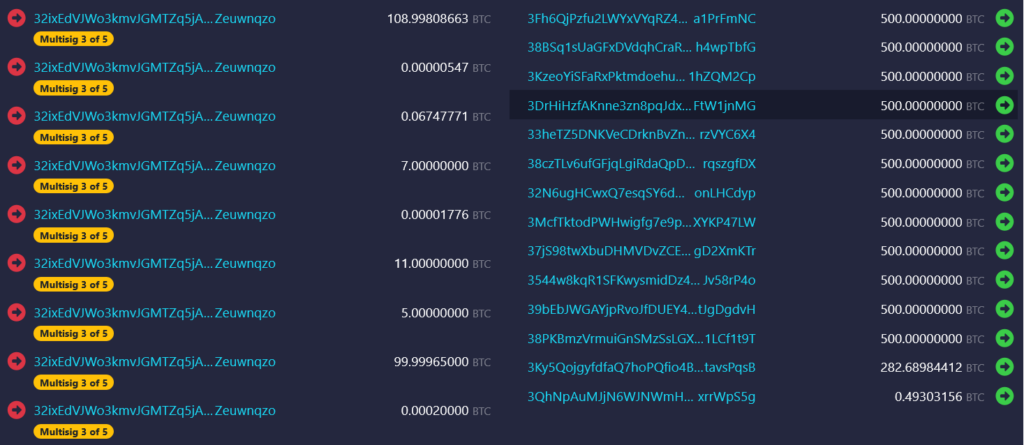
Salvador has just scattered most of its Bitcoin reserve in 14 new addresses, with a ceiling of around 500 BTC per portfolio. The objective: to reduce the attack surface if quantum computing attacked public keys revealed during on-chain expenses.

In short
- Salvador redistributed its 6,274 bitcoins ($ 678 million) to 14 separate wallets.
- This strategy aims to minimize the impact of a potential future quantum attack.
- Each new portfolio contains a maximum of 500 bitcoins to limit exposure to risk.
- The measurement comes while 32.7 % of global bitcoins remain vulnerable to quantum computers.
Salvador reviews its Bitcoin safety at quantum time
The Bitcoin Office of Salvador carried out a major security operation on Friday. The 6,274 bitcoins of the country, hitherto concentrated in a single blockchain address, were methodically distributed in 14 new portfolios.
The objective is simple: to reduce the risks linked to a possible quantum attack, by fragmenting funds in more modest amounts to limit the potential impact of a compromise.
This strategy illustrates a fine knowledge of cryptographic vulnerabilities. Whenever a Bitcoin address is used for a transaction, its public key becomes visible and therefore, in theory, exposed to future capacities for calculating quantum computers.
Thus, to contain this risk, the Salvador capped each wallet at around 500 BTC (or nearly $ 54 million).
This fragmentation is similar to real technological insurance. If, tomorrow, a breakthrough in quantum computer science came to compromise a public key, the impact would remain circumscribed to a single portfolio.
On-chain data already confirm the implementation of this strategy. Transfers are visible on the blockchain, reflecting assumed transparency despite the security issues.
This voluntary advertisement is undoubtedly not trivial: it also seeks to send an educational signal to the market, by showing the example to institutional investors confronted with the same questions.
Between technological anticipation and scientific realism
The crypto community remains shared on the urgency of the quantum threat. According to Chaincode Labs, nearly 6.36 million bitcoins, or 32.7 % of the total offer, remain potentially vulnerable.
But specialists put into perspective: to date, no quantum computer has managed to decipher a key of more than … 3 bits. We are still far from the 256 bits that protect Bitcoin keys.
For Michael Saylor, a figurehead of institutional adoption, these fears are mainly “media threshing”. In his eyes, if the threat should materialize, the Bitcoin community and equipment manufacturers could quickly adapt the protocol and deploy fixes. A confidence that the Salvadoral authorities do not seem to share.
This caution comes in a delicate geopolitical context. Indeed, the Salvador is currently negotiating with the IMF funding of $ 1.4 billion, with strict conditions on the reduction of its Bitcoin initiatives.
The fragmentation of reserves then constitutes a strategic compromise: it maintains a strong exposure to assets while demonstrating a rigorous risk management.
The Salvadorian initiative already attracts attention. Other countries accumulating cryptos observe this life -size experiment, shared between inspiration and skepticism. Stuck between daring financial innovation and institutional pressures, the country continues its route as a pioneer, even if it means walking on a narrow line.
Ultimately, the dispersion of Bitcoin reserves illustrates the fragile balance between innovation and prudence that characterizes the crypto ecosystem. Whether justified or premature, this anticipation of quantum risk reflects a rare institutional maturity for a state that has chosen to adopt bitcoin as a legal currency.
Maximize your Cointribne experience with our 'Read to Earn' program! For each article you read, earn points and access exclusive rewards. Sign up now and start accumulating advantages.