
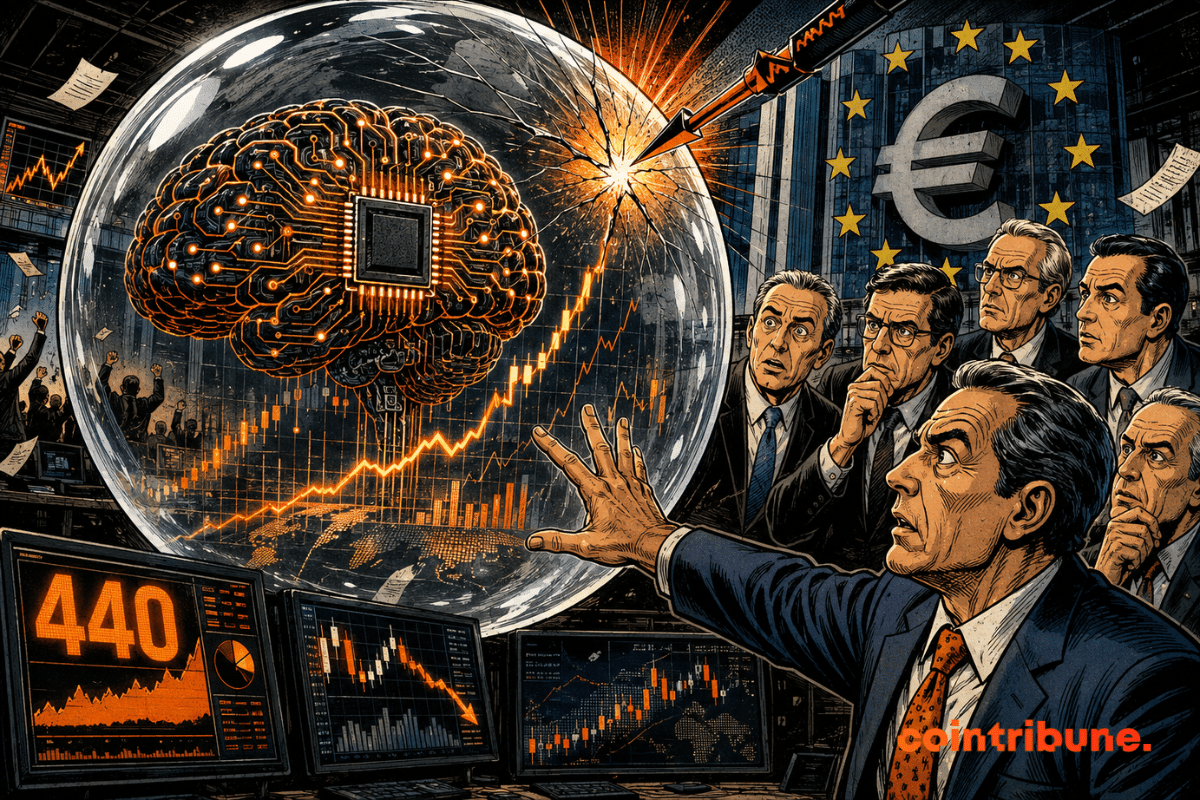
Five economists from the European Central Bank (ECB) have just sounded an alarm rarely heard so clearly. In a post published on August 17, 2026, they assert that a correction in AI-driven stock market valuations is likely whether or not current prices reflect economic reality. For crypto investors, accustomed to monitoring tech stocks as a barometer of risk, the warning deserves special attention.
In brief
- A correction could occur despite AI-supported profits and productivity.
- The CAPE ratio places US valuations near their all-time high.
- Euro zone households have approximately €440 billion of US technology exposure.
An AI fix remains likely, even if successful
In a post published on August 17, 2026, Malin Andersson, Johannes Breckenfelder, Stefano Corradin, Kalin Nikolov and Maria Antonietta Viola compare the AI boom to the railway, electricity and Internet revolutions. All transformed the economy before a correction of their first stock market winners.
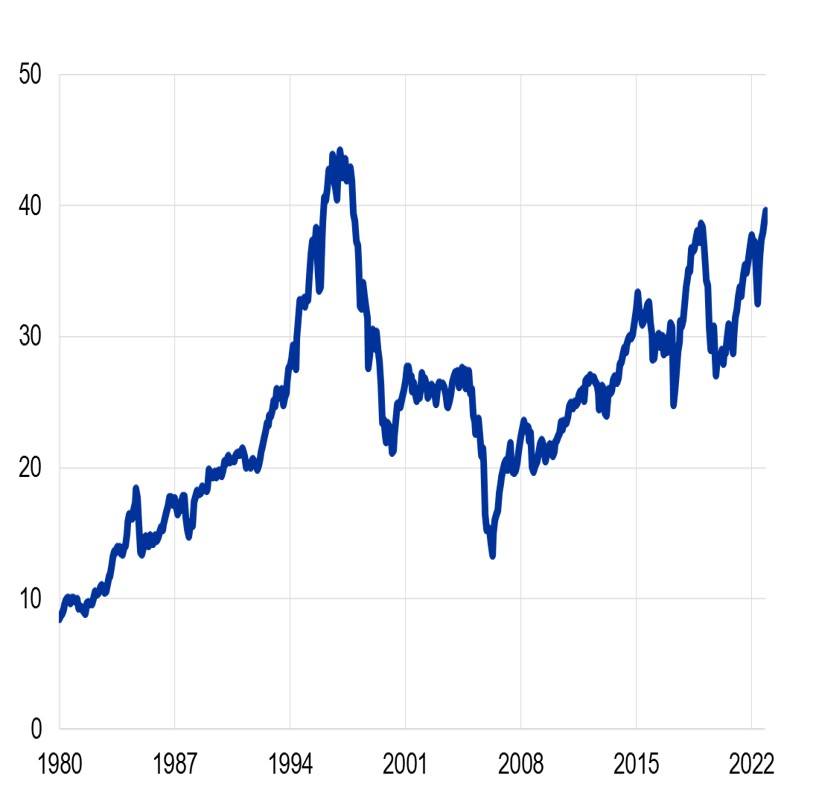
Their initial observation is based on the CAPE ratio. It measures the valuation of the US market by comparing prices to inflation-adjusted earnings over ten years. The latter is now close to its historic peak. In the euro zone, valuations have also increased, but to a much lesser extent.
Concretely, the 5 ECB economists rely on two complementary explanations. The first is called “rational”. It is based on academic reference work on past technological revolutions. According to this theory on the AI crashextreme uncertainty about the potential of an emerging technology justifies very high valuations.
Decryption: the investor only loses his stake, but the potential gain is difficult to limit. According to economists, this logic would explain the spectacular progression of Nvidia shares since 2022.
But this same logic carries within it the seeds of a reversal. As long as AI remains confined to a few companies, the potential failure of the technology remains an isolated risk, absorbable by the rest of the economy. As theadoption of artificial intelligence becomes widespread, this risk becomes systemic and can no longer be diluted. Investors then demand a higher risk premium. This weighs on prices even if profits continue to increase.
The second explanation turns out to be more intuitive: overconfident investors push prices beyond what the fundamentals justify. When this confidence crumbles, the fall can be more brutal than in the rational scenario.
In both cases, the outcome remains the same: a AI market correction is to be expected. Only the exact moment remains unpredictable.
Why does 440 billion euros put Europe at the forefront?
Using data from the third quarter of 2025, the authors of the blog post estimated at 440 billion euros the exposure of euro zone households to American technology stocks. This mainly involves global funds and ETFs dominated by the Magnificent Seven:
- Alphabet;
- Amazon;
- Apple;
- Meta;
- Microsoft;
- Nvidia;
- Tesla.
Insurers and pension funds also remain very exposed.
This structure can amplify a shock. A sudden decline in the AI market would trigger redemption requests. Which would force funds to sell their liquid assets first, then more fragile positions. These sales would accentuate the decline in prices and could cause further withdrawals. The risk would then shift from an American sectoral correction to a problem of European financial stability.
Another important point: European stocks appear cheaper and more linked to the old economy. But in reality, the markets of the two continents remain strongly correlated. Above all, rates and public budgets offer less margin than in 2000 to cushion a crisis. Financial uncertainty therefore remains high. Reuters, citing Goldman Sachsnotes that 11% of S&P 500 companies have quantified specific use cases of AI and only 2% have an effect on their profits.
What this changes for the crypto market
For a crypto investor, this AI market diagnosis particularly resonates. The fact is that bitcoin and large digital capitalizations have been evolving for several years in close correlation with American technology indices (especially during risk compression phases). A Nasdaq correction triggered by a deflation of AI valuations would likely propagate via institutional flows and leveraged positions to the crypto market.
The ECB also underlines a point rarely put forward: unlike the bursting of the internet bubble in 2000, the euro zone today has significantly less room for fiscal and monetary maneuver to cushion an economic shock of this magnitude. This observation also applies to the American authorities. Which limits the collective capacity to contain the effects of a AI correction if it coincides with broader financial instability.
AI crash? Scenarios to watch out for
ECB economists in no way favor the scenario of a collapse of the artificial intelligence thesis. If technology confirms its transformative potential, nothing excludes valuations from reaching levels higher than today after correction. The risk identified relates primarily to the timing and scale of an interim adjustment, not to the long-term viability of the AI sector.
Conversely, a more worrying scenario would combine:
- an American technological correction;
- contagion to other asset classes (including cryptocurrency).
This is possible in a context where central banks have few levers to intervene.
The authors point out, however, that these boom and correction cycles can only be identified a posteriori. Which makes any precise anticipation of the trigger or the calendar hazardous.
In any case, the warning from ECB economists deserves to be followed closely. A fix would not prove that the AI failed. It could simply reflect the transition from a sectoral promise to a generalized economic risk. Moreover, this post does not necessarily reflect the official position of the ECB or the Eurosystem.
Maximize your Tremplin.io experience with our ‘Read to Earn’ program! For every article you read, earn points and access exclusive rewards. Sign up now and start earning benefits.


