
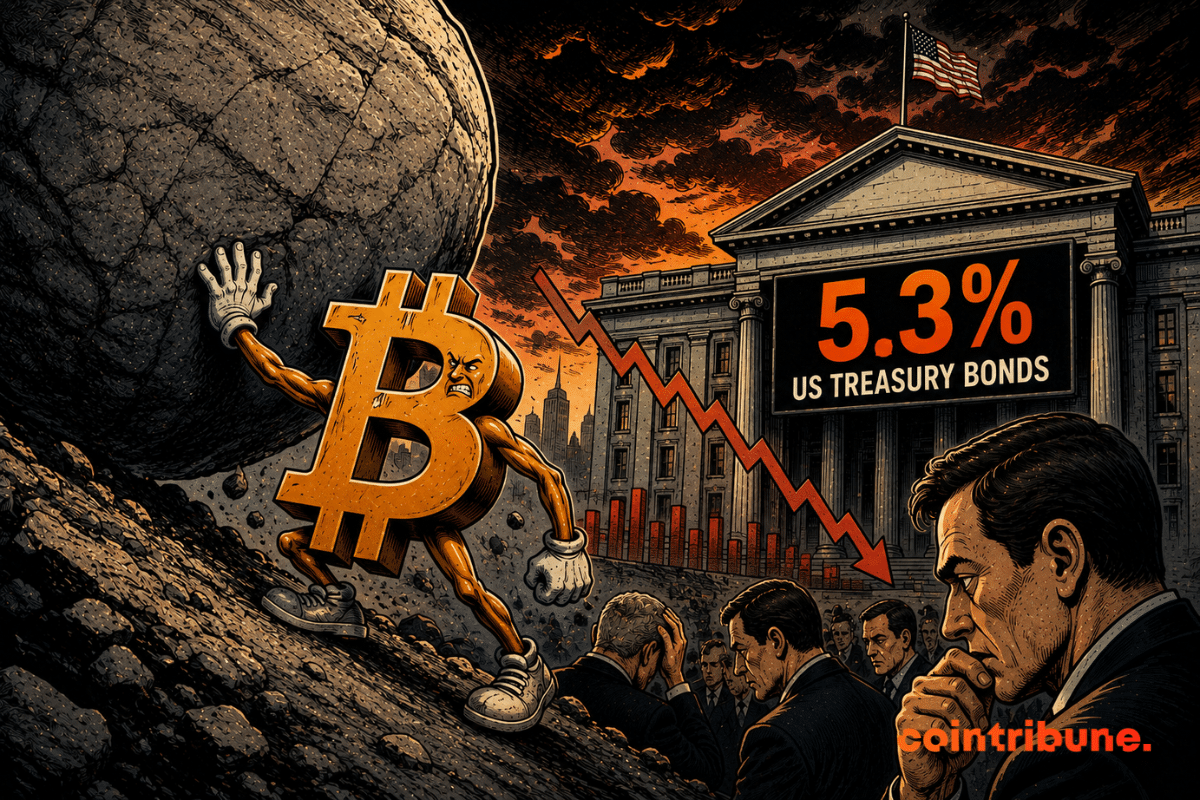
The crypto market is going through a delicate phase as rates rise. On August 17, the 30-year Treasury yield exceeded 5.3%, a level not seen since June 2007. Bitcoin was then trading around $64,610 at the session’s high. At the same time, loans backed by cryptocurrencies had already lost $22.53 billion since their peak. This contraction now changes the nature of the risk weighing on digital assets.
In brief
- The 30-year US Treasury rate exceeds 5.3%, a high not seen since June 2007.
- Cryptocurrency-backed loans fall $22.53 billion from peak.
- Current crypto deleveraging remains gradual, unlike the brutal shock observed in 2022.
- High bond yields increase competition for long-term capital.
- How rates, futures, and crypto credit move will determine the next phase of the market.
A game-changing American return
The crossing of 5.3% by the 30-year American rate occurs in a particular economic context. Operators now estimate the probability of a Fed rate cut in September at around 31%, compared to 55% a week earlier. However, this development did not prevent long-term yields from continuing to rise.
A close above 5.3% would then represent a first event in nineteen years. Bitcoin must deal with a bond environment now offering a real return. This situation increases the pressure on assets that do not produce intrinsic income.
Concerns also relate to the US budgetary trajectory and the volumes of corporate debt issuance linked to artificial intelligence. Real yields over thirty years are close to 3%their highest level in eighteen years. Thus, the increase in financing needs reinforces competition for long-term capital.
Crypto credit sharply reduces its exposure
THE report of Galaxy in the second quarter of 2026 confirms a clear decrease in loans guaranteed by cryptocurrencies. This development reflects a gradual deleveraging of the market, after several quarters of contraction. The crypto credit structure therefore appears less exposed than before. This situation distinguishes the current context from that which preceded the strong tensions of 2022.
Here are the key figures from the Galaxy report which allow us to precisely measure the extent of this contraction:
- $56.16 billion in loans secured by cryptocurrencies in the second quarter of 2026;
- $78.69 billion in the third quarter of 2025, matching the previous high;
- $22.53 billion decline since peak;
- $11.33 billion decline recorded in the second quarter of 2026;
- $47.13 billion in DeFi borrowing last September;
- $21.94 billion in DeFi borrowing as of July 21.
The contraction appears even more clearly in decentralized finance. Borrowings on DeFi lending applications have therefore decreased significantly since last September. This drop now exceeds half of the outstanding amounts observed at the previous peak. Furthermore, debt linked to cryptocurrencies has been declining for three consecutive quarters, reducing part of the exposure accumulated during the previous expansion phase.
This development also modifies the reading of systemic risk on the market. A gradual decline in credit does not produce the same mechanism as a sudden liquidation. Players are gradually reducing their exposure, rather than suffering a succession of margin calls and forced sales. Bitcoin remains exposed to price movements, but its credit structure now differs from that seen before the 2022 bankruptcies.
Bitcoin facing the previous shock of 2022
The previous cycle had experienced a much more brutal contraction. Loans backed by cryptocurrencies fell by more than 55% in a single quarter in 2022. They then fell by another 9%, then by 29% over the next two quarters. Bankruptcies of lenders and forced liquidations then increased the pressure on the entire market.
The current dynamic is moving forward differently. The declines reached approximately 10%, 5% and 17% over three consecutive quarters. Galaxy describes this development as a gradual reduction in risk, distinct from the forced unwinding that marked 2022. This difference is important for bitcoin, because it indicates that the credit contraction has not yet reproduced a comparable spiral.
However, open positions must be distinguished from real leverage. Some futures positions hedge spot positions and therefore are not simple directional bets. Despite this nuance, the structure of the market is evolving. Slow-moving loans have declined significantly, while exposure to fast-moving derivatives is starting to rebuild again.
US bonds become a direct competitor
Rising yields create new competition for long-term capital. Investors can now earn a real return, adjusted for inflation, through Treasury bonds. Bitcoin still pays no intrinsic return. This difference therefore becomes more visible when real rates reach high levels.
At the same time, large technology companies are sharply increasing their bond issues. Alphabet, Amazon and Meta have issued nearly $220 billion in bonds since the start of the year. This amount represents more than double the $108 billion issued by these three companies throughout 2025. This wave of borrowing adds additional pressure on available long-term capital.
The move comes amid an environment where governments and artificial intelligence companies are simultaneously increasing their borrowing. Financing needs therefore become greater while real yields remain high. For bitcoin, this competition can limit the relative attractiveness of an asset without intrinsic yield.
Two scenarios are emerging for the market
A first scenario presented by CryptoSaleassumes that bitcoin declines while loans tracked by Galaxy continue to decline at their current rate. Such a configuration would now point to mainly macroeconomic pressure. High real yields and the abundance of US and corporate bonds could then explain most of the movement. Crypto deleveraging would play a secondary role.
Another scenario would present a more fragile dynamic. An acceleration in the decline in collateralized lending, coupled with a strong bitcoin sell-off, would signal a different reaction. A sharp contraction in open futures positions would also reinforce this reading. In this case, derivatives could amplify market movements.
Conversely, a more favorable scenario could emerge if the 30-year rate falls below 5.1%. A decline in real yields from their current highs could also support digital assets. Bitcoin could then return to the area between $67,000 and $72,000, while open interest would remain broadly stable.
The opposite scenario would see the 30-year rate move between 5.4% and 5.7%, with real yields close to multi-decade highs. Bitcoin could then fall below $60,000, then reach the $52,000 to $58,000 zone. A sharp contraction in futures and increased liquidations would amplify the pressure. In this case, the movement would combine a macroeconomic origin and an effect of derivatives.
What happens next will therefore depend on the simultaneous evolution of rates, crypto credit and derivative products. The level of debt already removed from the market distinguishes this phase from that seen in 2022. However, Fed decisions and new yield movements may further shift the balance between bonds and digital assets. Bitcoin is thus entering a very different Treasury rate environment, and the next indicators will determine whether the tensions come mainly from the bond market or from crypto leverage.
Maximize your Tremplin.io experience with our ‘Read to Earn’ program! For every article you read, earn points and access exclusive rewards. Sign up now and start earning benefits.


