A new report from blockchain analytics firm Chainalysis reveals that more than $75 billion in cryptocurrencies linked to illicit activity could soon be within the reach of law enforcement. The findings come as governments consider building official crypto reserves, raising questions about how seized digital assets could fit into national financial strategies.
In brief
- Chainalysis identifies $75 billion in crypto linked to illicit activity, with $40 billion controlled by darknet market operators.
- Bitcoin accounts for 75% of illicit funds, although stablecoins are increasingly present in criminal transactions.
- Governments see seized crypto as a potential source for state-backed digital reserves and financial strategy.
- Despite the headlines, crypto crime has fallen to 0.14% of blockchain activity in 2024, down from previous years.
Chainalysis uncovers $75 billion in crypto linked to illicit activity, mostly in Bitcoin
Governments mining national cryptocurrency reserves could already have access to billions in recoverable assets on-chain, according to the latest research from Chainalysis.
In a report released Thursday, the analytics firm estimated that more than 75 billion dollars in cryptocurrencies are linked to illicit activities. This includes 15 billion held directly by illicit entities and more than 60 billion in portfolios with indirect exposure to them.
The company said darknet marketplace operators and sellers control more than $40 billion in cryptoassets, highlighting the scale of digital funds potentially recoverable through law enforcement action.
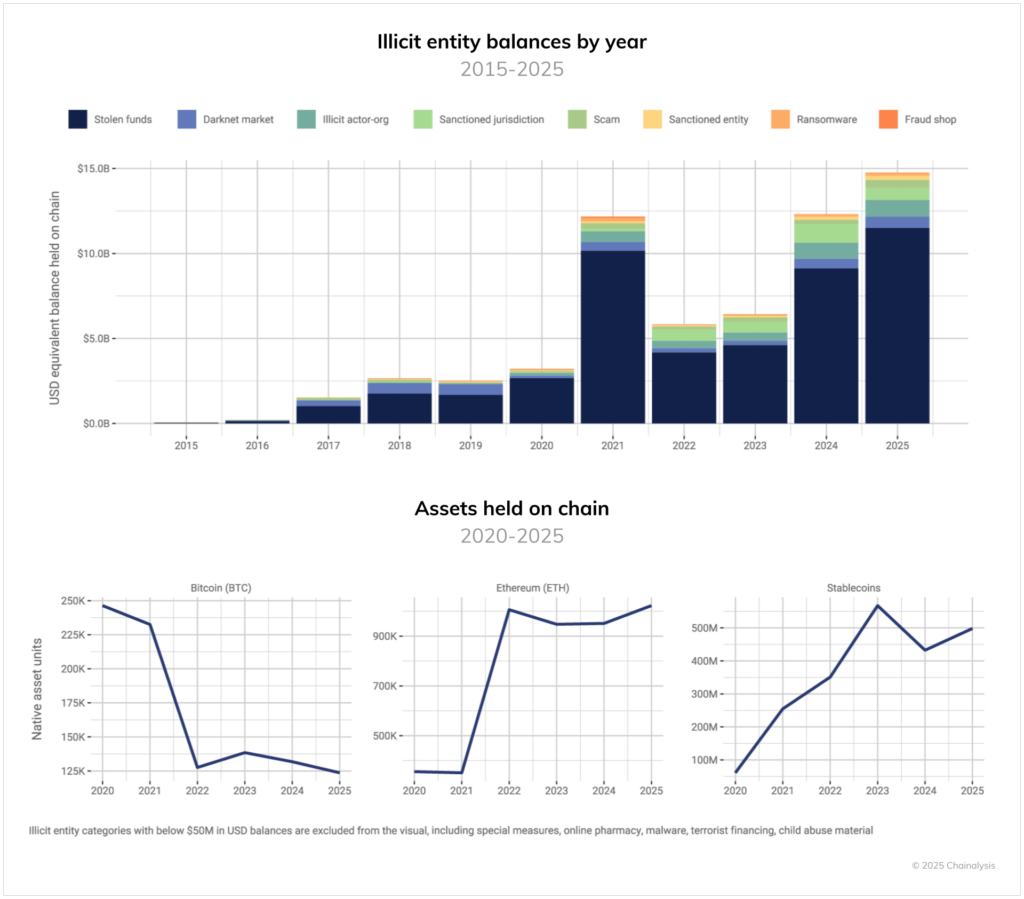
Chainalysis noted that bitcoin accounts for approximately 75% of total illicit value, although stablecoins are playing an increasingly important role in these activities. These findings come as countries, such as the United States, consider how to integrate digital assets into their financial systems, including through the creation of state-backed reserves.
The report cited the Trump administration's creation of the Bitcoin Strategic Reserve and the Digital Asset Reserve, initiatives aimed at building government crypto holdings through budget-neutral means, such as asset forfeitures.
Major digital asset seizures signal new era in financial law enforcement
According to Chainalysis, these developments mark a new frontier in financial law enforcement and national asset management. The analysis highlights that billions of dollars in illicit crypto are openly traceable on public blockchains. This created a major opportunity for authorities to recover funds through coordinated enforcement efforts.
The cryptocurrency ecosystem offers law enforcement an unprecedented opportunity: billions of dollars in illicit proceeds are present on public blockchains and are theoretically seizable if authorities can coordinate their actions.
Chainalysis report
Jonathan Levin, co-founder and CEO of Chainalysis, said the new estimates significantly expand the potential for asset forfeiture and could influence how governments consider building blockchain-based reserves in the future.
Recent enforcement actions illustrate this potential. In March, the US Department of Justice (DOJ) announced that it had dismantled a Hamas terrorism financing scheme, seizing approximately $200,000 in USDT used to finance the group's operations.
Separately, a Chinese national has been convicted in the UK following an international fraud investigation that led to what police say is the world's largest cryptocurrency seizure: 61,000 BTC valued at around £5 billion ($6.7 billion).
In Canada, authorities confiscated nearly $40 million in digital assets from the TradeOgre exchange platform, accused of operating without registration and facilitating money laundering. This decision has sparked criticism from part of the crypto community, who believe that regulators have exceeded their authority.
Crypto Crime Falls to Just 0.14% of Blockchain Activity, Chainalysis Reports
Although blockchain-based crimes have increased in number, Chainalysis found that their overall share of crypto activity remains relatively small. The company's 2025 Crypto Crime Report estimates that illicit transactions accounted for just 0.14% of all blockchain activity in 2024, continuing a downward trend seen in previous years.
In contrast, the United Nations Office on Drugs and Crime (UNODC) estimates between 2% and 5% of global GDP laundered each year via traditional finance.
Analysts note that blockchain transparency often makes crypto crime appear more widespread than it actually is, since every transaction is publicly visible and easier to trace than cash activities. Every transaction is recorded on public ledgers, making illicit movements easier to detect and more often reported than those involving cash or traditional banks.
As nations evaluate their approach to digital assets, Chainalysis' findings suggest the line between law enforcement and asset management is thinning — indicating that recoverable crypto could soon play a role in shaping national reserve strategies.
Maximize your Tremplin.io experience with our 'Read to Earn' program! For every article you read, earn points and access exclusive rewards. Sign up now and start earning benefits.