

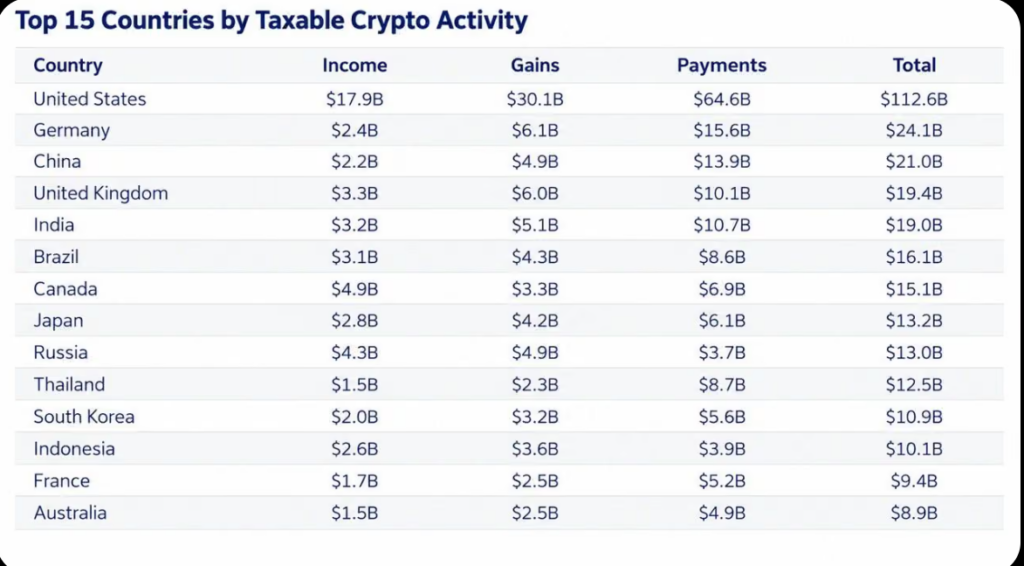
In France, crypto taxation could affect $9.4 billion of taxable activity during the year 2025, according to data provided by Chainalysis. This amount nevertheless constitutes neither hidden gains nor an estimate of taxes lost by the State.

In brief
- $9.4 billion of crypto activity would potentially be taxable in France in 2025.
- This amount includes payments, gains made and crypto income.
- The 368 million euros declared in 2024 are not directly comparable to this estimate.
- DAC8 will strengthen tax transparency thanks to data collected by crypto providers.
- Part of the DeFi activity and on-chain transactions will remain outside the practical scope of the system.
Three categories make up the 9.4 billion
Chainalysis positions France thirteenth in the world when it comes to potentially taxable crypto activity. In its report, the agency relies on transactions observed on bitcoin, Ethereum, Solana, Tron, BNB Smart Chain and Base.
The company allocates flows geographically using direct location data and the activity of identified services. However, it recognizes that its model does not cover all blockchains or internal transactions on exchange platforms.
This amount is divided between three main categories:
- $5.2 billion in crypto payments;
- $2.5 billion in realized gains;
- $1.7 billion in revenue from mining, staking, loans and gaming;
- $9.4 billion in potentially taxable activity in total.
The company Chainalysis specifically uses the theme “potentially taxable crypto activity” in its report published on August 26. Thus, a payment of 1000 dollars does not immediately correspond to a capital gain of 1000 dollars. Only part of the transaction can generate a gain subject to tax, depending on the purchase price and the taxpayer’s situation.
The sum of 9.4 billion cannot therefore be presented as a tax debt. It adds flows of different nature to which French regulations do not necessarily apply the same treatment.
The 368 million declared are not comparable
Nearly 24,000 French taxpayers declared 368 million euros in net capital gains for their 2024 income, according to figures communicated. The previous year, 7,700 people declared 150.8 million euros.
This increase is around 144% for the number of declarants and almost the same percentage for the amount of gains. Such statistics indicate improvement in reporting, even when they cannot fully determine fraud.
Making a direct comparison of €368 million to $9.4 billion would be misleading. The first amount relates exclusively to net capital gains declared for 2024. As for the second, it concerns the year 2025 and brings together gains, income and payments.
Also, the comparison with the 2.5 billion gains estimated by Chainalysis remains imperfect. The periods and currencies are different, while on-chain analysis does not always make it possible to establish tax residence, the purchase cost and any capital losses.
The 90% rate does not concern France
The assertion that more than 90% of French crypto gains are not declared does not emerge from the report. Chainalysis cites a study published by the Swedish tax administration according to which more than 90% of people examined on Swedish soil had not properly declared their activity.
No corresponding rate has been determined for France. Immediately applying this percentage to French taxpayers could therefore amount to transforming a foreign comparison into a national statistic.
However, the report establishes a lack of visibility for administrations. Globally, Chainalysis estimates potentially taxable activity at more than $457 billion in 2025. The European Union would account for $125.1 billion of this.
Crypto taxation in France would benefit from more concise information from 2027. Thus, the DAC8 directive already requires providers to collect data linked to operations carried out since 1er January 2026.
DAC8 will launch the first crypto information exchanges in 2027
Service providers will therefore have to send the identity, tax residence and transactions of their users. Thus, European administrations will be able to exchange the first data for the current year no later than September 30, 2027, according to the European Commission.
The DAC8 standard incorporates the principles of the OECD Crypto-Asset Reporting Framework. This is a device that mainly targets centralized exchange platforms, brokers and certain wallet providers.
Its effectiveness will remain partial. Chainalysis believes that events covered by CARF constitute only 14% of potentially taxable on-chain activity. Decentralized exchanges, transfers between individuals and certain income from DeFi would remain outside its practical scope.
Statistics received in 2027 will facilitate controls, however they will not directly reveal all undeclared earnings. The main challenge will be to reconcile information from service providers with on-chain transactions and the real tax situation of each user.
Maximize your Tremplin.io experience with our ‘Read to Earn’ program! For every article you read, earn points and access exclusive rewards. Sign up now and start earning benefits.


