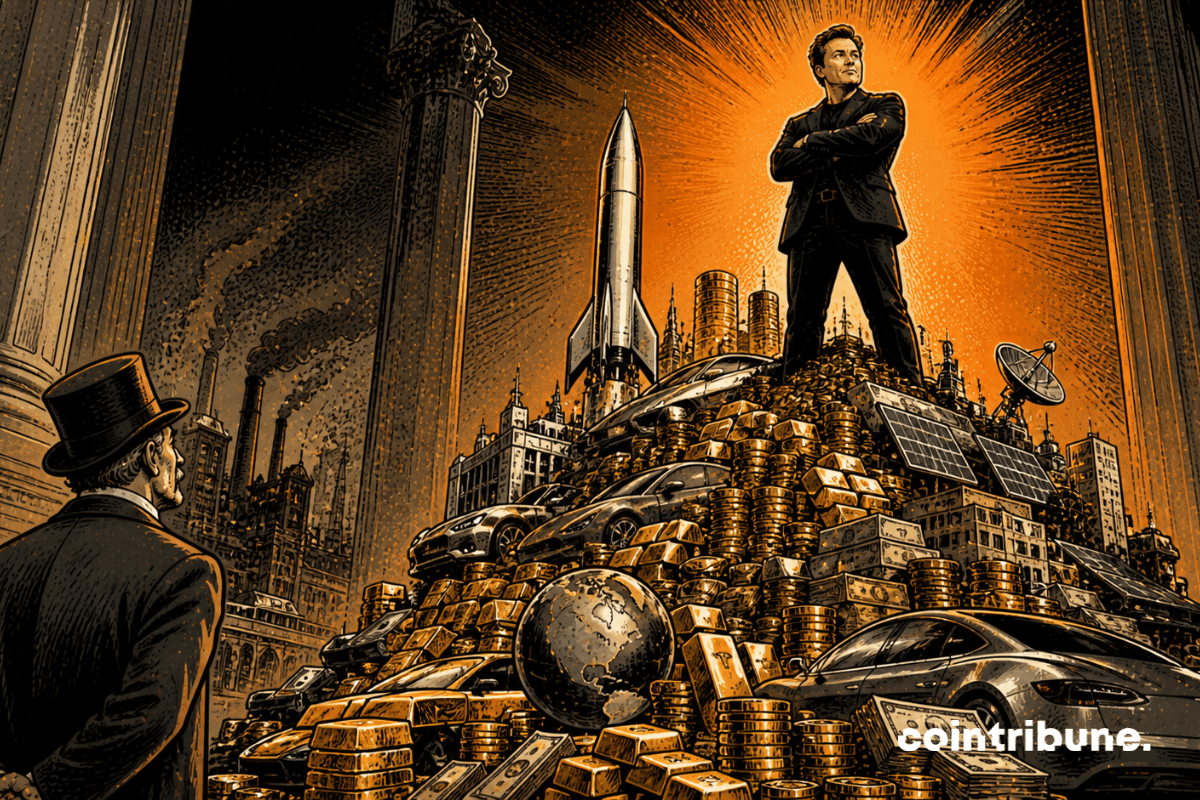
Wealth records rarely change scale. Elon Musk has just reached an unprecedented milestone, with a fortune estimated at more than $800 billion, a level that no individual has reached since John D. Rockefeller in 1913. This meteoric progression goes beyond a personal performance, but it illustrates an unprecedented concentration of capital in the era of technological giants. Between historical rupture and disproportionate ambitions, this new threshold questions current economic dynamics and their global implications.
In brief
- Elon Musk crosses the $800 billion threshold, reaching a level of wealth not seen in over a century.
- This fortune represents a significant share of American GDP and exceeds that of many countries, illustrating an extreme concentration of capital.
- The comparison with Rockefeller in 1913 underlines the historical nature of this progression.
- Elon Musk displays even higher ambition with a goal of 10,000 billion dollars, summed up by his shocking formula.
A historic fortune that redefines orders of magnitude
Elon Musk's fortune now exceeds $800 billion, a level rarely reached in modern history, even though he is already the richest man in the world. This progression is accompanied by spectacular comparisons which illustrate the magnitude of the record:
- It represents approximately 2.7% of the United States' GDP;
- It exceeds the average GDP of 176 countries, estimated at $612.36 billion;
- It refers to a situation comparable to that of John D. Rockefeller in 1913.
Faced with this rise, Musk reacted in a concise manner by declaring: “10 trillion dollars or nothing”.
These elements reflect an exceptional concentration of wealth on a contemporary scale. The reference to Rockefeller places this dynamic in a historical perspective, marked by the influence of great industrial fortunes. Crossing this threshold reveals an evolution of economic models, where technological leaders now occupy a dominant position in value creation.
A tenfold ambition that exceeds current standards
Beyond this record, Elon Musk is already planning a new stage by aiming for a fortune of 10,000 billion dollars, a multiplication by more than ten of his current assets. This ambition is summed up in his declaration, which sets a particularly high goal. Such a projection introduces a new reference scale, rarely mentioned in individual trajectories.
This perspective comes in a context where its companies continue to post significant valuations, supported by strong growth sectors. The stated objective thus goes beyond the simple personal record and underlines a long-term vision. This trajectory calls into question the mechanisms enabling such a level to be reached, as well as the potential limits of this dynamic.
Such an announcement opens a global debate on the concentration of capital and the transformations of the global economic system. It invites us to think about the possible consequences on the markets, macroeconomic balances and the growing role of major tech figures in structuring the economy, while Musk prepares SpaceX's IPO.
Maximize your Tremplin.io experience with our 'Read to Earn' program! For every article you read, earn points and access exclusive rewards. Sign up now and start earning benefits.