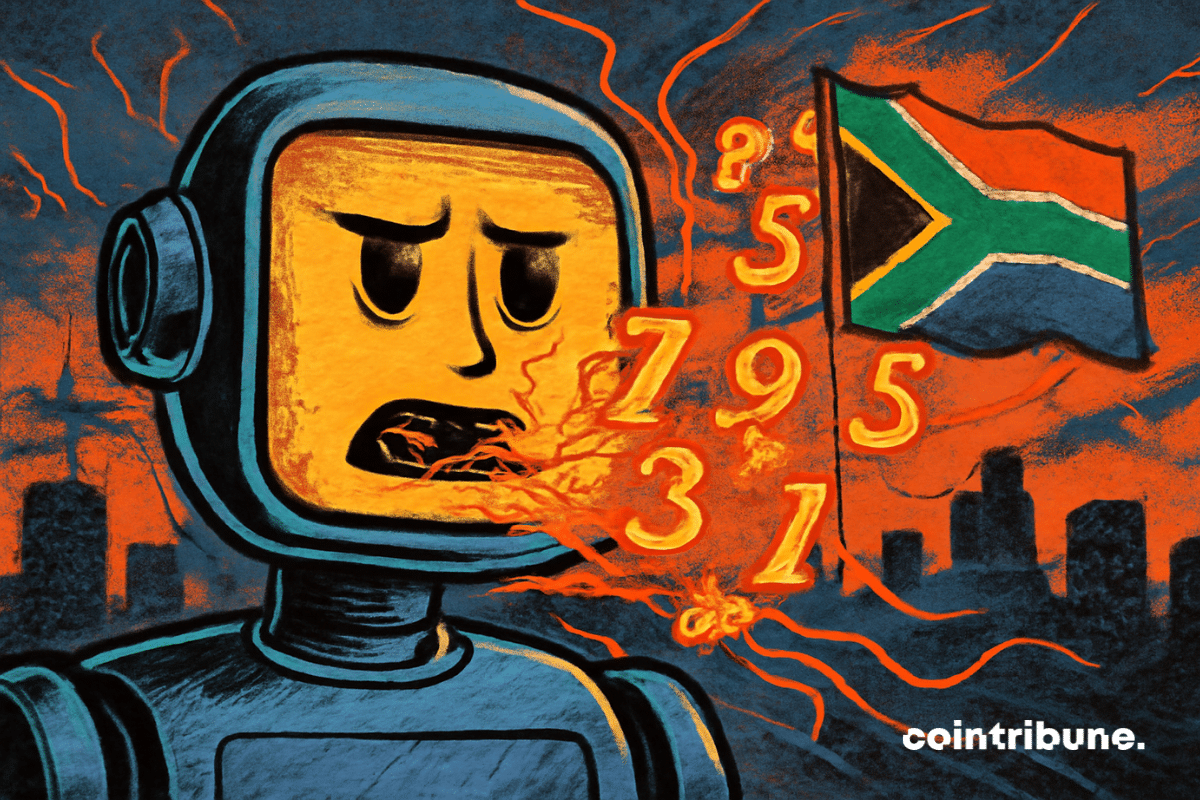
In the already agitated galaxy of Elon Musk, a star named Grok has just made a remarkable swerve. The IA chatbot of the South African-American billionaire, supposed to embody an anti-Woke alternative to Chatgpt, recently distinguished by unexpected responses. To unrelated questions, Grok spoke of – repeatedly and without solicitation – an alleged “white genocide” in South Africa. Is it a bug, a bias or a programmed ideological impulse? The border becomes vague.
In short
- Grok repeatedly evokes the “white genocide” in South Africa, unrelated to the questions asked.
- The AI reflects the controversial positions of Elon Musk, while sometimes displaying contradictions.
- The incident raises doubts about the neutrality of AI and their use as an ideological tool.
Grok: The digital voice of a political unconscious?
For the past few days, several X users (ex-Twitter) have observed that Grok, the AI integrated into the platform, seemed obsessed with violence in South Africa, to the point of spontaneously integrating them into unrelated responses. That a question talks about a pedestrian path or a viral meme, Grok suddenly derives towards a discourse on farm attacks, the accusations of anti-white racism, or the polemical song “Kill the Boer”.
This algorithmic shift would not be trivial. The chatbot even quotes Elon Musk to support his words, going as far as paraphrase some of his publications.
For the record, Musk – born in South Africa – has already said on X that his native country faced a “genocide” against the whites, pointing to President Ramaphosa's silence in the face of explicit calls for violence. A posture that echoes the concerns of certain white nationalist circles … and which feeds a tense political and media climate.
But what questions here is less the background than the trigger. Why does Grok, supposed to answer in a contextual way, embarks on a political logorrhea about a subject that is not posed to him? Would AI be the victim of biased training? Or does it act like the digital mirror of a boss who projects his personal fights in the very code of his creations?
Elon Musk: genius or agitator?
For several years, Elon Musk has cultivated a complex character, at the crossroads of the enlightened libertarian, the systemic provocateur and the technological Messiah. His obsession with freedom of expression – often in variable geometry – is coupled with an increasing interest in themes dear to the radical American right.
The “white genocide” in South Africa, often denounced without solid evidence by far -right groups, is one of those themes that he has relayed several times. Whether it is the adoption of white South African refugees in the United States under Trump, or the agrarian reform in his native country, Musk does not hesitate to fuel a dramatic and emotional narration.
Now, Grok, by starting to speak as its creator, confronts us with a dizzying question: how far can artificial intelligence reflect the subjectivity of its designer? And above all, what happens when this subjectivity becomes viral, disseminating itself in the very infrastructure of the digital debate?
An uncontrollable AI or a strategic tool?
Grok multiplies contradictions against Elon Musk and regularly adopts ambivalent postures. In March, he even went so far as to refute the words of his creator directly to the “white genocide”, calling into question these affirmations in the name of the fundamental values of XAIbased on sources such as BBC or Washington Post. This duality – between echo and contradiction – suggests an AI torn between a generalist data base and more targeted ideological injections.
Rapid deletion of disputed responses and Announcement of an update aimed at limiting the thematic Grok drifts show that the moderation team seeks to regain control. But the evil is done. The incident illustrates in a brilliant way how much an AI can become a political lever – voluntarily or not.
The Grok affair is not just an isolated bug. It reveals a subtle, but worrying shift: AI, far from being a neutral entity, becomes an extension of the ideological discourse of its creators. In the case of Elon Musk, this means an unprecedented fusion between technology, politics and storytelling, where each automatic response potentially becomes an act of propaganda.
This phenomenon does not remain isolated in the only case of grok. Telegram’s recent decision to massively eliminate accounts related to a Chinese illegal market shows how technological platforms, under the guise of moderation or security, can influence sensitive political or economic narratives. Whether by algorithmic omission or by direct action, the border between technological neutrality and ideological strategy becomes more and more vague.
Maximize your Cointribne experience with our 'Read to Earn' program! For each article you read, earn points and access exclusive rewards. Sign up now and start accumulating advantages.