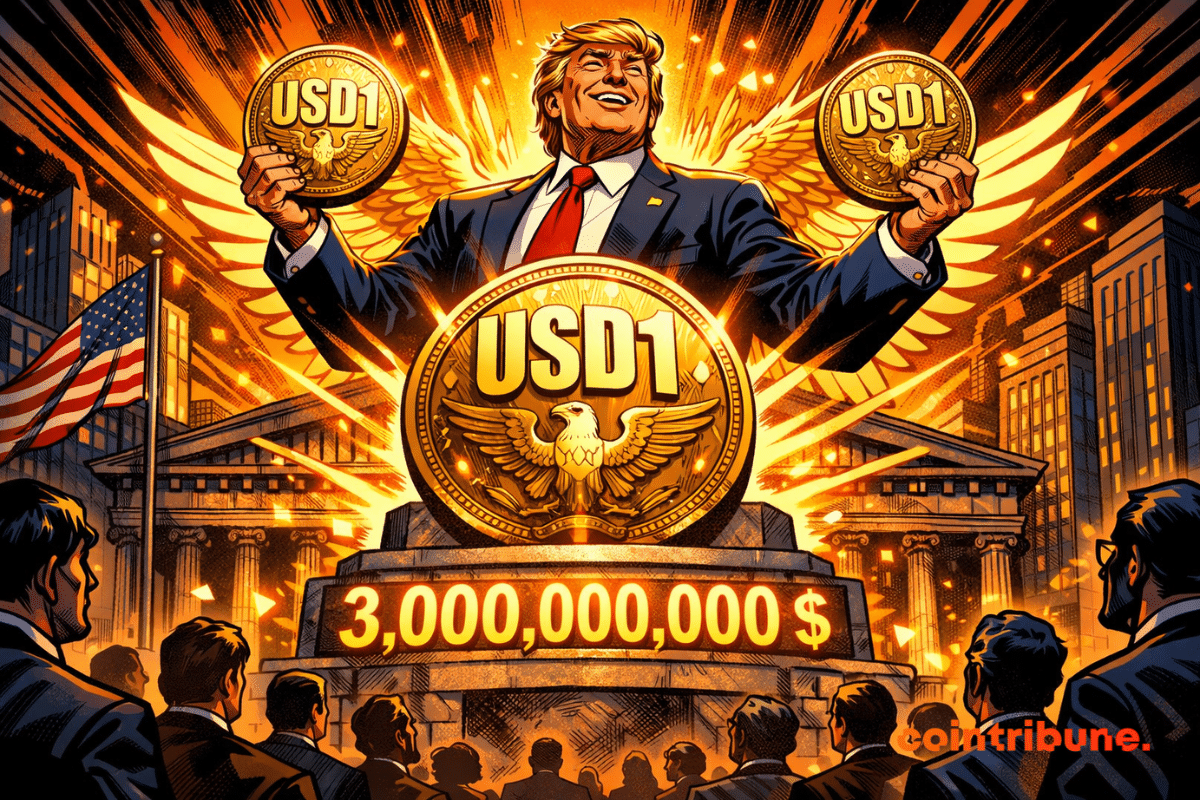
In the crypto universe, there are anonymous currencies, one-month star tokens… and there are tokens that sound like declarations of war. Right now, USD1, a stablecoin launched by the Trump family, is attracting all the spotlight. Its rise to power, both political and economic, is shaking up the balance of an ecosystem already under tension. Between community ambitions and geopolitical soap opera, this stablecoin leaves no one indifferent.
In brief
- USD1 exceeds 3.07 billion capitalization and becomes the 32nd crypto asset by size.
- Binance boosts USD1 with 20% APR and replaces BUSD with this new stablecoin.
- The project targets small investors, far from the institutional strategies of USDT or USDC. (15 words)
USD1 and its sprint to $3 billion: express record for a stablecoin
In just a few months, USD1 has exceeded 3.07 billion capitalization, after an increase of 6% in 24 hours. This figure places it among the 10 largest stablecoins in the world (7th last May), and even in 32nd position among the most valued crypto-assets according to CoinMarketCap.
This breakthrough of USD1 can be explained by several strategic moves. First, the Binance Booster program, which offers up to 20% APR for token holders. Then, a landmark decision: Binance replaced the collateral of its old BUSD with USD1 at a rate of 1:1, placing it at the heart of its digital asset system.
At the same time, WLFI, the stablecoin issuing company founded by Donald Trump Jr., is increasing its alliances. With Coinbase, FalconX, or even Raydium on Solana, the project is banking on broad and rapid distribution.
But USD1's rapid growth has also revealed its limits. During a flash crash on the BTC/USD1 pair, the price of bitcoin plunged to $24,000 before surging to $87,000, an anomaly caused by weak liquidity. A rise in power, therefore, but not yet without a hitch.
USD1, stablecoin flag of small holders or crypto political mirage?
From its launch, USD1 presented itself as a stablecoin designed for “retail users”. Where USDT and USDC dominate with institutional backing, USD1 seeks to take root in popular adoption. A posture assumed by its founders.
Zach Witkoff, co-founder of WLFI, explain :
This is just the beginning. We are building the future of finance, driven by the real adoption of USD1.
Partnerships also speak this language: memecoin Bonk, DEX Raydium, Solana network. All to target a decentralized crypto community, young and often far from the spheres of power.
However, this strategy raises doubts. The shadow of Trump looms large. Can we really present this token as “popular” when it is supported by a political dynasty? Doubt sets in. The mission of “financial democratization” is mixed with a well-established image war.
Despite everything, the facts are there. Adoption is rapid. Volumes are climbing. The rewards are attractive. The USD1 project walks a fine line between populist storytelling and crypto disruption.
Trump, CZ, Binance: the triangle of influence that changes the rules
Behind this success story, a political framework is being written. Starting with the deal between MGX (Abu Dhabi) and Binance: $2 billion settled via USD1, just before the presidential pardon granted by Trump to Changpeng Zhao (CZ), ex-boss of Binance.
The affair caused a reaction. Elizabeth Warren saw a play of influences, just as Congress was debating the GENIUS Act, a key law for the crypto industry. For its part, Binance US has calmed things down: purely commercial, assures management.
For observers, this Trump–Binance–USD1 triangle brings back the old codes of finance… in a tokenized setting.
An actor close to the project, Dylan_0x, sums it up like this :
Once USD1 finds its place in the stablecoin market, WLFI will naturally benefit from many advantages. For now, any attempt to boost WLFI by USD1 may seem relatively weak.
Five numbers to follow the trajectory of USD1:
- $3.07 billion in capitalization according to CoinMarketCap;
- 6% growth in 24 hours after Binance announcement;
- 20% APR offered to stablecoin holders;
- • 32nd place in the global crypto ranking;
- 1 flash crash: drop to $24,000, then peak to $87,000 in a few seconds.
While USD1 is turning heads in the crypto universe, the general mood is less festive. The overall capitalization of the crypto market has fallen below $3,000 billion, weighed down by the decline of Bitcoin and Ethereum. Further evidence that an asset's surge can mask a broader market decline.
Maximize your Tremplin.io experience with our 'Read to Earn' program! For every article you read, earn points and access exclusive rewards. Sign up now and start earning benefits.