
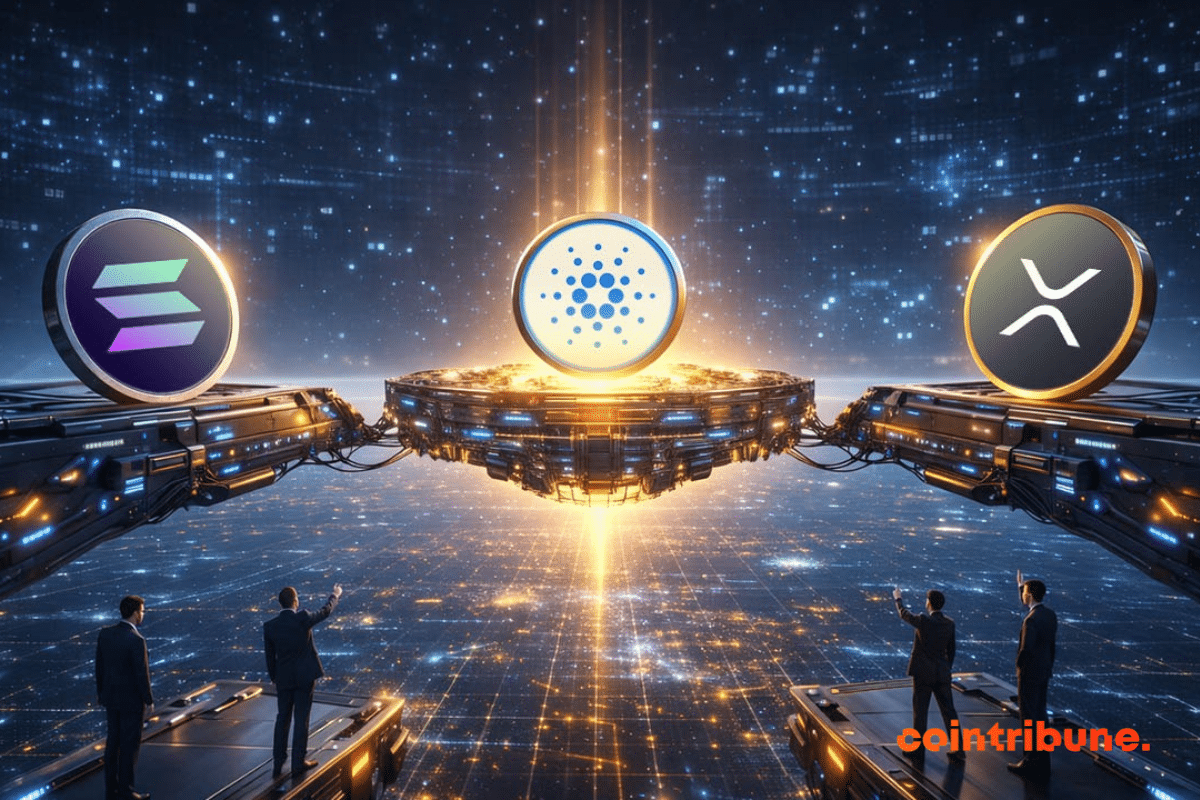
Recent exchanges between leaders of large blockchain networks have reignited the debate on cooperation between ecosystems. What started as a technical disagreement evolved into a broader discussion around shared infrastructure. Comments from Cardano founder Charles Hoskinson now raise questions about possible future collaboration between Cardano, Solana and XRP.
How did the debate take place?
The discussion started after the Angry Crypto Show shared a clip from Hoskinson's podcast discussing the performance differences between Cardano and Solana. While praising Solana's transaction throughput, Hoskinson said speed alone does not define the strength of a network.
Rather, he highlighted the difficulty of maintaining decentralization, high security standards, tolerance for Byzantine errors of 50% and large-scale Nakamoto-type recovery. According to Hoskinson, Cardano prioritizes these elements over raw performance.
Mert Mumtaz, CEO and co-founder of the Solana-focused Helius platform, responded with a harsh critique. Mumtaz rejected Hoskinson's arguments and raised concerns about Cardano's security model, citing an incident in November that briefly split the network. He also accused Hoskinson of misleading users and criticized Cardano's low transaction throughput, despite the network having been in existence for several years.
Hoskinson responded by saying the accusations were inaccurate. He invited a technical discussion around the chain split and its context. Mumtaz, for his part, continued his criticism of Cardano's production and accused Hoskinson of spending more time commenting than delivering working solutions.
Yakovenko considers Solana-Cardano feud irrelevant
The discussion took another turn when Solana Labs co-founder Anatoly Yakovenko intervened. He felt that comparing Solana to Cardano and XRP sent a negative signal to the market and harmed the entire crypto ecosystem.
Hoskinson agreed with this position and later stated that he was interested in development on both Solana and XRP. This statement quickly fueled discussions around possible cross-chain work.
Growing signals of cross-chain cooperation
Recent events suggest a growing interest in interoperability between networks:
- Public conflicts are increasingly evolving into technical exchanges.
- Major founders discourage zero-sum competition.
- Bridges between ecosystems are becoming more frequent.
- Institutional actors support cross-chain infrastructures.
- Developer communities are pushing towards shared standards.
These trends indicate a gradual change in the relationships between major blockchains.
Past disputes have already led to collaborations between ecosystems. A few weeks ago, a public clash between a Solana Foundation executive and the XRP community was followed by Hex Trust's announcement at Breakpoint of its intention to build an XRP bridge to Solana.
Charles Hoskinson has also expressed interest in a Cardano-XRP tie-up in the past.
With the intensification of discussions around potential partnerships, attention is also being focused on more modest projects likely to benefit from the domino effect of such collaborations.
Minotaurus (MTAUR) and broader interoperability trends
Increased collaboration between large blockchain players often triggers a series of positive movements among smaller projects. According to some speculations, Minotaurus (MTAUR) attracts attention as a project that can benefit from this favorable context.
MTAUR is the native token of Minotaurus, a blockchain-based game focused on maze exploration, combat, and treasure collection. Gameplay is the platform's core offering, with blockchain features supporting in-game ownership and actions without distracting from the gaming experience.
Token holders can access features such as referral benefits, vesting programs, and community incentives. For example, the platform currently offers participation in a draw of 100,000 USDT.
Each MTAUR token is currently valued at 0.000126 USDTmaking it one of the low entry barrier assets in the market. At this level, 100 USDT corresponds to approximately 780,000 tokens.
Some market observers are talking about long-term upside scenarios, although these prospects remain speculative and dependent on execution and adoption. Without being directly linked to collaborations between large chains, projects like Minotaurus often benefit indirectly when interoperability becomes a stronger focus of the industry.
Maximize your Tremplin.io experience with our 'Read to Earn' program! For every article you read, earn points and access exclusive rewards. Sign up now and start earning benefits.


