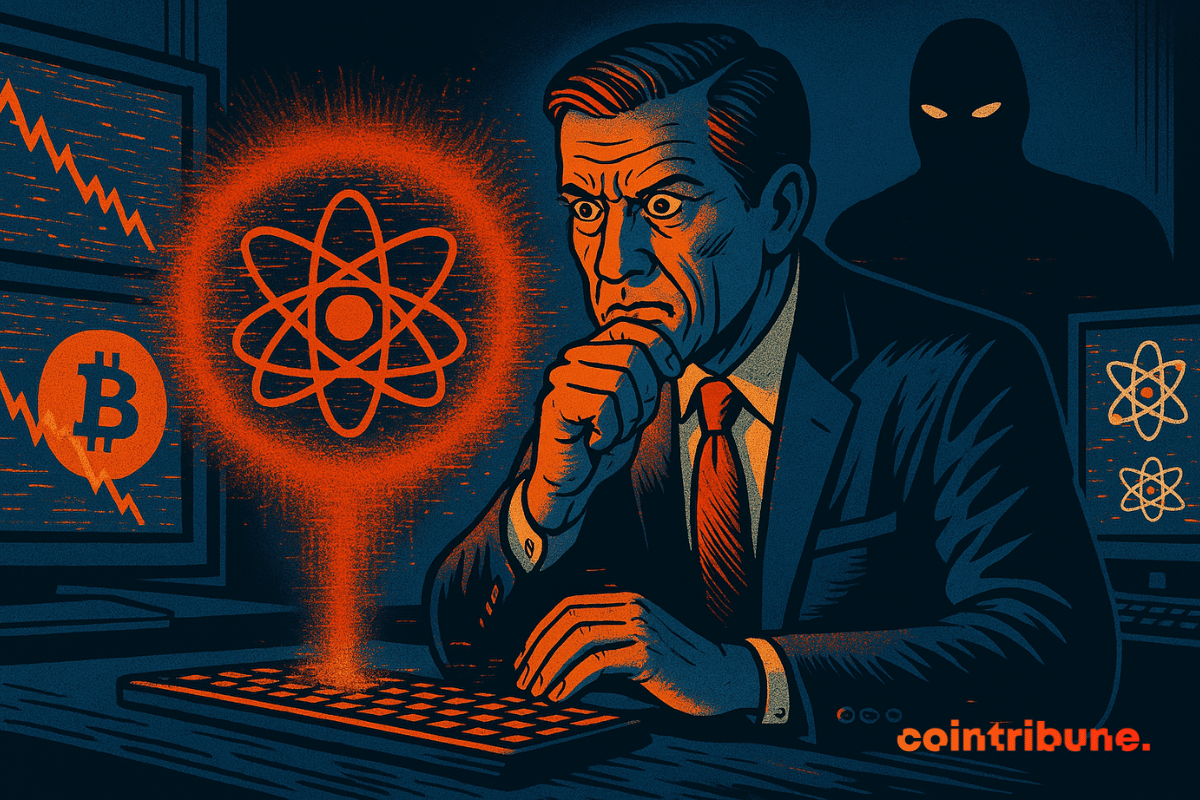
Doubts are growing around the famous “Q-Day”. This day when quantum technology would go beyond cryptography protecting Bitcoin. This concern comes from BlackRock, who added an explicit mention of the quantum risk in his file by Etf Bitcoin. This advance raises a question: is the safety of bitcoin obsolete in the face of the power of future quantum computers? The issues are colossal, because it is not just a theoretical risk.
In short
- Blackrock Lists the quantum risk for the first time in its Bitcoin ETF file.
- 25 % of bitcoins would be vulnerable in the event of a powerful quantum computer.
- Google has developed a quantum processor capable of carrying out impossible calculations for conventional superordinators.
- Post-quantic solutions are already being tested to protect Bitcoin against this upcoming threat.
The quantum danger lies with Bitcoin
Blackrock, the asset management giant, for the first time mentioned the threat of quantum computer science In his prospectus updated for his Etf Bitcoin, Ishares. This threat is based on a potential capacity of quantum computers to decipher private keys that secure Bitcoin transactions.
In his fileBlackrock explains that:
If fairly powerful quantum processors emerge, they could decipher private keys and compromise the safety of the wallets.
The firm also emphasizes that the transition to Quantum resistant cryptography would require a large consensus within the Bitcoin community. This transition to a new standard could be complex, even conflicting.
Technically, fear comes from theShor algorithmcapable in theory of breaking elliptical cryptography on which the Bitcoin network rests. Google and Microsoft presented advances in quantum computer science, such as the Willow and Majorana 1 processors, capable of carrying out unimaginable calculations in minutes. However, reality is still far from the immediate threat.
As Paolo Ardoino explains, CEO de Tether, “Lhe quantum machines are still far from being able to crack 256 -bit security This leaves a little respite.
However, according to analyzes, near 25 % of bitcoins in circulation are stored in potentially vulnerable addressesespecially those that have already unveiled their public key. If one day a fairly powerful quantum computer is born, these corners would then be at risk.
Crossed views on the quantum threat
Opinions are shared in the Crypto community. Some like Office area alert to the threat. Their tweet underlines:
The largest world asset manager, BlackRock, has just added quantum IT as risk in its Bitcoin ETF file.
This institutional warning has something to strengthen attention.
Conversely, experts like Ole Lehmann adopt a more reassuring posture. They recall that Bitcoin anticipated this risk a long time ago. Ole writes: ” Bitcoin is not afraid of Willow, the quantum processor of Google. Satoshi planned this threat 14 years ago ”. He details that the Willow processor, although revolutionary, is just a first step in a long journey. To threaten Bitcoin, it would take a technological jump of several orders. Ole adds that:
Bitcoin developers are already working on post-quantic signatures, such as Sphincs+, which will replace old methods.
In addition, the blockchain is not frozen. THE recent forks, such as segwit or taproot, have already reinforced the security and scalability of the network. The community and developers show an adaptability that suggests a future with effective post-quantic protections.
Key figures and financial issues
Quantum represents a potential threat but also a considerable economic challenge For Bitcoin and the crypto-sphere. Here are the figures to remember:
- Blackrock's Bitcoin Ishares Fund has $ 64 billion in net assets;
- About 25 % of bitcoins (around 4 million) are in vulnerable addresses;
- Google has announced a quantum processor capable of solving a problem in 5 minutes, against 10^25 years for conventional superordinators;
- Since the beginning of the year, the Bitcoin ETF have attracted more than $ 41 billion, proof of a strong interest despite the risks;
- Post-quantic signatures such as Sphincs+ are already tested on Bitcoin testnets.
This observation shows a contradiction : The market is still widely ignored the threat, focused on immediate volatility and growth, while quantum threat calls for deep preparation. In addition, the transition to a post-quantic cryptography could be laborious and divide the community.
In this race against the clock, some actors also see in quantum IT an opportunity. For example, Noris, specialized in cybersecurity, offers solutions to secure compatible EVM blockchains without requiring Hardfork. This innovative approach offers additional comfort in the face of future risks, while retaining the compatibility of networks. Thus, the rise of the quantum could stimulate a new generation of protections, combining reinforced security and technological continuity.
Maximize your Cointribne experience with our 'Read to Earn' program! For each article you read, earn points and access exclusive rewards. Sign up now and start accumulating advantages.