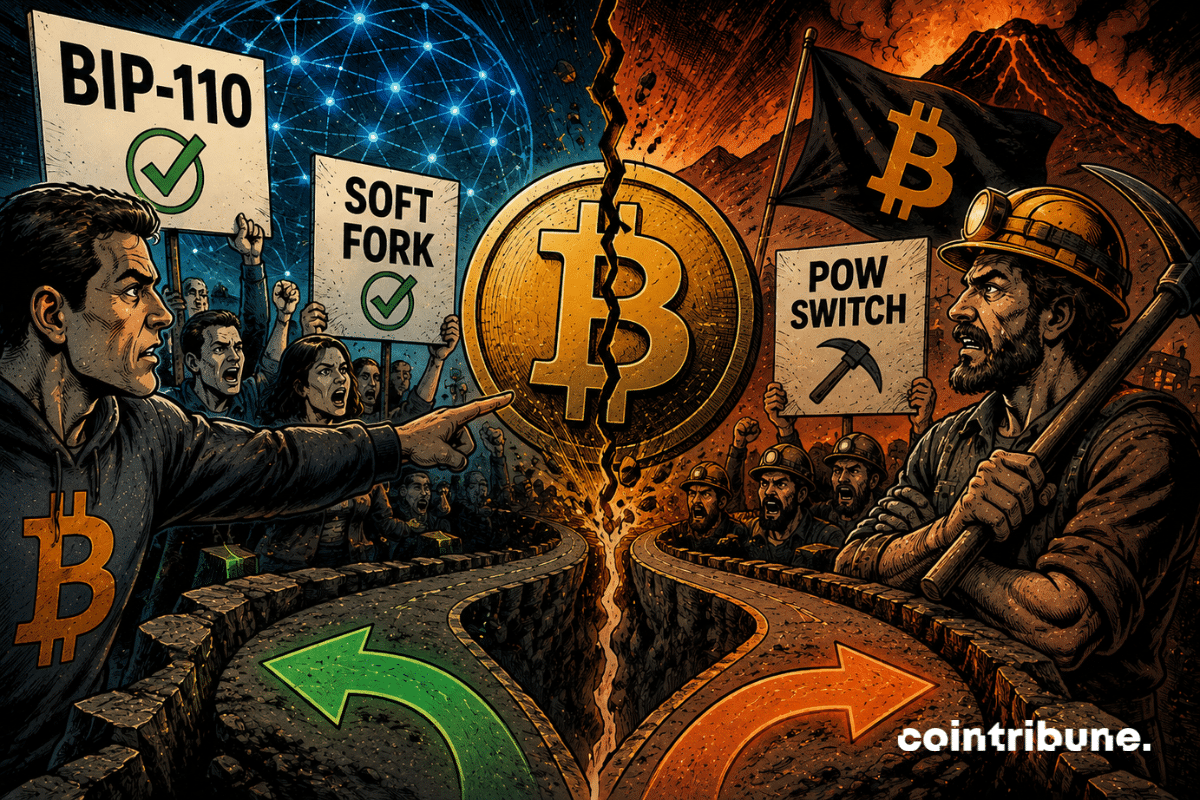
External threats are raining down on Bitcoin, from quantum computers to security vulnerabilities. However, it is from within that the most immediate danger comes. The network is preparing to cross block 961632, triggering a mandatory window for BIP-110. The miners have already chosen their camp. Developers brandish the threat of an algorithm change. The crypto-sphere is holding its breath.
In brief
- Miner support for BIP-110 caps at 2.59%, far from the 55% threshold required for activation.
- Bitcoin Knots developers are threatening to change the proof-of-work algorithm to bypass miner obstruction.
- MARA Pool mined a block with a Pepe image as a provocation against reform supporters.
- Australian exchanges Bitaroo and Hardblock have already published their contingency plans in the event of a network split.
Block 961632: the countdown that makes miners tremble
The weekend promises to be decisive for the bitcoin ecosystem. The mandatory BIP-110 window opens at block 961632, a deadline that revives the old demons of the 2017 wars. This proposalchampioned by the developers of Bitcoin Knots, aims to reduce non-financial data in Bitcoin transactions. Ordinals and other registrations could see their days numbered.
However, the miners do not see it that way. Support peaks at 2.59%, a paltry figure. Only 47 out of 1818 blocks signaled their approval. The 55% threshold seems out of reach, as Michael Saylor pointed out. MARA Pool even mined a block with a Pepe image, a digital middle finger to reform supporters.
“ Really MARA? 3.85 MB of space for that? People use Slipstream for that… », was indignant one user out of.
The large mining pools, Antpool, F2Pool, ViaBTC, maintain a deafening silence. Only a few small pools, like SoV or Roughnecks, show their support. The exchanges are preparing for the worst.
The nuclear option: a change in PoW to counter miners
Faced with obstruction from miners, developers brought out the heavy artillery. Chris Guida has prepared code that would change Bitcoin’s proof of work algorithm. This contingency measure, based on code from Luke Dashjr from 2017, would make current ASICs obsolete on a new chain. A real earthquake for the mining industry.
“ This is just a code to keep on hand in case miners betray Bitcoin, to activate it later “.
Guide to X
Luke Dashjr was more trenchant: “ Core is the scamcoin “. The new chain would have an initial mining difficulty a million times lower, allowing classical computers to participate. The code exists, but no activation date has been set.
Options include SHA-256, SHA-256d, RIPEMD-160, and HASH160. Such a move would create a minority crypto with fragile infrastructure, a prospect that already divides the crypto community.
The Battle for the Soul of Bitcoin: Ordinals versus Pure Transactions
The BIP-110 conflict revives a fundamental question: what should Bitcoin be used for? A network of pure financial transactions or an immutable data repository? Proponents of Ordinals and Runes want to use block space to store images, text, anything that can fit into a transaction.
Defenders of BIP-110 believe that this practice diverts Bitcoin from its original mission. The block mined by MARA Pool with a Pepe image constitutes an explicit provocation.
“ Not on my knot », replies a user, summarizing the position of the reform supporters. Start9 has closed its Lightning channels to protect itself from a possible split. Australian exchanges Bitaroo and Hardblock have already published their contingency plans. “ Does this sound like creating another BCH, BSV, etc? », asks a user, summarizing the ambient concern. Comments on X oscillate between concern, irony and resignation.
Key figures for the BIP-110 deadline
- BTC price at time of writing: $64,901
- Support from minors: 2.59% (47/1818)
- Required threshold: 55% (1109/2016)
- Start block: 961632
- Planned activation block: 965664
The eye of the storm: Bitcoin resists, but existential questions remain
Despite the threat of a split, the price of Bitcoin remains stable around $64,000. Markets appear to be ignoring the conflict or waiting for a clearer signal before reacting. The mandatory window could force miners to position themselves. If the split takes place, users will have to choose between two channels. Some accuse Guida and Dashjr of wanting to create a new “shitcoin”.
Others believe that miners are betraying Bitcoin by refusing to report BIP-110.
Bitcoin governance is at a turning point. Will economic nodes impose their rules on miners? Will miners maintain control of the network? The battle for the soul of Bitcoin has never been more intense. One thing is certain: the outcome of this conflict will redefine the rules of crypto governance for years to come.
The quantum threat looms over Bitcoin, and some analysts are concerned about the network’s strategic lag. As the BIP-110 conflict divides the community, the crypto industry is holding its breath. The split may be inevitable. Bitcoin will survive, but at what cost?
Maximize your Tremplin.io experience with our ‘Read to Earn’ program! For every article you read, earn points and access exclusive rewards. Sign up now and start earning benefits.