
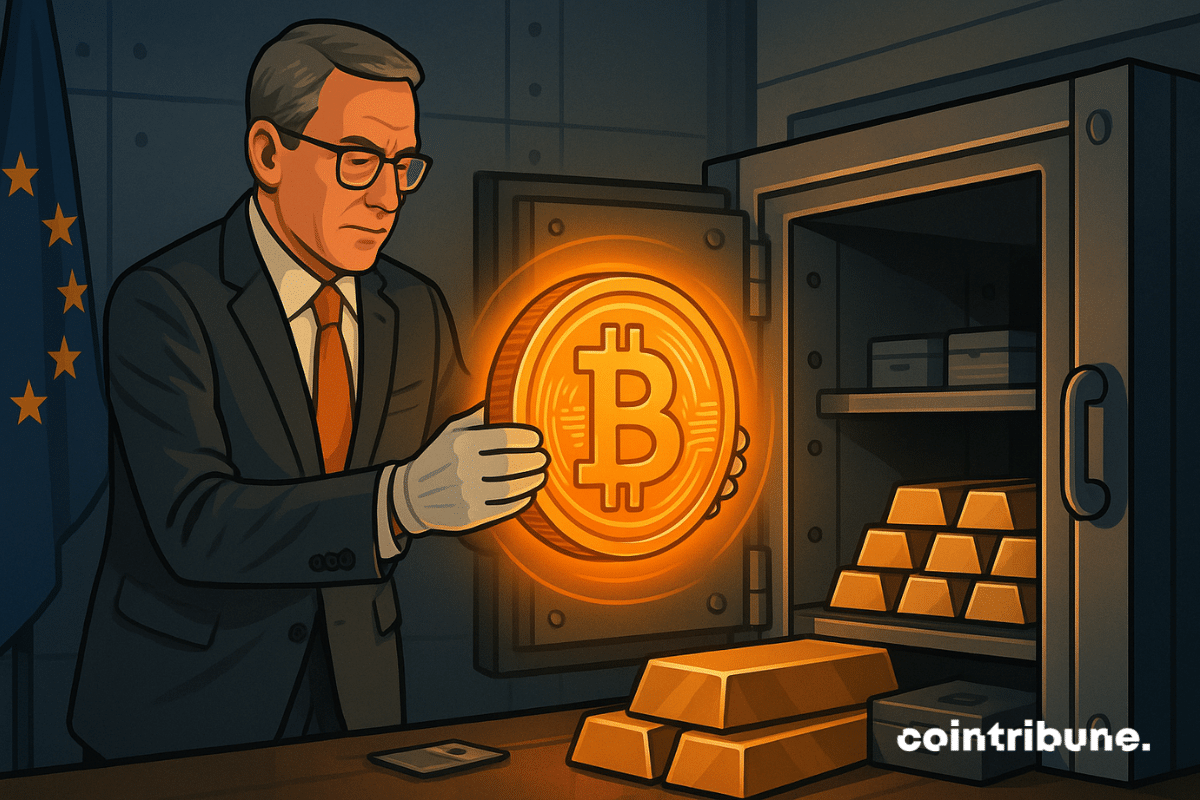
The Czech National Bank has just reached an unprecedented milestone: the purchase of $1 million in crypto, including bitcoin. This is a first for a European central bank, at a time when many institutions remain cautious about cryptos. Behind this symbolic amount, it is a strong declaration of intention, because the country wants to understand and test the future of finance. A discreet gesture, but which could well announce a turning point in monetary policies in the era of these assets.
In brief
- The Czech National Bank makes a historic purchase of $1 million in crypto, including Bitcoin.
- This test aims to gain real-world experience in managing cryptocurrencies, without signaling immediate adoption.
- The experimental wallet includes three types of assets: Bitcoin, a dollar-backed stablecoin, and a tokenized bank deposit.
- This project is part of the CNB Lab, an innovation program dedicated to blockchain and financial technologies.
A first supervised crypto acquisition, cautious but unprecedented
As crypto treasuries evolve, the Czech National Bank (CNB) has formalizedon Thursday, November 7, 2025, the purchase of cryptos for an amount of $1 million as part of a test phase.
The institution specifies that this initiative aims to acquire a “practical experience” in the management of cryptos, without signaling an immediate change in monetary policy. The experimental wallet set up by the CNB includes Bitcoin, a stablecoin backed by the US dollar, and a tokenized bank deposit.
The bank's governor, Aleš Michl, underlines the symbolic and prospective scope of the operation: “it is realistic to imagine that one day, we could buy tokenized Czech bonds or a coffee with a simple digital transaction”. This declaration places this approach within a long-term vision of the evolution of the monetary system.
Such an experiment is part of the broader CNB Lab program, an innovation structure launched by the bank to study the uses of blockchain and other emerging financial technologies. Far from being limited to bitcoin, this initiative aims to equip the central bank to face structural transformations in the sector. Here is precisely what this test wallet contains:
- Bitcoin (BTC): chosen for its diversification potential and its low correlation with traditional assets, notably bonds;
- A stablecoin backed by the US dollar: used to assess stability dynamics in digital exchanges;
- A tokenized bank deposit: integrated to observe the tokenization mechanisms of traditional banking assets.
By setting up this portfolio, the CNB is not seeking to obtain an immediate return, but to prepare for possible international developments, particularly in exchange standards or accounting practices linked to cryptos. Therefore, the understanding of these assets can no longer remain theoretical for a central bank wishing to remain competitive on a global scale.
A broader exhibition strategy, between ambition and restraint
The November crypto initiative does not constitute the CNB's first foray into the world of cryptos. Last January, Aleš Michl proposed the purchase of bitcoin for an amount equivalent to 5% of the bank's international reserves, or approximately $7.3 billion.
This bold proposal, which aimed to diversify reserves due to the zero correlation between bitcoin and bonds, was however not validated by the board of directors of the CNB.
Michl then justified his approach using portfolio logic: “Bitcoin could one day be worth either zero or a colossal sum”. This positioning, both lucid about the risks and open to the potential, illustrates a permanent tension between innovation and prudence within the Czech central bank.
Furthermore, the CNB has also explored a form of indirect exposure to cryptos. In July, it invested in 51,732 shares of Coinbase, the American crypto exchange giant. This investment, valued at $18 million at purchase, amounts to $15.7 million today.
Although these are not cryptos strictly speaking, this investment reflects a desire to integrate into the ecosystem without assuming the direct volatility of the assets. By combining technological approach (via the CNB Lab), direct experimentation (with the purchase of BTC) and indirect exposure (with Coinbase), the CNB is thus building an active monitoring strategy on the sector, without a brutal break with its traditional monetary doctrine.
Through these movements, the Czech National Bank displays a posture that could inspire other central banks in Europe, particularly those of mid-sized countries, more inclined to experimentation, while the ECB has often reaffirmed a critical position with regard to bitcoin. Far from a model of dollarization or adoption of the flagship crypto as legal tender, the Czech case illustrates a pragmatic approach, aiming to anticipate rather than undergo future changes.
Maximize your Tremplin.io experience with our 'Read to Earn' program! For every article you read, earn points and access exclusive rewards. Sign up now and start earning benefits.


