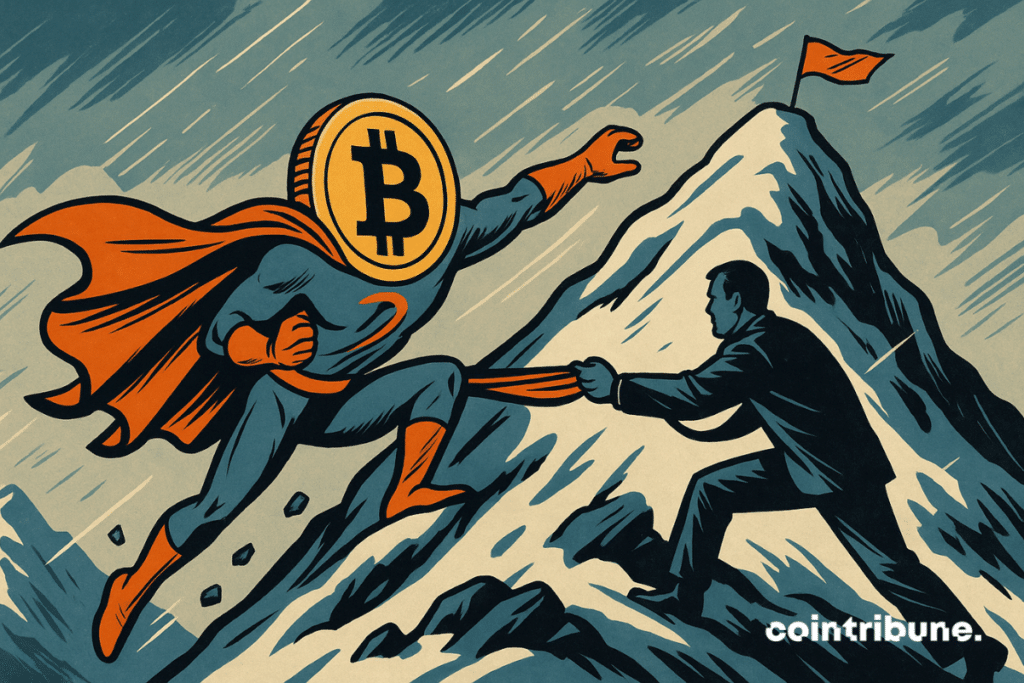
Buoyed by its status as a benchmark in the crypto market, bitcoin faces a crucial question: can it return to the euphoria of last January, when it crossed $109,000 for the first time? Between macroeconomic uncertainties and structural advances, the trajectory of BTC triggers as many expectations as doubts. Is the bull cycle already behind us or simply on pause?
In brief
- Bitcoin is once again gaining attention as January approaches, with the backdrop of memories of its all-time high of $109,000 reached in early 2025.
- 21Shares co-founder Ophelia Snyder believes that such a scenario is unlikely in 2026, due to an unfavorable macroeconomic context.
- Several recent events, including a 10% drop and a $19 billion selloff, are weakening market sentiment.
- Despite this, some analysts remain optimistic in the medium term, banking on the rise of crypto ETFs, the interest of States and the role of Bitcoin as a safe haven.
A repeat of January? Unlikely according to 21Shares
For Ophelia Snyder, co-founder of crypto investment firm 21Shares, investors should be cautious about hopes of a new all-time high for bitcoin as soon as January 2026.
In fact, she declared : “the factors causing the current volatility are unlikely to resolve in the short term”. She specifies that “January performance will depend heavily on general market sentiment”.
Clearly, BTC would be more dependent on macroeconomic dynamics than on its own fundamentals. Snyder insists that the recent decline is not linked to specific crypto elements, but reflects widespread risk aversion in global financial markets.
Snyder's analysis draws on several important facts that affected his trajectory:
- Bitcoin reached a peak of more than $126,000 in early October, before entering a marked decline;
- A massive $19 billion liquidation destabilized the crypto market on October 10, triggering a widespread downward movement;
- Market sentiment remains sluggish, which limits the likelihood of a significant inflow of capital, including via Bitcoin ETFs, traditionally favored at the start of the year;
- Finally, January's portfolio repositionings, although usual, could this time come up against a context of global uncertainty, reducing their impact on prices.
In this context, Snyder tempers expectations around an explosive recovery at the start of next year, believing that current conditions do not lend themselves to a large-scale bullish restart in the short term.
Structural levers for a long-term rebound?
Despite this displayed caution, Ophelia Snyder does not rule out a bullish scenario in the medium or long term, driven by fundamental elements.
“I feel more optimistic, as I see this recent correction as a response to the general climate of risk aversion, rather than internal issues within the crypto industry”she confides.
For her, several catalysts could fuel positive dynamics in the future, such as the expansion of the offer of crypto ETFs on large platforms, or the rise of bitcoin as an alternative safe-haven asset to gold. Added to this is the growing interest of some states in cryptos, which could contribute to increased institutional adoption.
A divergent voice, however, supports the idea of a possible rapid return to the summits. Tom Lee, president of BitMine, estimates that bitcoin will reach a new historic high before the end of January 2026.
This prediction, although isolated, is based on historical observation. Since 2013, bitcoin records on average +3.81% performance during the month of January, according to CoinGlass data. This could be enough to trigger a technical rebound, even if its extent remains uncertain in a still-febrile economic context.
The price of bitcoin remains suspended in a fragile balance between hopes of institutional adoption and economic uncertainties. Without a clear catalyst, the prospect of a new high appears uncertain, despite an improving market infrastructure.
Maximize your Tremplin.io experience with our 'Read to Earn' program! For every article you read, earn points and access exclusive rewards. Sign up now and start earning benefits.