
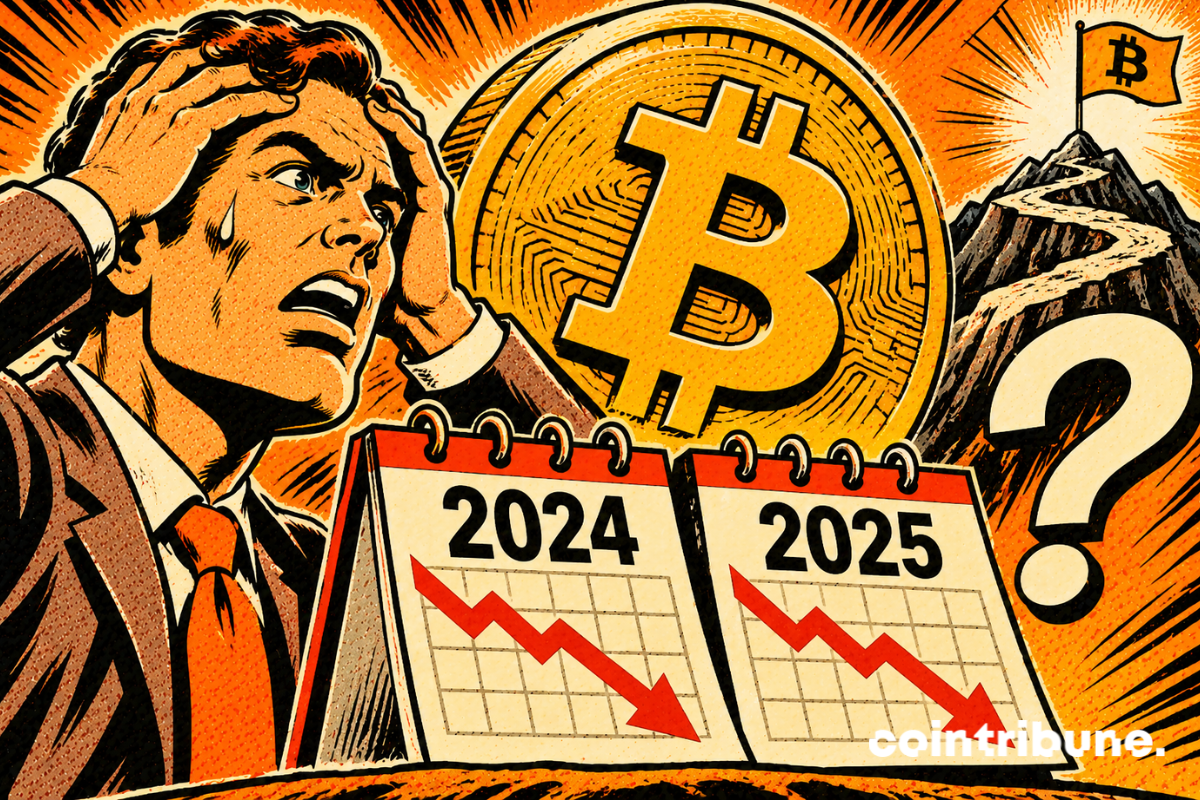
Bitcoin could end 2026 in the red after having already lost 6.34% in 2025, a sequence never observed since its creation. However, this historic first does not mean that the market is going through its worst winter. Above all, it shows that the old four-year cycle is gradually disappearing in favor of a bitcoin more influenced by rates, ETFs and Wall Street.
In brief
- Bitcoin could end 2026 in the red after a drop of 6.34% in 2025, a first in its history.
- To avoid two consecutive years of losses, BTC would need to rebound by around 18.5% before December 31.
- Despite this unprecedented sequence, the cumulative loss remains lower than that of the major crashes of 2018 and 2022.
- This possible double decline calls into question the traditional four-year cycle, historically punctuated by halving.
- ETFs, interest rates and institutional flows now influence the evolution of Bitcoin more.
Two red years would break an 18-year-old rule
Bitcoin is trading around $74,300 on November 11, a drop of around 15.7% since the start of 2026. To avoid a second consecutive negative year, it should return above its annual opening price, close to $87,500.
Such a rebound would require an increase of around 18.5% before December 31. The scenario remains possible given the usual volatility of BTC, but it becomes more difficult as ETFs record withdrawals and markets anticipate a further rise in US rates.
Annual performances put this risk in context:
- 2024 ended with an increase of around 121%;
- 2025 recorded a decline limited to 6.34%;
- 2026 currently shows a decline close to 16%;
- The cumulative loss over the two years reaches around 21%;
- No negative year has so far been followed by another annual decline.
Previous bear markets had always been followed by a rebound before the end of the following year. After its 73.6% collapse in 2018, bitcoin had gained around 92% in 2019. After its 64.3% fall in 2022, it had gained more than 155% in 2023.
A negative close in 2026 would therefore put an end to an alternation which seemed solidly established. It would also weaken the belief that each bearish year for bitcoin automatically prepares for a powerful rally over the following twelve months.
The calendar nevertheless minimizes the violence of the crash
Two red years may seem more alarming than a single sharp decline. However, their cumulative loss of around 21% remains much lower than the collapses recorded in 2018 and 2022.
This annual reading depends above all on an arbitrary border: December 31. It compares the price on two fixed dates without describing the route followed between them.
Bitcoin reached a record near $126,200 in October 2025 before falling below $58,000 during the summer of 2026. Its actual decline from the peak therefore exceeded 50%, while the two annual candles only show a cumulative loss close to 21%.
This difference comes from the fact that the 2025 record was reached during the year. Bitcoin started this year around $93,400 and ended near $87,500. The annual decline appears small, but it masks a drop of more than 30% since the October peak.
The opposite is also true for investors who entered earlier. BTC had increased by more than 120% in 2024. A person who bought at the start of that year would still retain significant capital gains despite the losses in 2025 and 2026.
The number of negative years therefore measures the duration of the weakness, not its severity. A long erosion can produce several red fences without causing destruction as brutal as a collapse concentrated over a few months.
Bitcoin’s four-year cycle loses its compass status
The possible double annual decline above all calls into question the plan built around halving. Historically, the year following the halving of mining rewards has always been positive: 2013, 2017 and 2021 all saw an increase.
The year 2025, which followed the halving of April 2024, broke this sequence by finishing in the red. A further decline in 2026 would confirm that programmed scarcity is no longer enough to organize bitcoin cycles on its own.
The size of the market partly explains this development. An asset worth more than a trillion dollars requires much larger flows to double. Maximum performance has also decreased over the cycles, going from several thousand percent during the first years to 155% in 2023.
ETFs have also brought bitcoin closer to traditional markets. Managers now adjust their exposure based on bond yields, the dollar, technology stocks and Federal Reserve decisions. In 2025, BTC behaved more like a risky assetin parallel with American actions.
This institutionalization can reduce some annual falls through deeper liquidity, without preventing significant corrections from the highs. It turns a once explosive cycle into a potentially longer succession of moderate gains and losses.
The first double annual drop in bitcoin would therefore not prove that the asset has become more fragile. Rather, it would signal that its rhythm has changed. Halving remains a supply factor, but global liquidity and institutional flows now dictate more of the timing.
Maximize your Tremplin.io experience with our ‘Read to Earn’ program! For every article you read, earn points and access exclusive rewards. Sign up now and start earning benefits.


