
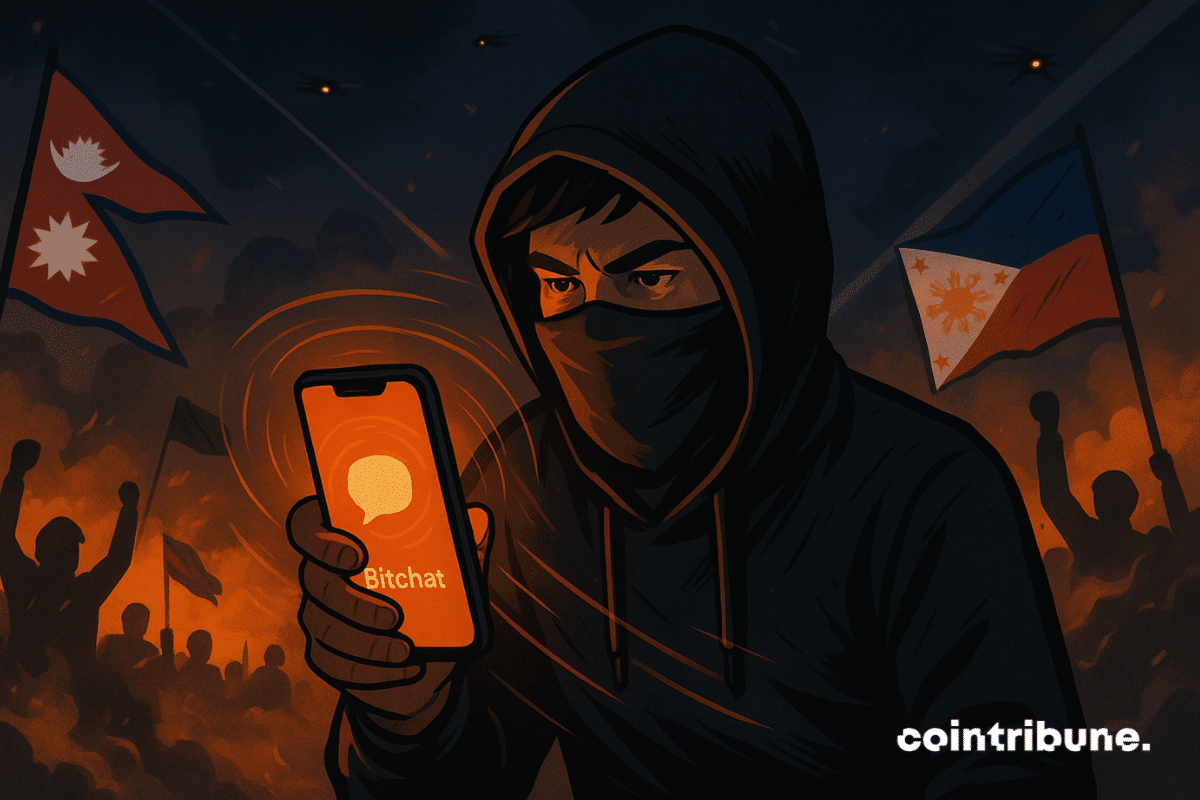
Digital repression reaches its limits. In Nepal as in Indonesia, the censorship of social networks propelled Bitchat, the decentralized application of Jack Dorsey, to the rank of a protest tool. Deprived of traditional platforms, thousands of citizens adopt it massively. Like Bitcoin who upset finance, Bitchat opens a space of free expression, out of the reach of states.
In short
- Bitchat downloads explode in Nepal and Indonesia during the events.
- The ban on social networks transformed the application into a protest tool.
- Bitchat, offline and without account, bypasses censorship and protects communications.
- This adoption illustrates the growing role of decentralized technologies in the fight against authoritarianism.
When repression feeds citizen innovation!
The story has almost become a classic: a government blocks Facebook, Whatsapp or YouTube, thinking of stifling the dispute. But in Nepal, this strategy has produced the opposite effect.
After the prohibition of 26 platforms, Bitchat downloads exploded, from 3,300 to more than 48,000 in just a few days, according to data from the open source developer EBTC. This explosion made the country the world's epicenter of the application, created by Jack Dorsey, co -founder of Twitter.
This dazzling adoption intervenes in a context of major political crisis. The demonstrations against corruption have already left more than thirty dead and forced Prime Minister KP Sharma Oli to resign.
Deprived of its usual networks, the Nepalese youth turned to Bitchat to organize, share information and maintain a voice despite censorship.
In Indonesia, the scenario presents disturbing similarities. During demonstrations against parliamentary allowances deemed abusive, police repression fueled popular anger.
The tragic death of a young VTC driver crystallized the movement. Again, thousands of users have adopted Bitchat, perceived as a credible alternative to the channels monitored and controlled by the State.
Bitchat, the formidable plan B which bypass all censorship
Bitchat is not just a messaging. Thanks to its peer -to -peer architecture, operating offline and without registration, it stands out as a symbol of digital autonomy.
In a context where governments strengthen their censorship and surveillance arsenal, this application illustrates a switch: citizens seek to regain control of their communications.
As explained to Decrypt the expert Christian Ruz, “ Decentralized and censorship -resistant messaging applications will experience an adoption explosion ».
Behind Bitchat is therefore drawn much more than a technological phenomenon: a global movement which links social demands and decentralized innovations. In the same way that Bitcoin has opened a breach in traditional finance, tools like Bitchat today open a free space for public speech and citizen coordination.
These solutions appear to be a real life buoy in societies where the legitimacy of institutions is crumbling. Their boom in Nepal and Indonesia could school in other countries in the South, often marked by recurring political, economic and social crises.
In this sense, Bitchat is now established as a digital weapon in the face of repression. Its success demonstrates that decentralized technologies are not simple gadgets, but powerful political levers and tools of freedom. The application of Jack Dorsey thus joins the growing arsenal of digital resistance instruments, serving a more autonomous and more resilient challenge.
Maximize your Cointribne experience with our 'Read to Earn' program! For each article you read, earn points and access exclusive rewards. Sign up now and start accumulating advantages.


