
OpenAI claims to have used its own AI models to thwart an espionage attempt at its San Francisco premises. According to the US Department of Justice, a company engineer, Abdulrahman Alfozan (35), is accused of having hidden a listening device in a strategic conference room. But beyond the legal case, it is the unprecedented defensive role played by AI which marks a turning point.

In brief
- OpenAI mobilizes its AI models to analyze a device hidden on its premises, trace its origin and identify the suspicious employee.
- The engineer is charged with interception of oral communications and risks up to 5 years in prison and a $250,000 fine.
- OpenAI indicates that it has not detected any exfiltration of its AI source code, model weights or customer data.
AI investigates its own security at OpenAI
The case began around September 30, 2026, when OpenAI teams discovered an audio recording device plugged into the USB port of a television, hidden in toilet paper in a management meeting room. This room regularly hosted highly confidential discussions about OpenAI’s research, AI products, and superintelligence technology.
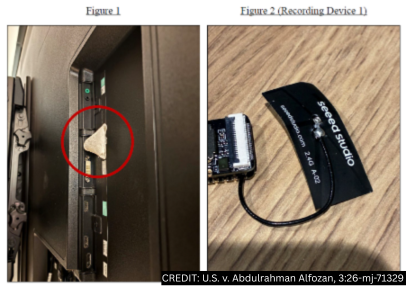
Rather than conducting a purely traditional investigation, OpenAI used its own technology. According to the firm, its AI models were directly used to examine the device, analyze its operation and cross-reference the data in order to trace it back to the person who installed the equipment. An unprecedented demonstration of the capacity of models to serve as a defensive shield against the most complex physical and computer threats.
The mechanics of the investigation: the AI and the FBI on the trail of the accused
The investigation, the technical and material details of which were confirmed by the Justice Department’s complaint, shows how the clues match:
- Before September 28 (the estimated date of installation of the device), the accused had queried a productivity tool for building addresses and meeting room calendars. A chatbot account linked to the engineer had also submitted, from September 24 to 30, specific questions on the manufacture of an audio recorder.
- By cross-referencing OpenAI analysis models and video surveillance images, OpenAI AI targeted the suspect. The engineer, who did not have authorization to access this room, was filmed there on several occasions.
- On October 5, OpenAI security discovered a second similar device in a bag belonging to the accused.
FBI Director Kash Patel highlighted the seriousness of the act in a press release from October 13, 2026:
According to the complaint unsealed today, Abdulrahman Alfozan allegedly hid a clandestine recording device in the conference room of his employer’s management, in order to secretly capture sensitive discussions about the company’s super intelligence technology.
If convicted, the defendant faces a maximum sentence of 5 years in federal prison as well as a fine of up to $250,000, and 3 years of supervised release.
Chronology of a technological thriller at OpenAI
| Date (2026) | Event | Source |
| September 24 – 30 | Queries about making a recorder via chatbot account linked to suspect | Department of Justice |
| Around September 28 | Clandestine installation of the microphone behind the television | Department of Justice |
| Around September 30 | Discovery of the device; OpenAI mobilizes its AI models to analyze the threat | OpenAI / DOJ |
| October 5 | Suspect filmed near TV; second device discovered by security | Department of Justice |
| October 9 | Engineer arrested by FBI | Department of Justice |
| October 13 | OpenAI’s first appearance and statement on the role of its models | OpenAI / DOJ |
The incident proves that the protection of AI models and superintelligence is now elevated to the level of national security. OpenAI wanted to be reassuring. The company says it has detected no signs of inappropriate access or exfiltration of its AI source code, customer data or “model weights” (the fundamental parameters of the system).
This case marks a symbolic milestone for the world of tech. While artificial intelligence is often seen from the perspective of risk or productivity, OpenAI has just proven that it also constitutes a formidable investigation and counter-espionage tool. A first victory for AI in protecting its own secrets.
Maximize your Tremplin.io experience with our ‘Read to Earn’ program! For every article you read, earn points and access exclusive rewards. Sign up now and start earning benefits.