What if your smartphone became a global computing node? This is the bet of Acurast, a Swiss startup which challenges the cloud giants with a decentralized network relying on phones, and not on servers. Based in Zug, the young company announces a fundraising of 11 million dollars in the run-up to the launch of its Genesis Mainnet, scheduled for November 17. Its objective is to build a verifiable, confidential and distributed computing infrastructure, ready to disrupt the digital economy and the foundations of Web3.
In brief
- Acurast raises $11 million to launch a decentralized computing network based on smartphones.
- The Genesis Mainnet will launch on November 17, accompanied by the deployment of the native token $ACU.
- The goal is to transform inactive phones into verifiable computing nodes, without going through data centers.
- The Acurast testnet already shows more than 146,000 phones connected and nearly 490 million transactions processed.
Strategic fundraising and the deployment of an ambitious mainnet
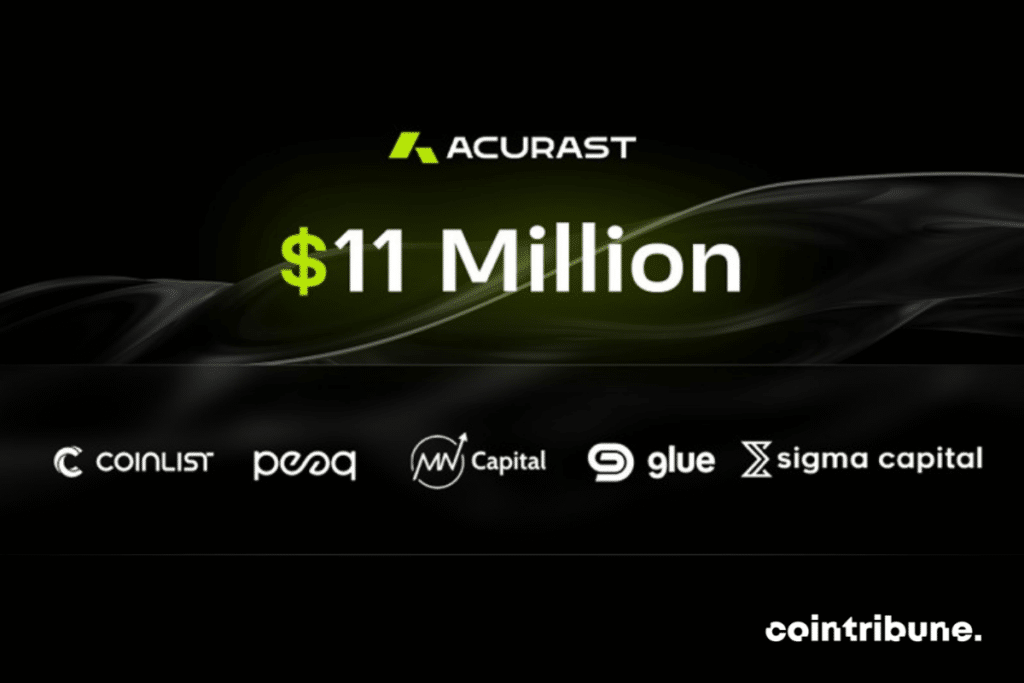
While Microsoft and OpenAI sealed a surprise deal, Acurast announced that it had raised a total of $11 million, a sum raised over several rounds between 2023 and 2025, combining non-dilutive grants and token sales. Among these financings is a public sale on CoinList last May, which raised $5.4 million.
This operation was widely subscribed, a clear signal of market interest. On this occasion, Acurast attracted major figures from the crypto ecosystem: Dr. Gavin Wood (co-founder of Ethereum, founder of Polkadot), Leonard Dörlochter (founder of peaq), and Michael van de Poppe (founder of MN Capital), among others.
“Acurast is creating a new user-owned layer of computing, perfectly aligned with the evolution of AI”underlined Vineet Budki, CEO of Sigma Capital, one of the investors in the project.
The launch of the Genesis Mainnet, scheduled for November 17, constitutes a structuring step in the project's strategy. It will mark the opening of the network to the public as well as the deployment of the native $ACU token. Alessandro De Carli, founder of Acurast, insists on the scope of this step: “the mainnet marks the moment when Acurast becomes a truly open, global computing fabric, ready to integrate into the real world”. Through this launch, Acurast intends:
- Transform billions of smartphones into decentralized computing nodes, without the use of data centers;
- Reduce infrastructure costs through the use of existing and widely available hardware;
- Remove intermediaries in access to computing power;
- Providing secure and confidential execution on a global scale, accessible to everyone.
By making this pivot, the project wants to make the smartphone the basic unit of a new layer of IT infrastructure, accessible, resilient, and verifiable.
Solid numbers and notable pre-mainnet adoption
Beyond the fundraising, it is above all the technical traction of Acurast which calls out. Even before the mainnet launched, the team deployed an incentivized testnet that proved its ability to operate at scale.
To date, more than 146,443 smartphones have been registered to provide computing power. Developers have completed more than 85,784 deployments, the network has processed more than 489 million on-chain transactions, and 179,000 accounts have been created. This rise has been supported by community initiatives such as Cloud Rebellion, a program rewarding early contributors while extending the network's reach.
Acurast's architecture is based on precise technical mechanisms. Task execution takes place in secure enclaves, where even the owner of the device cannot access the on-chain data.
Unlike other compute platforms that rely on self-reported server specifications, Acurast performs cryptographic verification of the hardware, ensuring a high level of confidentiality and integrity. This positioning makes it possible to target dApp developers, but also companies looking for censorship-resistant backends, for sensitive use cases such as automation, AI, web crawling or even resilience testing.
With its smartphone-based model, Acurast is charting a new path for Web3 infrastructure. By combining verifiability, confidentiality and large-scale distribution, the startup opens the door to a more resilient, decentralized and accessible ecosystem, where each user becomes an actor in global computing power.
Maximize your Tremplin.io experience with our 'Read to Earn' program! For every article you read, earn points and access exclusive rewards. Sign up now and start earning benefits.