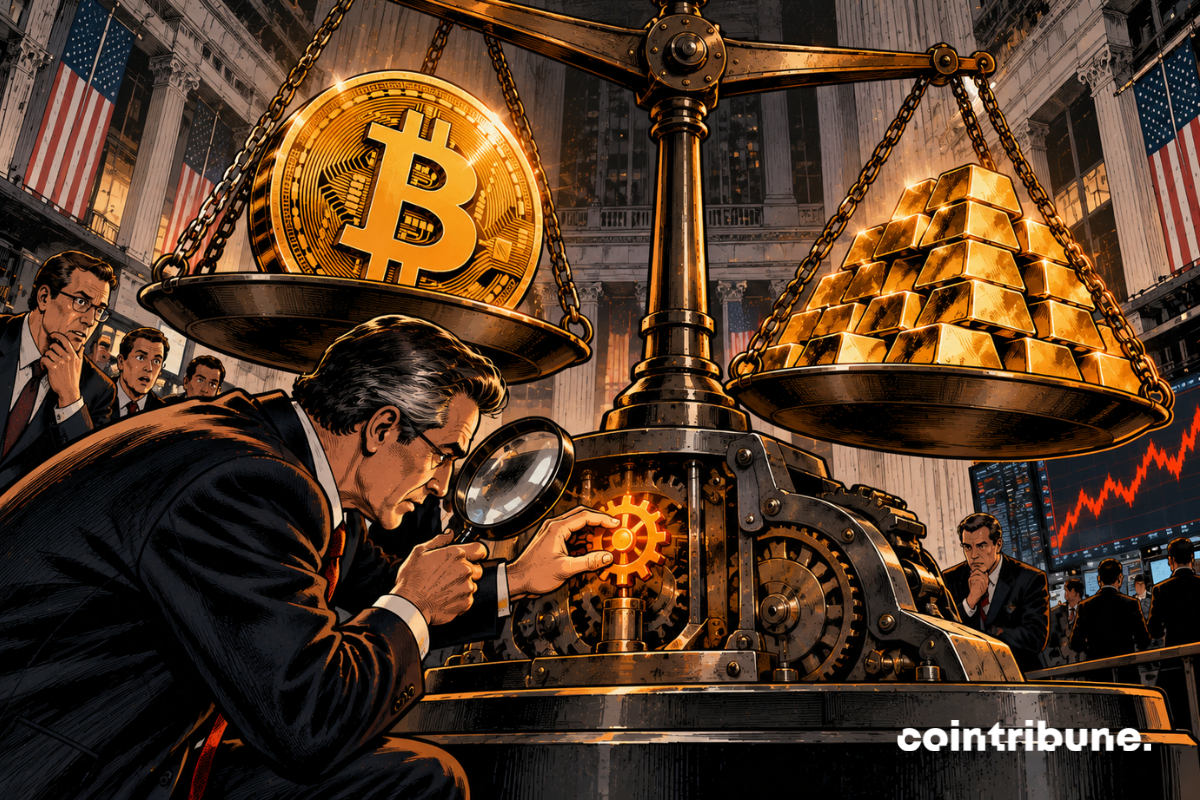
The market would have an unexpected paradox in store for bitcoin. Indeed, the mistrust that still surrounds it would become a supporting factor if investors reduce their hedging. In a note, JPMorgan analysts led by Nikolaos Panigirtzoglou compared bitcoin’s recent momentum to that of gold. Their reading is based on three elements: flows to ETFs, institutional positioning on futures markets and the level of coverage around the main listed funds. Gold therefore appears more advanced in its recovery, while bitcoin retains more potential to catch up.
In brief
- Gold ETFs have erased their 2026 outflows, while Bitcoin ETFs have only recovered about half of them.
- Bitcoin remains more shorted and hedged than gold, according to JPMorgan analysis.
- IBIT’s short interest remains close to its annual high, while that of GLD is moving below its historical average.
- JPMorgan believes this caution could support Bitcoin if demand for hedging wanes.
- The scenario remains conditional and depends on the evolution of investors’ positioning and the market context.
ETF Flows Show Gold Advantage
Following the Federal Reserve meeting at the end of July, ETFs backed by bitcoin and gold received inflows, accompanying the return of “debasing trade”according to JPMorgan. Such momentum ran out of steam during the week preceding the publication of this note. Analysts link the decline to rising inflation-adjusted mandatory yields and the Senate’s failure to advance the CLARITY Act.
This gap appears in the flow recovery. Gold ETFs have offset all of the outflows recorded earlier this year. When it comes to Bitcoin ETFs, they have only recovered almost half of that. Also, JPMorgan notes a recent decline in demand for Bitcoin ETFs.
The analysts think that this delay leaves more room for a recovery if the flow becomes more favorable. At this stage, gold therefore shows a more complete recovery, while bitcoin remains more dependent on a change in sentiment.
Three elements summarize the gap observed by JPMorgan between the two markets:
- Gold ETFs have recovered all of their outflows recorded earlier in 2026;
- Bitcoin ETFs have only recovered about half of that;
- Recent demand for Bitcoin ETFs has weakened again.
Positioning on IBIT reveals greater caution
This picture changes as soon as we look at the futures markets and short positions. JPMorgan specifies that futures positioning remains high for both bitcoin and gold, which reveals institutional support for both assets.
The clearest difference is at the ETF level. Thus, the short interest of BlackRock’s iShares Bitcoin Trust, IBIT, remains close to its highest level of the year, while that of SPDR Gold Shares, GLD, is progressing below its historical average.
JPMorgan therefore describes “an initial positioning that is more skeptical than on gold”which he links to higher hedging demand around bitcoin. The put/call open interest ratio is also higher for IBIT than for GLD.
These statistics consolidate the idea of a more defensive market against bitcoin, despite recent entries into ETFs and the accumulation of positions in futures. Caution is therefore more visible on bitcoin than on gold.
The reduction in coverage could change the balance of power
It is this difference that fuels the scenario put forward by JPMorgan. Analysts write that the higher short interest on IBIT compared to GLD “could strengthen bitcoin’s appeal relative to gold from here, if demand for hedging weakens”.
The wording remains conditional. Thus, the reasoning does not consist of announcing that bitcoin will outperform gold, but of identifying a market mechanism. If investors reduce their protections, the pullback of some defensive positions could offer more support to BTC.
Analysts also indicate that other factors can influence the respective trajectories of bitcoin and gold. Above all, their comparison is about positioning. Gold arrives with ETF flows already restored and a relatively contained level of short interest. However, bitcoin retains more short positions and stronger hedging demand. This asymmetry can become an advantage if it is resolved.
JPMorgan’s reading remains nuanced. Thus, bitcoin is still lagging behind in recovering ETF flows compared to gold, but this delay is accompanied by a more skeptical positioning which could, under certain conditions, turn in its favor. Everything will depend on the evolution of the demand for coverage and the market context. The potential identified by the bank has less to do with directional conviction than with the possibility of catching up if current caution begins to relax.
Maximize your Tremplin.io experience with our ‘Read to Earn’ program! For every article you read, earn points and access exclusive rewards. Sign up now and start earning benefits.