
According to data published by CryptoQuant, Ethereum reserves on crypto exchanges reached their multi-year low on September 8, 2026. These platforms now only hold 14.88 million ETH. This tightening coincides with a staking record of 35.91% as well as sustained ETF flows. Enough to feed the hopes of a price rise! Decryption.

In brief
- Crypto exchange reserves fall to 14.88 million ETH, a multi-year low.
- Around 6.42 million ETH have left exchanges since July 2025.
- Staking now locks up 43.1 million ETH, or 35.91% of the supply.
- However, sales of intermediate portfolios slow down the scenario of a supply shock.
Why are Ethereum reserves on crypto exchanges reaching a multi-year low?
After a 9-year low reported in February 2025, the quantity of Ethereum held directly on crypto platform wallets peaked at 21,301,177.2 ETH on 1er July 2025. In fourteen months, nearly 6.42 million ETH have left the exchanges. These were removed to:
- personal wallets;
- institutional care solutions;
- staking contracts.
On Binance, the trend is clearly confirmed. THE ETH reserves there fell to approximately 3.74 million tokens. This is their lowest level in three months.
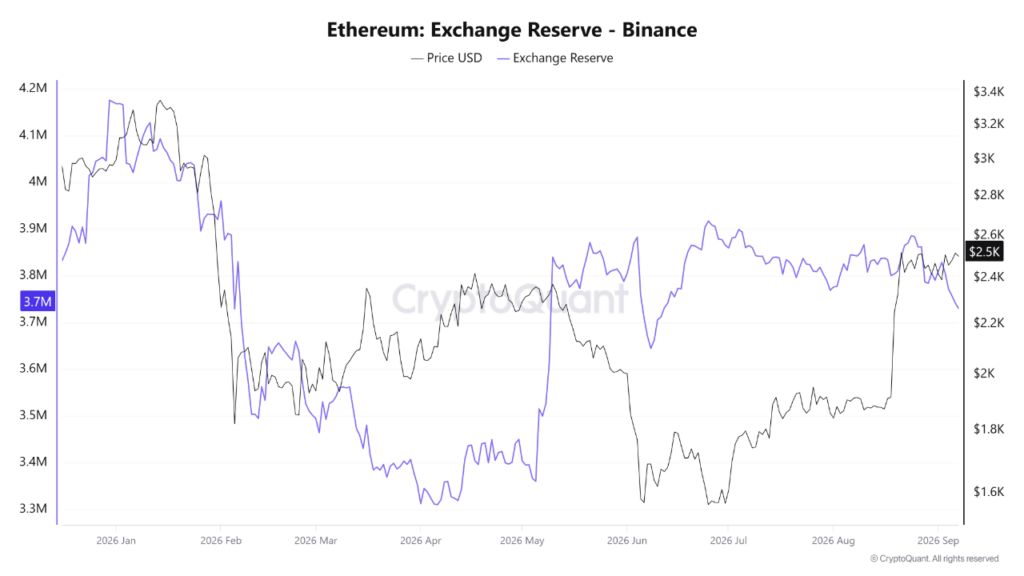
Historical data also confirms the scale of the phenomenon:
- At the peak recorded in 2021, crypto exchanges held more than 33 million Ethereum. The offer available on the platforms has therefore been divided by more than two in the space of five years.
- In January 2026, reserves stood at almost 16.2 million ETH before fall below the 15 million mark at the end of April.
- On July 23, 2026, Ethereum reserves on CEX stood at 15.1 million ETH.
Crypto: Ethereum staking breaks record at 35.91% of circulating supply
Always according to CryptoQuantapproximately 43.1 million ETH was staked on September 8, 2026. This represents approximately 35.91% of the total circulating supply. This level constitutes an absolute record for the crypto network. The fact is that it far exceeds the threshold of 32% reached at the end of May 2026, which already represented a historic peak at the time. This proves that the long-term accumulation dynamic has never really reversed since the launch of staking on Ethereum.
This data is of particular importance insofar as the progression of the staking rate has been done in fits and starts since 2021 with notable milestones:
- around 30% at the turn of 2026;
- 32% in May;
- now almost 36% in September.
Each level crossed mechanically withdraws an increasing part of the supply of liquid circulation. Enough to strengthen the thesis of a structurally rarer digital asset on the crypto market.
Ethereum ETF flows add another piece to the puzzle
According to SoSoValue metricsEthereum spot Us ETFs recorded approximately $2.345 billion in net inflows since July 1, 2026. Which brings their assets under management to $15.57 billion.
Last week, net inflows into Ethereum ETFs fell to $218.4 million (from $824 million the previous week). This reflects a clear slowdown in institutional demand in the short term.
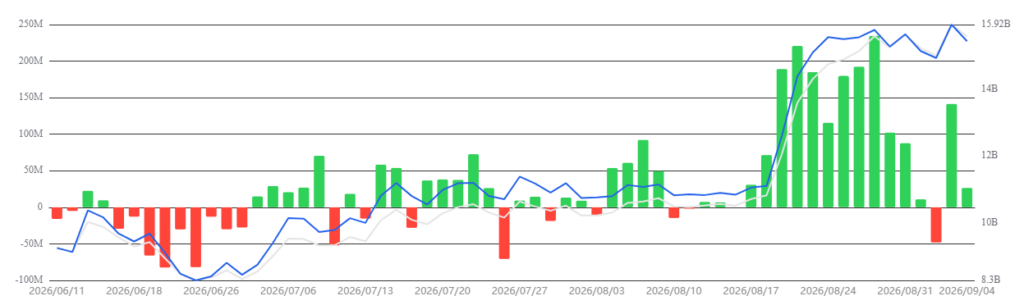
THE behavior of different onchain investor profiles confirms this contrasting climate.
- Crypto whales continue to accumulate, but at a slower pace: +82,000 ETH over the week.
- Conversely, retail investors take their profits: wallets of 1,000 to 10,000 ETH distributed 214,000 ETH, and those of 100 to 1,000 ETH gave away an additional 93,000 ETH.
These represent a combined retail distribution of 307,000 ETH over the week, according to CryptoQuant data.
Towards a supply squeeze for ETH crypto? Key scenarios and levels to watch
This Tuesday, September 8, the ETH price is moving around $2,470. This crypto asset is down around 1% over the last 24 hours, but an increase of 1.96% over a seven-day period.
On the technical side, Ethereum is trading above its 20, 50, 100, and 200 period exponential moving averages. Crypto experts generally interpret this signal as bullish in the medium term. Immediate resistance lies at $2,544, followed by $2,626 and then $2,786. In terms of support, the first level is at $2,431, reinforced by the 20 EMA at $2,385, then by the 50 EMA at $2,192 and the 200 EMA at $2,183.
Crypto analyst Ali Martinez offers an interesting prediction based on URPD (UTXO Realized Price Distribution). This onchain indicator identifies areas where investor acquisition costs are concentrated. According to him, Ethereum is based on a major support zone around $2,475. Around 2.86 million ETH have previously changed ownership there. The real resistance lies between $2,723 and $2,822. This corresponds to an area in which over 10 million ETH have been traded. As long as the support holds, the scenario of a return to $2,723 therefore remains relevant.
In any case, Ethereum is entering a decisive phase. Will the reduction in available supply really be enough to confirm the upward pressure on the price of ETH? The answer in the coming months. File to follow…
Maximize your Tremplin.io experience with our ‘Read to Earn’ program! For every article you read, earn points and access exclusive rewards. Sign up now and start earning benefits.