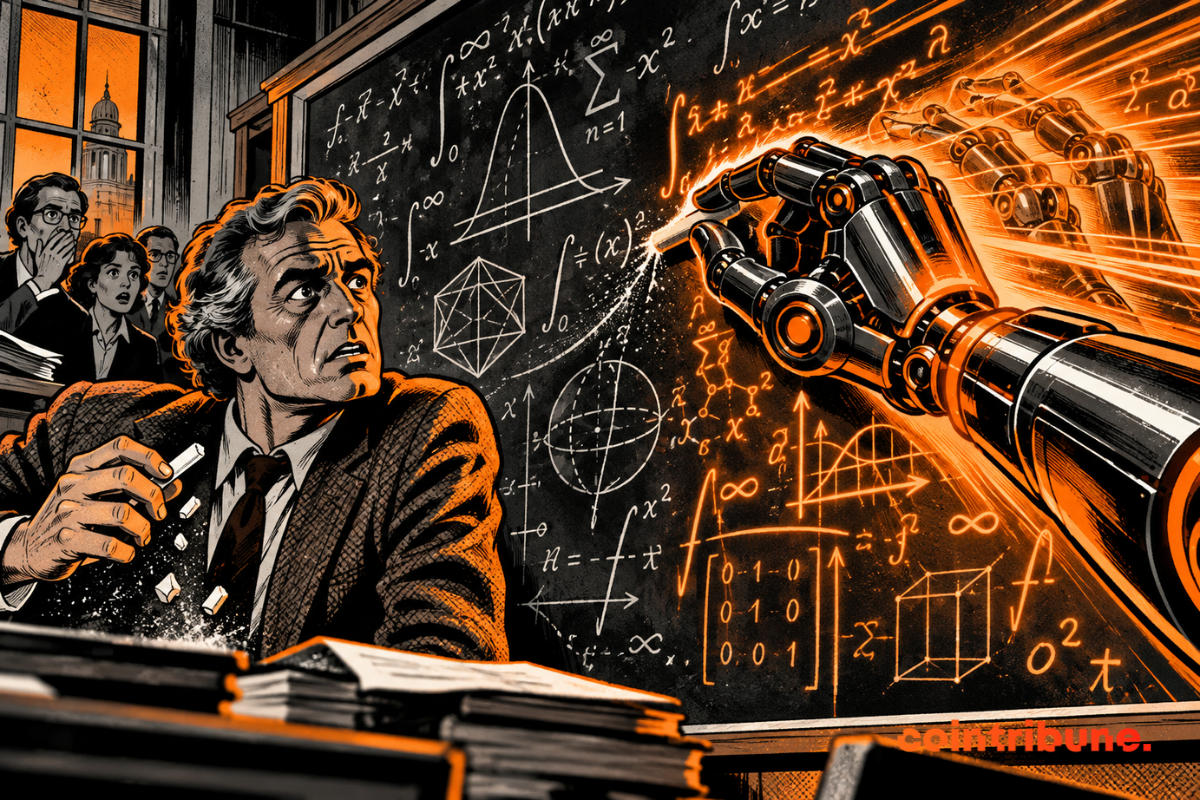
Terence Tao, professor at UCLA and winner of the Fields Medal in 2006, published a warning on September 8, 2026 on the Mathstodon network that went around the academic community. According to him, AI no longer just assists researchers. It threatens the very essence of human understanding and fundamental research. And for good reason, artificial intelligence is drying up the pool of “good open problems”. It is these unresolved questions that truly advance a scientific field.
In brief
- AI solves age-old problems in days, compared to years for humans.
- Terence Tao warns: AI is exhausting “good questions” in mathematics.
- Mathematicians fear a devaluation of their role and their discoveries.
- The community is calling for new rules for the use of AI in research.
AI solves age-old problems in record time
Since May 2026, announcements related to artificial intelligence follow one another at a frantic pace. OpenAI first invalidated Erdős’ conjecture on unit distances, a problem open since 1946. A few weeks later, the same AI company claims to have solved one of the seven “millennium problems” from the Clay Mathematics Institute: the existence and regularity of solutions to the Navier-Stokes equations. These describe the movement of fluids.
According to Tristan Buckmaster, a mathematician behind a promising approach, OpenAI’s AI would have completed in a weekend what he and his colleague Levent Alpöge (an employee of Anthropic) had been trying to finalize for months.
That’s not all! In August 2026, OpenAI also released ten new major mathematical and computer results obtained with its Astra model. These cover:
- geometry;
- cryptography;
- code theory.
For its part, Anthropic used Claude to formalize the proof of Fermat’s last theorem in just 11 days. This AI company has just announced an imminent IPO.
Terence Tao: AI exhausts “good questions” in mathematics
In a post published on MathstodonTerence Tao, considered the best mathematician alive, issues an unequivocal warning. According to him, the real danger is not that AI solves problemsbut it does it too quickly before the community has been able to learn all the lessons.
He wrote:
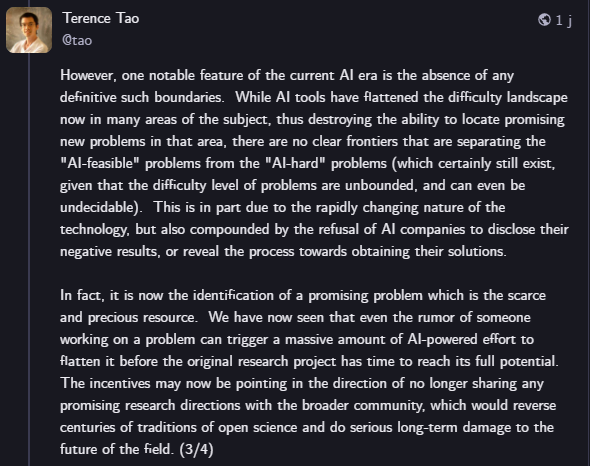
Indiscriminate use of powerful solution extraction tools can achieve the immediate goal of solving problems, but at the cost of supporting the ecosystem for the next wave of progress.
For Tao, the value of a mathematical problem lies as much in its solution as in the path taken to get there. In fact, this process makes it possible to:
- discover new methods
- find new connections between domains
- (sometimes) rephrase the question itself.
With AI, however, this path is short-circuited. In this sense, Tao warns:
We have now seen that even the rumor that someone is working on a problem can trigger a massive amount of AI-powered effort to flatten it before the original research project has time to reach its full potential.
Decryption: AI transforms mathematics from a discipline of “scarcity of evidence” into a discipline of “abundance of evidence”. What threatens to devalue human labor.
Mathematicians facing an identity crisis with AI?
Beyond Tao’s declarations, the entire profession is questioning itself. “If the main purpose of mathematics is to prove theorems, it becomes easy to ask: now that machines seem to be able to do this almost at will, what good are we for? », asks Henry Yuen, mathematician at Columbia University in an interview given to The Telegraph.
In June 2026, more than 3,000 mathematicians have signed the Leiden Declaration. This document calls for:
- responsible use of AI;
- rigorous verification of results;
- proper citation of human and artificial contributions.
For his part, Terence Tao suggests an idea: classify certain problems as requiring analysis. This means that a raw answer (especially that provided by artificial intelligence) only counts if it is accompanied by understandable and informative reasoning.
What future for mathematics in the age of AI?
Some see AI as a productivity tool. The point is that it frees humans from tedious tasks, allowing them to focus on formulating new questions. Others, however, fear an industrialization of proof. According to them, intellectual value could therefore be erased in favor of speed.
Both nevertheless agree on one point: the rules must change. The Leiden Declaration thus insists on transparency and recognition of contributions. But how can we apply these principles in a race where AI models are not public and evidence is generated within hours?
In any case, AI has reached a milestone in mathematics. The ball is now in the community’s court: define new rules so that artificial intelligence remains a tool and not a replacement.
Maximize your Tremplin.io experience with our ‘Read to Earn’ program! For every article you read, earn points and access exclusive rewards. Sign up now and start earning benefits.