
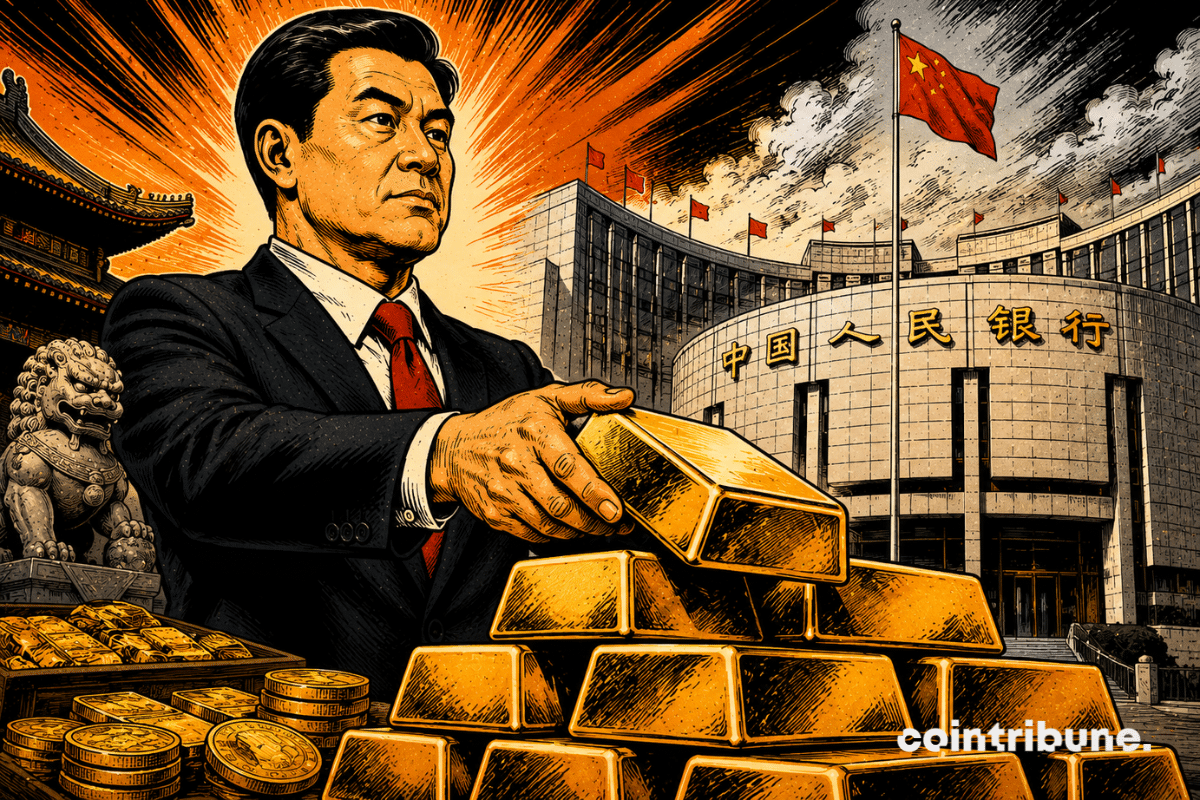
While the crypto market struggles to find a clear direction, China is discreetly accelerating its strategy on a completely different terrain. The People’s Bank of China (PBOC) has just once again increased its gold reserves, confirming an accumulation policy pursued for several months. This choice reflects Beijing’s desire to strengthen its financial autonomy in an environment marked by geopolitical tensions, monetary uncertainties and the questioning of the world economic order.
In brief
- The People’s Bank of China acquired 640,000 ounces of gold in July (~20 tonnes), its largest monthly increase since October 2023.
- This movement marks the 21st consecutive month of accumulation, bringing Chinese reserves to more than 76 million ounces ($306 billion).
- Beijing is repatriating part of its stocks from London to Hong Kong to free itself from Western networks and create an Asian listing hub.
- International financial institutions purchased 289 tonnes of gold in Q2 (+74% year-on-year), propelling the price of the metal to $4,342/oz (+8% year-on-year).
The increase in gold reserves of the People’s Bank of China and the logistical pivot to Hong Kong
The People’s Bank of China made its largest monthly purchase of gold in almost three years in July, thus consolidating an uninterrupted accumulation trajectory through key figures:
- A record volume of purchases: according to data published by The Kobeissi Letterthe Chinese monetary institution integrated approximately 640,000 troy ounces of gold into its balance sheets during the month of July alone (or almost 20 metric tons), constituting its largest individual acquisition since October 2023;
- An extended historical series: this operation marks the 21stth consecutive month of accumulation by the Chinese central bank, bringing its official reserves from less than 75.5 million ounces at the end of June to more than 76 million ounces at the end of July;
- A colossal valuation: at current market prices, the overall value of the stock of gold held by the Chinese state now exceeds the threshold of 306 billion dollars.
Beyond the gross volume of bullion absorbed, it is the pace of acceleration of Beijing’s interventions in this market which is attracting the attention of financial analysts. After recording a relatively modest addition of 160,000 ounces in March, China’s central bank gradually ramped up its order volume over the following months, reaching 480,000 ounces in June before setting the July high.
In parallel with this quantitative strengthening, the Chinese government is carrying out a major geographical and strategic reorganization of its assets by transferring a substantial fraction of its historical gold reserves kept in London to the territory of Hong Kong. Commenting directly on this infrastructural migration, analysts at The Kobeissi Letter clarified: “the transfer is expected to continue as Hong Kong launches a new gold clearing system, aiming to make the city a major hub for trading and setting global gold prices.” This approach aims to gradually free the country from Western custody networks while consolidating the operational autonomy of the Asian financial center.
Global institutional pressure and divergent market trajectories
The activism of the People’s Bank of China is part of a general buying trend that encompasses all issuing institutions on an international scale. Thus, data compiled by the World Gold Council reveals that global central banks accumulated a record volume of 289 tonnes of gold during the second quarter, which represents a net increase of 74% compared to volumes recorded over the same period the previous year.
This massive institutional demand served as a catalyst for the recovery in the price of the precious metal, interrupting a brutal correction phase which had seen the ounce fall from its historic high of $5,600 to a low point below $4,000. Following this wave of state purchases, the price of gold rebounded by 8% in the space of a week to settle at $4,342 per ounce.
This buying impulse allowed physical gold to neutralize all of its annual losses and return to its equilibrium level since the start of the financial year. Indeed, this recovery trajectory contrasts sharply with the performance observed in the crypto market during the same period. Bitcoin continues to struggle to stay around the $65,000 threshold, recording a drop of more than 25% since the start of the year. This significant valuation gap illustrates the marked preference of large institutional investors and governments for material assets devoid of counterparty risk in a climate of macroeconomic uncertainty.
Regulatory lock-in of cryptos and strategic perspectives for the ecosystem
Alongside this massive hoarding of precious metals, the Chinese authorities maintain extremely strict supervision over the digital currency ecosystem. Earlier this year, Beijing again tightened its regulatory restrictions, confirming that any commercial activity related to virtual assets remains formally illegal across the mainland. This administrative control has expanded into expanding segments, including increased oversight of stablecoins and real-world asset tokenization projects (RWA). Such a firm policy demonstrates the desire of the central state to prohibit channels of escape of non-sovereign capital while channeling liquidity towards instruments under direct state control.
The confrontation between institutionally backed physical gold and decentralized cryptos highlights divergent visions of the modern store of value. As China builds an alternative clearing hub in Hong Kong to strengthen its financial independence, the crypto sector faces increased demands for compliance and transparency. The direction taken by central banks indicates that the search for sovereignty takes precedence over decentralized innovations in the short term.
In short, the record accumulation of gold by the People’s Bank of China and the strengthening of financial structures in Hong Kong mark a key stage in the reconfiguration of global monetary balances. The regulatory rigor applied to cryptos reminds us that States favor absolute control of their reserves in the face of geopolitical uncertainties. For bitcoin and cryptos, the challenge will be to prove their structuring usefulness and their maturity in the face of a yellow metal that retains the full confidence of international institutions.
Maximize your Tremplin.io experience with our ‘Read to Earn’ program! For every article you read, earn points and access exclusive rewards. Sign up now and start earning benefits.


