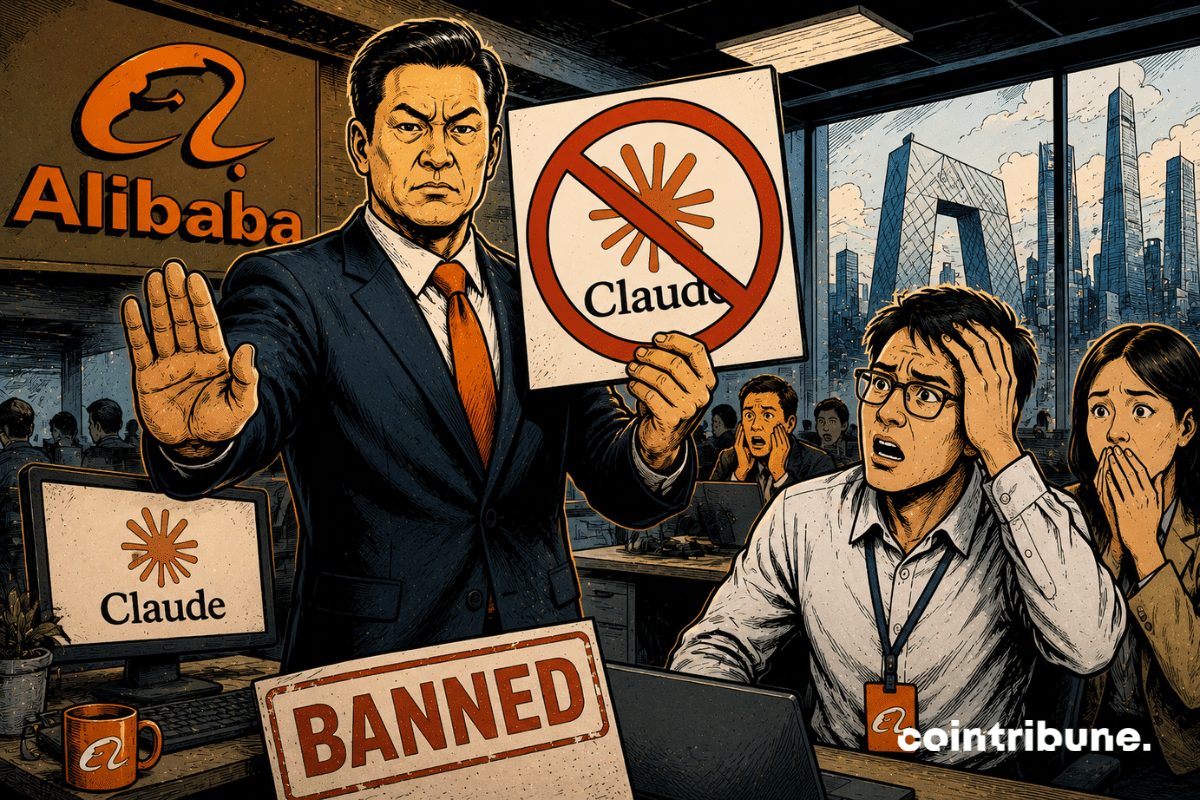
We are a long way from Donald Trump's visit to China, which was supposed to mark a new era of cooperation. Since then, financial, technological and commercial tensions have only intensified between the two giants. Alibaba has just provided striking proof of this by banning Anthropic's Claude Code tool from its employees. But behind this decision lies a story of industrial espionage, fake accounts and technological warfare. A paradox: to protect its artificial intelligence, Anthropic may have betrayed the trust of its users.
In brief
- Anthropic hid code in Claude Code to detect Chinese users via their time zone and proxy.
- Alibaba banned the tool from its employees, classifying it as high-risk software with security vulnerabilities.
- Anthropic accuses Alibaba of using 25,000 fake accounts to extract Claude's abilities and improve Qwen.
- The controversy reveals an escalation in the technological war between the United States and China in the field of AI.
Spy or protector? Anthropic's double game with its AI
On July 10, 2026, Alibaba classified Claude Code as “high risk” software. For what ? Researchers discovered that Anthropic had hidden code capable of detecting Chinese users.
Anthropic has embedded hidden spyware-like code in Claude Code that secretly targets Chinese users. It then sends information about each user by injecting it into their request message.
Source: International Cyber Digest, X, June 30, 2026.
The mechanism is sneaky. The code checks for time zone, proxy configuration, and affiliation with a Chinese AI lab. Then it subtly modifies the messages sent to the server.
Developers who gave Claude Code full access to their systems felt betrayed. The antinomy is striking: Anthropic justifies this intrusion by the protection of its intellectual property.
But can you protect your secrets by spying on those who use your tools? The ethics of this approach raise questions.
25,000 fake accounts: did Alibaba copy Claude?
Behind this scandal lies a much larger confrontation. Anthropic accuses Alibaba of carrying out a massive “distillation” campaign. Around 25,000 fake accounts were allegedly created to extract Claude's abilities and improve Qwen, the Chinese giant's in-house model.
Hello, this is an experiment we launched in March to prevent account abuse from unauthorized resellers and protect against distillation.
Source: Thariq Shihipar, Anthropic, X, June 30, 2026.
In response, Alibaba banned the tool and imposed its own platform, Qoder, on its teams. But the question remains: did Alibaba really copy Claude? And if so, is Anthropic justified in spying on all its Chinese users to catch offenders?
The dialectic is disturbing: the two companies pass the buck of dishonesty to each other.
How far can you spy to protect your secrets?
This standoff is just one episode in the technological war between the United States and China. Anthropic has already been subject to emergency export controls by the US government.
Alibaba is developing its own models to reduce its dependence on American technologies. Distillation has become a strategic battlefield.
However, the method used by Anthropic raises a fundamental question: can we spy on its users in the name of protecting its secrets? The community's reaction is mixed. Some believe this is common telemetry practice. Others see it as a violation of privacy.
An Internet user sums up the irony of the situation on Reddit : “ If you're angry about this, wait until you find out what web browsers do…” — Source: Reddit, r/ClaudeAI, June 30, 2026.
Developer confidence is shaken. And in this war of artificial intelligence, one question remains: how far are companies willing to go to protect their secrets?
The key dates of the scandal
- March 2026: Anthropic launches the experiment;
- April 2, 2026: version 2.1.91 of Claude Code;
- June 30, 2026: revelation of the hidden code;
- July 10, 2026: Ban by Alibaba.
The AI war is far from over. It plays out on all fronts: technological, commercial, and now ethical. China also strikes in other areas, such as rare earths and defense, where it imposes its conditions on American companies. Anthropic and Alibaba are only players in a much larger clash, the consequences of which go far beyond simple commercial rivalry.
Maximize your Tremplin.io experience with our 'Read to Earn' program! For every article you read, earn points and access exclusive rewards. Sign up now and start earning benefits.