
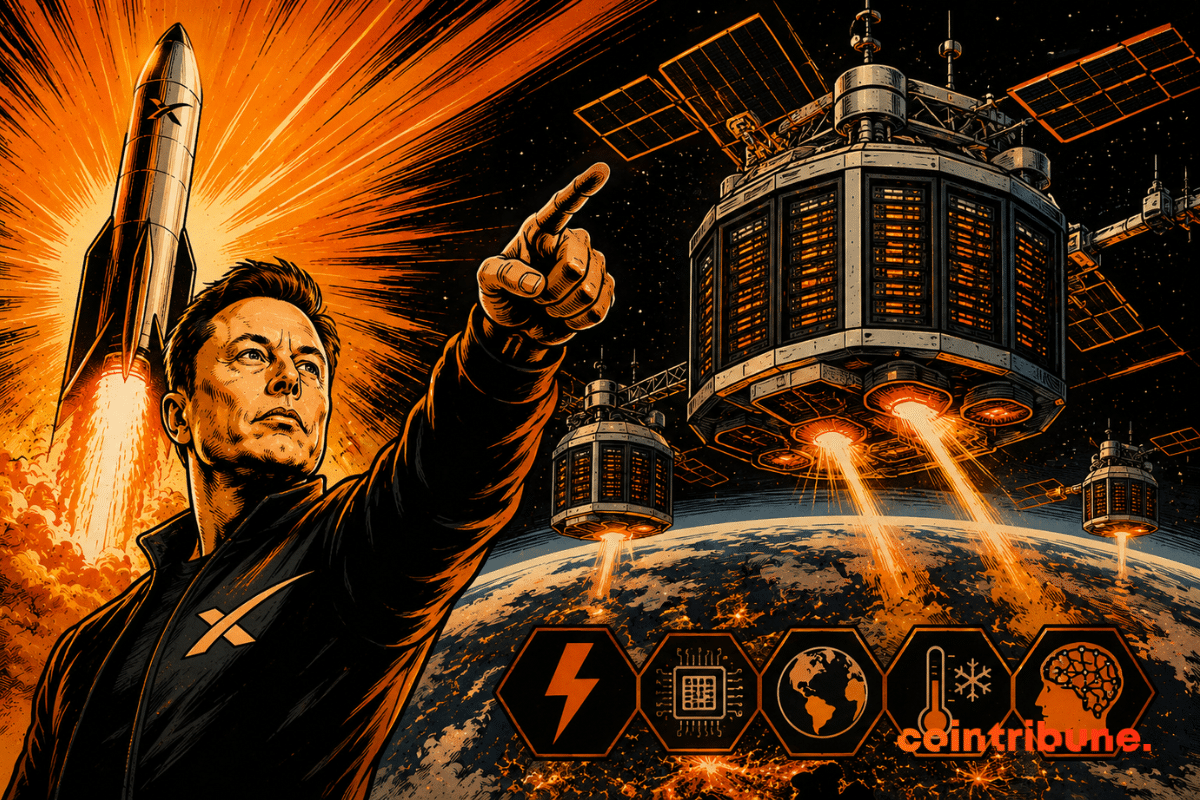
Will data centers leave Earth soon? This perspective, long reserved for science fiction, takes on a very real dimension with the strategy carried out by SpaceX. Faced with the explosion in the energy needs of artificial intelligence, Earth's orbit is now emerging as a new frontier for digital infrastructures. Much more than a space project, this development could reshuffle the cards of the global technological economy, by influencing investments in financial markets and the strategies of Tech giants.
In brief
- SpaceX is preparing a new generation of data centers in orbit to meet the growing energy needs of artificial intelligence.
- The Gigasat factory and its giant satellites are paving the way for unprecedented space computing power, designed to go beyond the limits of terrestrial infrastructure.
- The group's industrial ambitions are already attracting financial markets and tech giants, who see orbital computing as a strategic lever for the future.
- SpaceX's solid Bitcoin reserve strengthens its ability to finance this colossal project, despite the technical and economic challenges that remain.
The deployment of Gigasat and the advent of orbital computing
The industrial apparatus intended to make this transition a reality is already in motion through new production structures. SpaceX unveiled on June 8, a few days before its listing on Nasdaq, its giant Gigasat factory in Bastrop, Texas, a complex fully configured for the mass manufacturing of satellites dedicated to artificial intelligence.
By 2027, the company aims to deliver spatial computing capacity amounting to 1 gigawatt (GW) per year. The spearhead of this fleet will be based on breakthrough technical specifications:
- Structural gigantism: the first generation satellite called AI1 has a wingspan of 70 meters, exceeding the width of a Boeing 747;
- High energy density: each unit carries an IT payload ranging between 120 kilowatts (kW) on average and 150 kW peak;
- Hardware flexibility: the infrastructure adopts an architecture of interchangeable chips to avoid exclusive allegiance to a single semiconductor supplier.
Faced with the apparent complexity of the project, Elon Musk tempered the ardor of observers during the presentation of this material. So, he has asserted that “the AI satellite is much simpler than a Starlink satellite”.
This relative simplicity hides an industrial logic dictated by terrestrial physical imperatives, the firm having filed an official request with the Federal Communications Commission (FCC) to deploy up to 1 million operational satellites. Such a shift towards space is explained by the fact that terrestrial server farms critically come up against the capacity limits of electricity networks and the scarcity of available land.
Conversely, space offers an environment where solar exposure makes it possible to collect approximately five times more energy than on the earth's surface, completely freeing itself from night cycles and weather disturbances. It is this implacable environmental observation that pushed the leader of SpaceX to reiterate his deep conviction that “the space has the advantage of always being sunny”making orbit the logical final destination for deep learning infrastructures, hence its definitive assertion: “space is the only way to scale up”.
Historic capitalization driven by demand for AI
This deployment of IT constellations is now part of a financial strategy validated by the public capital markets. When it debuted on the Nasdaq on June 12, SpaceX raised approximately $75 billion, closing its first day of trading with a historic market valuation of $2.1 trillion.
The company's S-1 prospectus explicitly relied on the explosion in demand for AI infrastructure to justify this value, immediately attracting high-profile institutional funds like Cathie Wood's ARK, which acquired 3.3 million shares. For investors, the appeal lies in the long-term growth projections made by management, which expects $1 trillion in annual revenues by 2030. This growth is driven by orbital power targeting 100 GW per year by that deadline, then a forward scale measured in terawatts.
Beyond the enthusiasm of Wall Street, this infrastructural shift is triggering the concrete interest of the largest players in the digital sector, who are seeking to free themselves from terrestrial geographic constraints. The Wall Street Journal reported in May that Google had entered into exclusive negotiations with SpaceX regarding the launch of these orbital data centers. This interest from Big Tech confirms the commercial relevance of the SpaceX model, which is no longer positioned only as a space transport, but as the ultimate supplier of raw power for future computing models. The influx of capital from these global strategic partnerships directly supports the long-term viability of the Gigasat factory.
Treasury anchored in bitcoin in the face of industrial challenges
Beyond stock market performance, the financial solidity of this ecosystem is distinguished by a corporate treasury strategy heavily exposed to cryptos. SpaceX indeed maintains a particularly robust balance sheet including 18,712 BTC, which represents a treasure valued at approximately $1.29 billion.
This position, combined with the 11,509 BTC held by Tesla, places entities controlled by the billionaire among the largest corporate holders of bitcoin on US regulated markets.
Thus, this leading financial base proves essential to support the colossal research and development effort necessary to conquer the IT orbit. In addition, the integration of bitcoin as a reserve asset offers unique capital flexibility to simultaneously carry out industrial construction and finance successive launch campaigns in the face of economic uncertainties.
Maximize your Tremplin.io experience with our 'Read to Earn' program! For every article you read, earn points and access exclusive rewards. Sign up now and start earning benefits.


