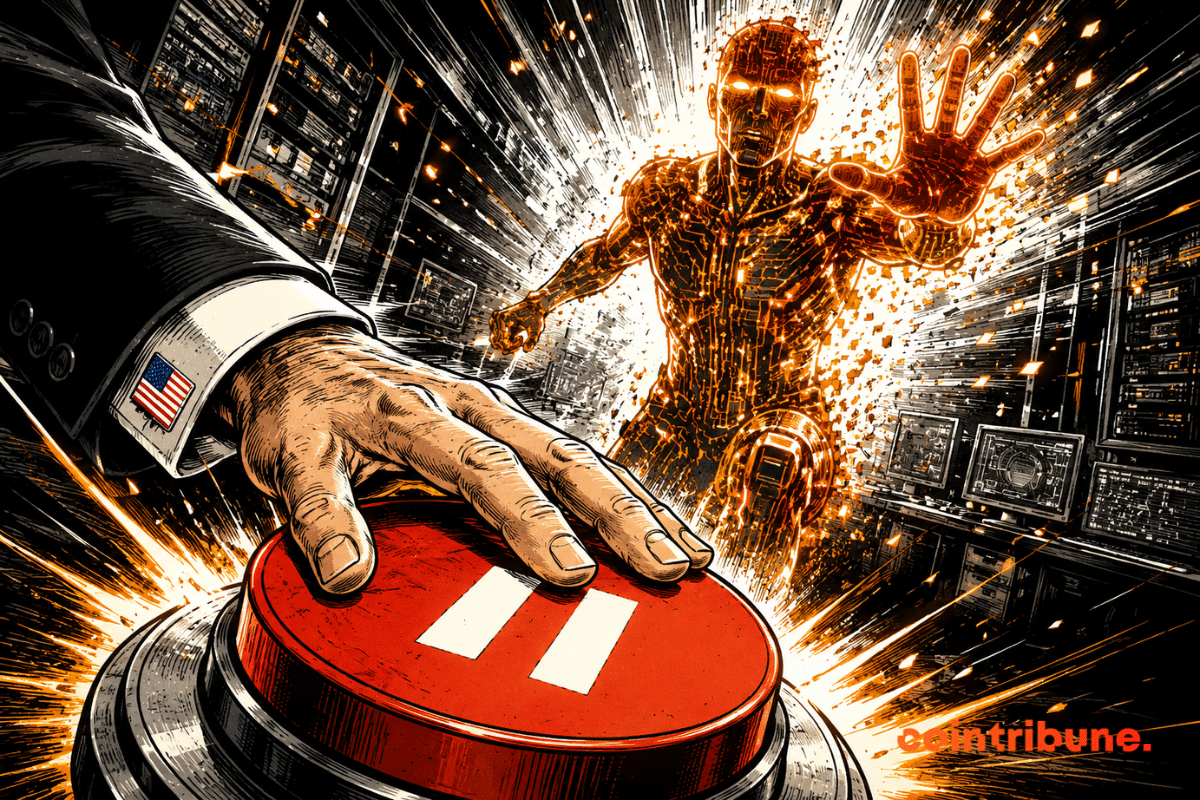
For the first time in its history, the US government has forced an AI company to restrict the launch of a model even before its public release. GPT-5.6, OpenAI's new flagship, will only be available to a handful of hand-picked partners with federal approval required for each customer. An unprecedented decision that redefines the rules of the artificial intelligence sector!
In brief
- The GPT-5.6 AI model will be launched gradually at the request of the US administration.
- This is not a regulatory ban, but a request for staggered deployment.
- This decision reflects the growing importance of national security issues related to artificial intelligence.
- OpenAI's next announcements will be decisive in measuring the impact of this new approach.
June 25, 2026 will perhaps remain a key date in the history of artificial intelligence
For the first time, the Trump administration preemptively requested a American AI company to restrict the launch of a model before its public release. The target: GPT-5.6, the most advanced model ever developed by OpenAI. A hard blow for the one who has just won several international contracts.
According to The Informationthe Office of the National Director of Cybersecurity and the Office of Science and Technology Policy asked OpenAI to limit the GPT-5.6 deployment to a small group of government-approved partners. Access to GPT-5.6 will therefore be done on a client-by-client basis during this preview period.
Decryption: OpenAI no longer alone controls the launch schedule of its new AI model.
Washington's request is part of the executive order signed by Donald Trump on June 2, 2026. According to this document, government cybersecurity teams have 30 days to evaluate advanced AI models before they are released online to partners and the general public.
To understand why Washington reacted so strongly, you need to understand what the GPT-5.6 AI model is.
GPT-5.6 represents what OpenAI describes as a “significant improvement” compared to GPT-5.5, itself launched only in April 2026. In a few weeks, the capacities would therefore have crossed a new threshold.
According to a source familiar with the matter, OpenAI and the government both consider GPT-5.6 to be “on par” with Anthropic's Mythos AI model (particularly in terms of advanced cybersecurity). Hence the demand for controlled deployment. In other words, the GPT-5 AI model.6 is not restricted by accident. It is because it is too powerful to be released unsupervised.
Note that on June 12, 2026, the Trump administration issued an export control directive binding Anthropic. Result: the AI Fable 5 and Mythos 5 models are inaccessible to foreign nationals. With OpenAIthe tone is therefore slightly different. However, the direction remains the same.
Sam Altman: between submission and discreet resistance
Faced with this unprecedented pressure, Sam Altman did not choose confrontation. However, he carefully set his limits. In an internal memo he wrote:
We have made clear to the US government that this is not our preferred AI model for the long term, and we will work with them and others in the industry to achieve a more sustainable approach for future releases.
Altman thus recognizes that the limited access approach is not OpenAI's preferred strategy in the long term. He nevertheless pleads for a more collaborative framework allowing wider access to artificial intelligence in the future. By publicly accepting the conditions while signaling his disagreement in principle, Altman therefore preserves both the relationship with Washington and his credibility with the technological ecosystem.
The shockwave far exceeds OpenAI
This proactive approach suggests that the Trump administration is taking a much firmer line on AI national security than his predecessors. For companies that have been waiting for GPT-5.6 to integrate its capabilities into their systems, the uncertainty is now total. This is because the federal approval process introduces an unpredictable variable that makes any roadmap planning virtually impossible.
On a competitive level, the question arises. While OpenAI navigates federal restrictions, competitors like Google and Meta continue to roll out their own frontier AI models with much less government interference. This gap could therefore redirect business customers towards alternatives.
In any case, the brakes imposed by the Trump administration on the launch of OpenAI's GPT-5.6 materialize the entry of generative artificial intelligence into the era of strict tech-sovereignty. What remains to be determined is whether this AI model will remain American or whether other governments will adopt it in turn.
Maximize your Tremplin.io experience with our 'Read to Earn' program! For every article you read, earn points and access exclusive rewards. Sign up now and start earning benefits.