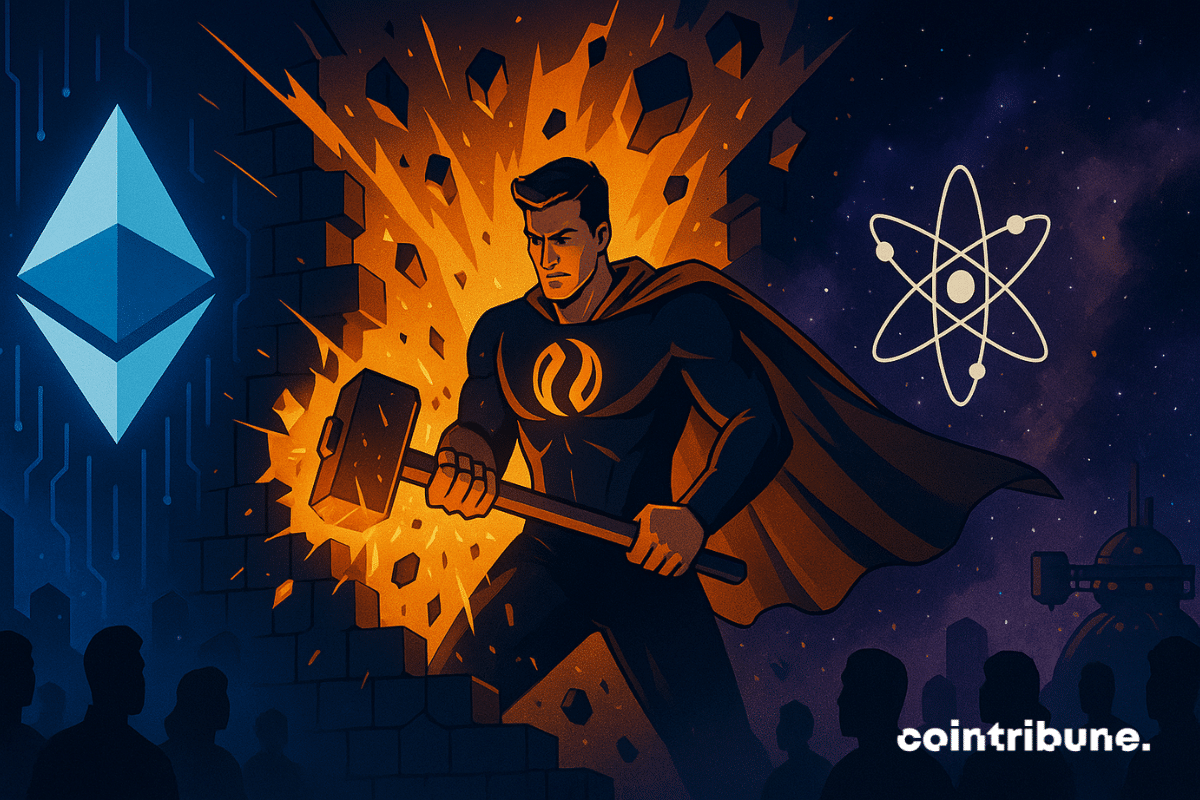
Injective has just deployed its native EVM mainnet, marking a turning point in the evolution of layer 1 blockchains. This integration allows Ethereum developers to harness the power of Cosmos without sacrificing performance. But will this technical prowess be enough to reverse the downward trend of the INJ token, down more than 60%?
In brief
- Injective officially launches its native EVM mainnet on its high-performance Cosmos blockchain.
- The platform aims for a MultiVM approach unifying WebAssembly, EVM and soon the Solana virtual machine.
- Developers benefit from full Ethereum compatibility without sacrificing execution speed of 0.64 seconds per block.
- The architecture allows sharing of liquidity and resources between different virtual machine environments.
Injective rolls out native EVM support to Cosmos
Injective reached a major milestone in its roadmap on Tuesday with the activation of its EVM mainnet.
Concretely, the blockchain inherited from Binance now allows developers to deploy Ethereum applications directly on its Cosmos infrastructure, without any code adaptation. This technical feat creates a bridge between two hitherto compartmentalized worlds.
The innovation lies in the “MultiVM” environment that Injective has been methodically building since 2023. After months of testing on its inEVM layer 2, the team has succeeded in its challenge: to make coexist WebAssembly and EVM on the same platform.
Developers can now choose their preferred virtual machine, with the planned arrival of Solana, while sharing liquidity, resources and modules.
This unified architecture eliminates typical friction. “ No more manual interventions between user environments », explains the Injective team.
The MultiVM Token Standard ensures consistent representation of assets across the ecosystem, removing duplicate token versions that cause confusion. Transactions become atomic: they either execute in full or are rolled back, protecting user funds.
Performance demonstrates the effectiveness of the system. With block times of 0.64 seconds and fees falling to $0.00008, Injective positions itself as a serious alternative for transaction-intensive decentralized applications. This speed, combined with Ethereum compatibility, could appeal to developers tired of the prohibitive fees of other networks.
Institutional appeal is confirmed
The activation of the EVM comes in a favorable context for Injective. Indeed, in October, 21Shares filed a spot ETF application with the SEC, joining Canary Capital in this process.
The network has increased strategic partnerships with Google Cloud, T-Mobile and Deutsche Telekom, consolidating its credibility.
Its ability to process more than 25,000 transactions per second via a DPoS consensus mechanism is attracting the attention of professional players. The pre-existing infrastructure for pre-IPO markets and the creation of the Injective Council reinforce this institutional dimension.
The price of the INJ token, although far from its highs of $52.75 in March 2024, remains around $8.75. This relative stability, despite crypto volatility, reflects underlying investor confidence.
The possible approval of an ETF could catalyze new dynamics, providing institutional investors with regulated exposure to the layer 1 DeFi ecosystem.
In short, the native integration of EVM positions Injective at the crossroads between technical innovation and mainstream adoption. By unifying multiple virtual machines while preserving exceptional performance, blockchain shapes an environment where developers Ethereum, Cosmos and soon Solana can collaborate without compromise.
Maximize your Tremplin.io experience with our 'Read to Earn' program! For every article you read, earn points and access exclusive rewards. Sign up now and start earning benefits.