A year after Ethereum’s historic move to the Proof-of-Stake (PoS) consensus mechanism, the world’s second-largest crypto continues to evolve. However, the path remains strewn with technical challenges and concerns about possible centralization.
The Merge: Heading towards the Eco-transition
The merger of Ethereum with the Beacon Chain, carried out exactly a year ago, caused a significant reduction in its energy consumption.
Initially based on a very energy-intensive proof-of-work (PoW) model, Ethereum has moved to a significantly more environmentally friendly proof-of-stake (PoS) system.
According to data from the Cambridge Center for Alternative Finance, this transition reduced its energy consumption by almost 99.9%, from 21 Terawatt hours to almost nothing.
In addition to the energy aspects, this change has led to a reduction in the supply of ETH. According to data fromUltrasound.Money, over 300,000 ETH have been burned since the Merge. Although, theoretically, this reduction in supply could have caused an increase in prices, macroeconomic factors, such as the banking crisis, have thwarted this trend.
Crypto staking: a new era for Ethereum, but at what cost?
The adoption of proof of stake has introduced a new central figure to the Ethereum ecosystem: validators. Unlike miners from the PoW era, liquid staking operators have established themselves on the Ethereum scene, with $19.5 billion in ETH staked by their intermediaries.
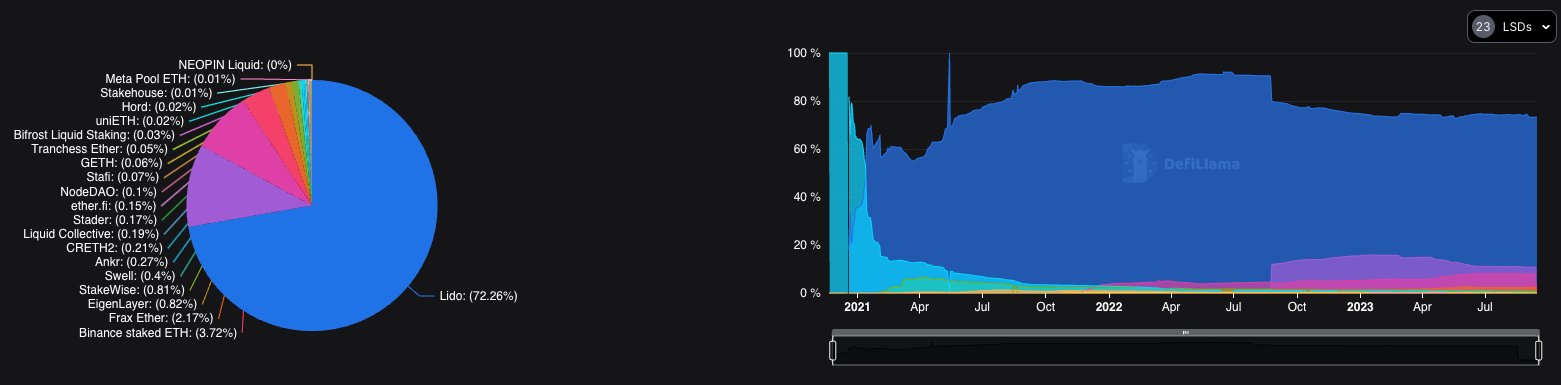
The Shella update in April 2023 largely promoted ETH staking. Liquid staking providers such as Lido and Rocket Pool are big beneficiaries of this development. Lido, alone, currently holds an impressive 72% share of all ETH staking, raising concerns over the potential centralization of the system.
Feeny, CEO of Labry, while promoting the advantages of Liquid Staking, warned of the risk of centralization, particularly with regard to providers such as Lido Finance.
“Lido currently manages 32.26% of all Ether staking on the network, representing more than $14 billion. In the long term, I am confident that Ethereum is better positioned with liquid staking than without it. However, many obstacles remain to be overcome” has declared Feeny at Cointelegraph.
While some providers are considering implementing a 22% staking limit to preserve decentralization, Lido has decided not to join this initiative. It currently owns 32.26% of all staked ETH, a concentration that could pose risks for the network in the future.
Vitalik Buterin’s crypto vision for a decentralized future
Apart from staking, customer diversity also remains a central issue. During Korea Blockchain Week, Vitalik Buterin pointed to centralization as one of Ethereum’s main concerns to address. He outlined six challenges to overcome to resolve this issue, including the need to diversify Ethereum nodes.
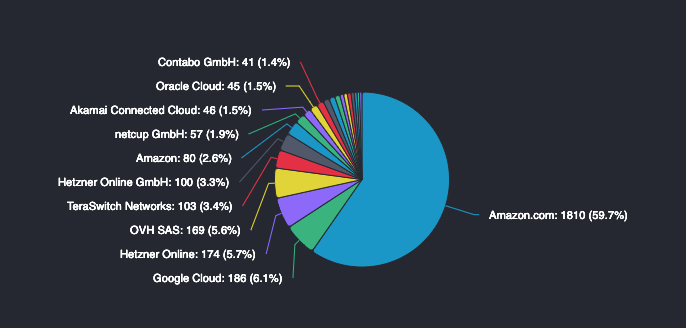
Recall that at present, the majority of the 5,901 active Ethereum nodes are administered by centralized web providers such as Amazon Web Services. According to several experts, this configuration puts the Ethereum blockchain in a vulnerable position facing a potential single point of failure. This centralization poses considerable risks for Ethereum.
For Buterin, it is crucial to encourage the operation of nodes by individuals by reducing costs and material requirements, in order to ensure lasting decentralization.
“ Currently, one node requires hundreds of Ggigabytes of data to work. With stateless clients, it is possible to run a node with almost no data. »
Buterin plans to combat centralization by opting for almost data-free operation of nodes, an idea he calls “statelessness”. However, he admits that while these challenges are paramount, they could take a decade or more to fully overcome.
Ethereum has made significant progress in energy efficiency with its transition to proof of stake. However, many obstacles remain. Centralization issues and technical adjustments require constant vigilance and innovation in order to ensure a solid and decentralized future.
Receive a summary of the news in the world of cryptocurrencies by subscribing to our new service daily and weekly so you don’t miss anything of the Tremplin.io essentials!