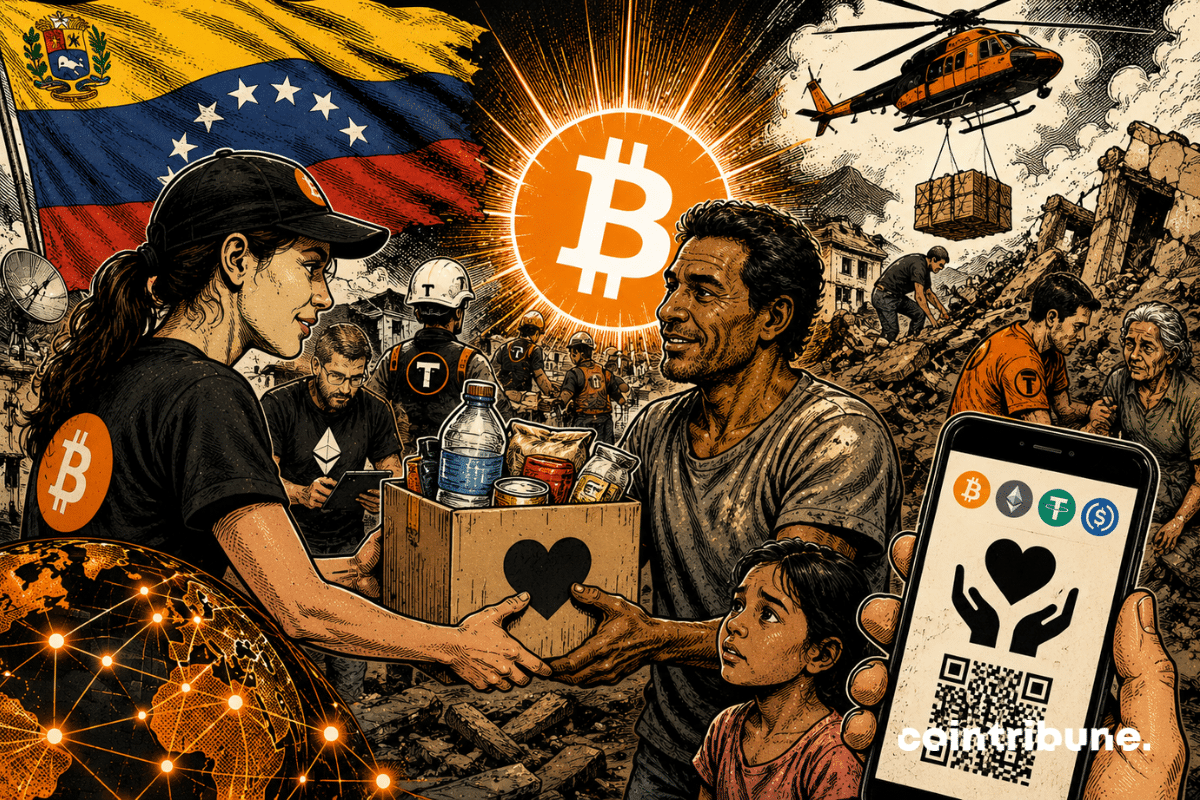
Major crises are often powerful reveals of the public utility of financial innovations, propelling cryptos well beyond their speculative dimension. This is exactly the scenario that is currently unfolding on the South American continent where, following the devastating earthquakes that hit Venezuela, the global ecosystem of these assets has mobilized at lightning speed. In a context where traditional banking circuits are proving inoperable or severely blocked, the speed, absence of borders and disintermediation offered by blockchain technology appear to be capital advantages for delivering aid.
In brief
- Two powerful earthquakes plunge Venezuela into a major humanitarian crisis, where cryptos become a rapid way to deliver emergency aid.
- Binance, El Dorado and others in the industry are mobilizing millions of dollars and waiving fees to speed up transfers to victims.
- Citizen and university initiatives rely on blockchain to organize transparent and verifiable collections in real time.
- This mobilization confirms the growing role of cryptos in humanitarian action, while recalling the need to fight against fraudulent donation campaigns.
An extraordinary humanitarian catastrophe and the emergence of cryptos as a vital recourse
While the crypto ecosystem suffered its most violent decline since April, northern central Venezuela was shaken on June 24 by two major earthquakes, with respective magnitudes of 7.2 and 7.5. Indeed, the La Guaira region is one of the most affected. The official reports thus summarize the extent of the damage on these essential data :
- A provisional human toll of at least 920 dead and more than 3,300 directly injured;
- More than 50,000 people currently missing under the rubble of collapsed infrastructure;
- A total paralysis of water, electricity and telecommunications networks in the north center of the country.
Faced with the scale of this tragedy, observers fear an inevitable deterioration of the data, like Doctor Robert W. Malone who shared on his X account: “It's hard to imagine, but if half of those 51,000 missing in Venezuela are under the rubble and are most likely dead… The extent of this disaster is beyond imagination”. The speed of transfer of the crypto industry is crucial to circumventing these structural blockages and accelerating the sending of funds to disaster areas.
Conventional flows are slowed down by banks under pressure, while a crypto transfer is carried out directly from wallet to wallet in a few minutes. To manage this crisis, dollar-backed stablecoins, such as USDT and USDC, are the tools of choice. These mechanisms avoid the risk of volatility and ensure that populations can immediately purchase food, medicine or life-saving equipment, thus taking the place of the traditional banking sector.
The operational and financial response of the giants of the crypto industry
Faced with the emergency, large manufacturers and centralized platforms immediately put in place direct financial support measures to realize this technical advantage. Binance responded in a significant institutional way by announcing a $3 million USDT donation to users in the seven states hit by the June 24 earthquakes. The relief plan includes the distribution of coupons worth 20 USDT and the temporary removal of peer-to-peer (P2P) market fees and merchant fees.
Richard Teng, head of Binance Charity, declared publicly: “We are deeply saddened by the disaster caused by the earthquakes in Venezuela. Binance Charity to donate $3 million in USDT to help Binance users residing in affected areas ».
At the same time, the Latin American P2P exchange platform El Dorado has also ended its commissions for transfers to Venezuela made by expatriates. The company highlighted the importance of its action on social networks: “As Venezuelans expatriates, we know that in times like this it is essential to have a quick way to help our loved ones”.
The intervention of the giants of the sector makes it possible to immediately inject liquidity into the heart of the affected regions thanks to exchange infrastructures already established and used every day by the local population. By removing price barriers and paying funds directly into the accounts of verified users, these companies are turning their platforms into veritable emergency relief windows. This centralized approach allows for mass execution, which can simultaneously affect tens of thousands of displaced or resource-deprived people.
The joint action of Binance and El Dorado shows how commercial actors can instantly shift into a role of public infrastructure, proving that the circuits of digital private capital can be mobilized for the general interest in record time where international aid agencies sometimes took several days to deploy their budget lines.
Decentralized mobilization and the challenge of on-chain transparency
Solidarity goes beyond the framework of industrial companies and is organized in a bottom-up manner through community, academic and associative collections centered on the public traceability of funds. Thus, the local figure Ana Ojeda, known under the pseudonym “Cryptolawyer”has partnered with Decaf Pay to centralize international contributions in USDC, by credit card or transfer, with the funds then converted locally via Airtm.
On her X profile, she indicates: “If anyone wants to help families impacted by the earthquakes in Venezuela, we are collecting donations in USDC/USDT for hospital costs, transportation, food and emergency supplies”.
The Academia BT&C structure of the Andrés Bello Catholic University (UCAB), for its part, opened the “Emergency Earthquake Fund Venezuela 2026”accepting bitcoin, USDT and BinancePay, while ensuring transparent institutional custody: “each contribution to self-custodial addresses will be verifiable on the blockchain”.
Finally, international organizations such as Mercy Corps and World Vision collect digital aid via the specialized platform The Giving Block, while isolated citizen initiatives, like the LIVRE profile, collect various cryptos (BTC, ETH, SOL, SUI, USDC) to obtain first aid medical equipment.
This convergence of initiatives shows a major structural evolution, with cryptos now establishing themselves as a reliable and auditable global humanitarian infrastructure. This technical efficiency is nonetheless accompanied by risks that must be underlined with nuance. With blockchain transactions being irreversible and natural disasters causing urgent emotion, conditions are ripe for the proliferation of fraudulent campaigns and fake fundraising profiles.
The future of this decentralized humanitarian aid will therefore depend on the capacity of the ecosystem to impose rigorous verification standards. For donors, official links and platforms that offer full public traceability of funds spent must always be favored, in order to reconcile the technical speed of blockchain with the ethical and security requirements essential to humanitarian action.
Maximize your Tremplin.io experience with our 'Read to Earn' program! For every article you read, earn points and access exclusive rewards. Sign up now and start earning benefits.