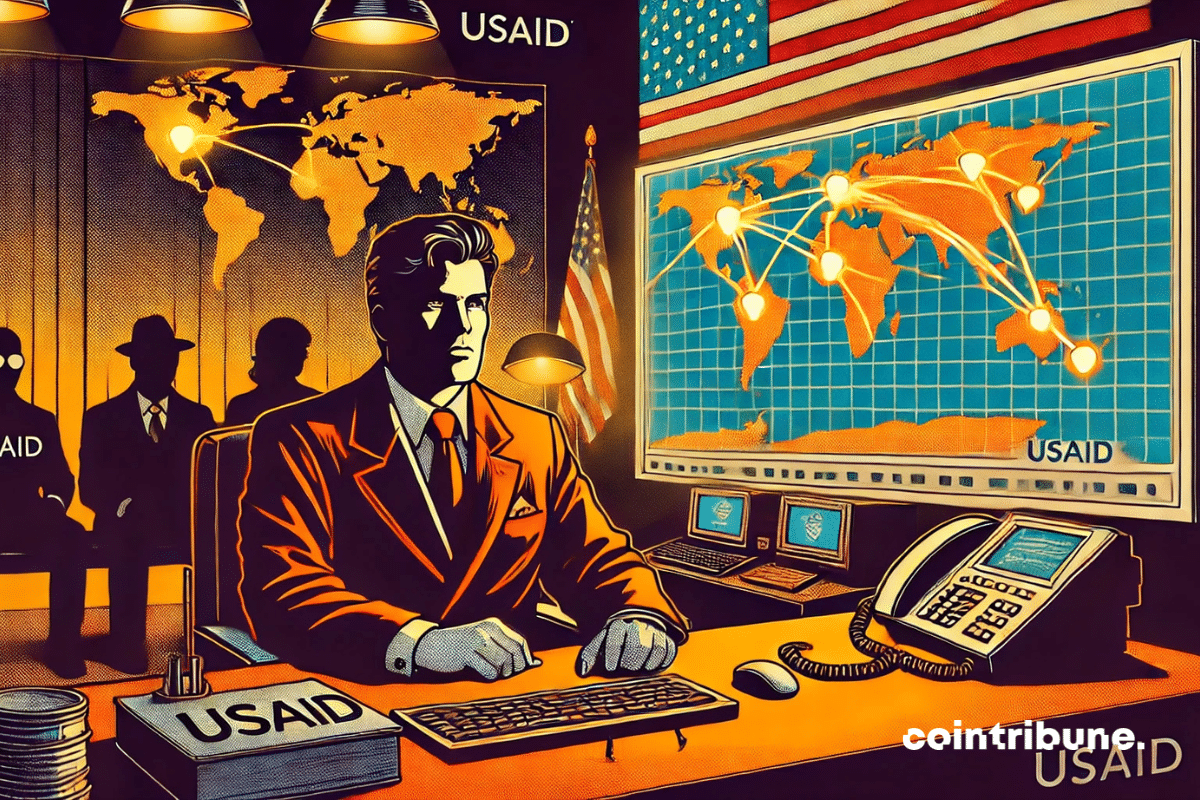
What if the blockchain became the new feature-pilot of humanitarian aid? A persistent rumor agitated Washington: USAID, pillar of international assistance, could transform under the leadership of Trump advisers. Their idea? Inject a dose of crypto into the agency's bureaucratic veins. Objective displayed: track down each dollar, eradicate leaks, and redefine transparency. A daring turn, which combines technological innovation and political calculation.
A structural reform under the sign of the crypto
The American Agency for International Development (USAID) could soon wear a new name – American agency for international humanitarian assistance – and a new roadmap.
Placed under the direct supervision of the Secretary of State, this institutional moult would be accompanied by an unprecedented tool: the blockchain. Indeed, far from Trump's speech to the DAS, an internal document disclosed reveals that the technology would be used to “secure and trace distributions” of aid, making each transaction indelible.
Imagine a digital register, infalcrirable, where each transfer of funds would be engraved in real time. More gray areas, more opaque intermediaries.
The blockchain would act as a virtual notary, validating each step from Washington to the final beneficiaries.
A revolution for programs often undermined by corruption or ineffectiveness. However, this ambition comes up against a complex reality: in January, USAID suspended its payments, causing legal chaos and legal appeals.
In this context, crypto appears as much as a solution as a symbol. In parallel, the Department of Government Effectiveness (DOGE), an entity managed by Elon Musk, tries to restructure the agency.
Irony of history: DOGE, an unexpected partner, embodies this alliance between techno-utopism and political pragmatism. It remains to be seen whether the marriage between bureaucracy and crypto will resist the realities on the ground.
Transparency or technological mirage?
Behind the promises of traceability hide much more thorny issues. Can crypto really clean up humanitarian aid? Its defenders argue that the immutability of the registers would discourage diversions.
But his detractors underline a paradox: how to reconcile anonymity of beneficiaries and absolute transparency? Not to mention that the crypto, often associated with volatility, will have to prove its stability in a sector where every penny counts.
The Trump administration relies on a breakup effect. By integrating the crypto, she seeks to restore the image of an agency criticized for her heaviness.
However, this modernization hides an increased control desire. By placing USAID under the aegis of the State Department, Washington would centralize the management of the aid, mixing diplomacy and assistance. A risk of politicization denounces certain NGOs, which fear instrumentalization of funds.
Finally, the technical question remains. The most vulnerable regions, often without digital infrastructure, could be excluded from this system. The training of local actors, the security of crypto wallets, or even internet access would become essential prerequisites. A colossal challenge, which requires additional investments. Without support, the blockchain risks digging the inequalities it claims to resolve, while Michael Saylor warns: without Bitcoin, the euro is condemned! Without support, the blockchain risks digging the inequalities it claims to resolve, while Michael Saylor warns: without Bitcoin, the euro is condemned!
Maximize your Cointribne experience with our 'Read to Earn' program! For each article you read, earn points and access exclusive rewards. Sign up now and start accumulating advantages.