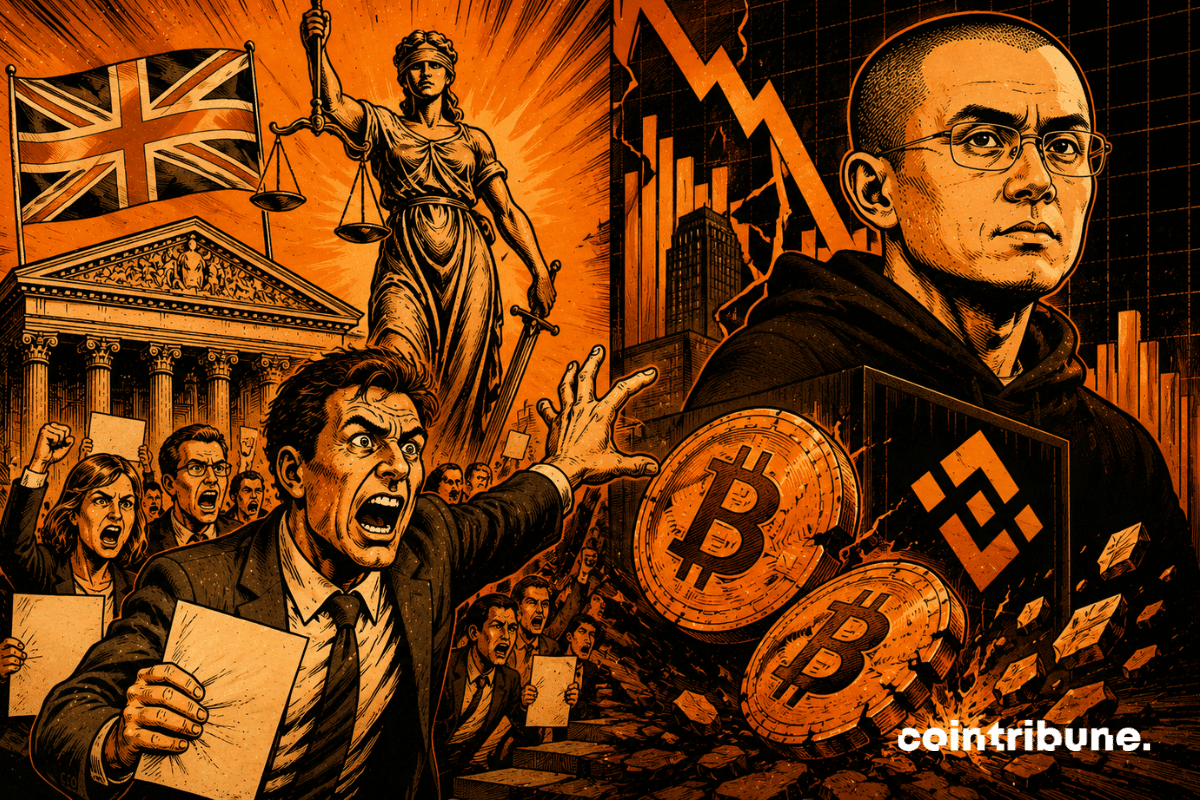
The judicial and regulatory noose is tightening further around the historic giants of the crypto ecosystem, reminding us that the past always ends up catching up with the most daring players. As the industry strives to coalesce under ever-stricter compliance banners, strategic decisions made at the heart of the previous bull bubble are coming back to haunt its figureheads. This dynamic is perfectly illustrated with the questioning on British soil of the first global exchange platform and its emblematic founder.
In brief
- Nearly 1,700 UK investors are seeking $200 million from Binance and its founder Changpeng Zhao in a class action.
- The plaintiffs accuse the exchange of trading leveraged derivatives products without the required regulatory approvals in the United Kingdom.
- The FCA's historic position on crypto derivatives could strengthen investors' arguments and weigh on the outcome of the dispute.
- The accumulation of these legal and regulatory proceedings could set a precedent for all large centralized exchange platforms.
A collective of 1,700 British investors launches a major financial offensive against Binance
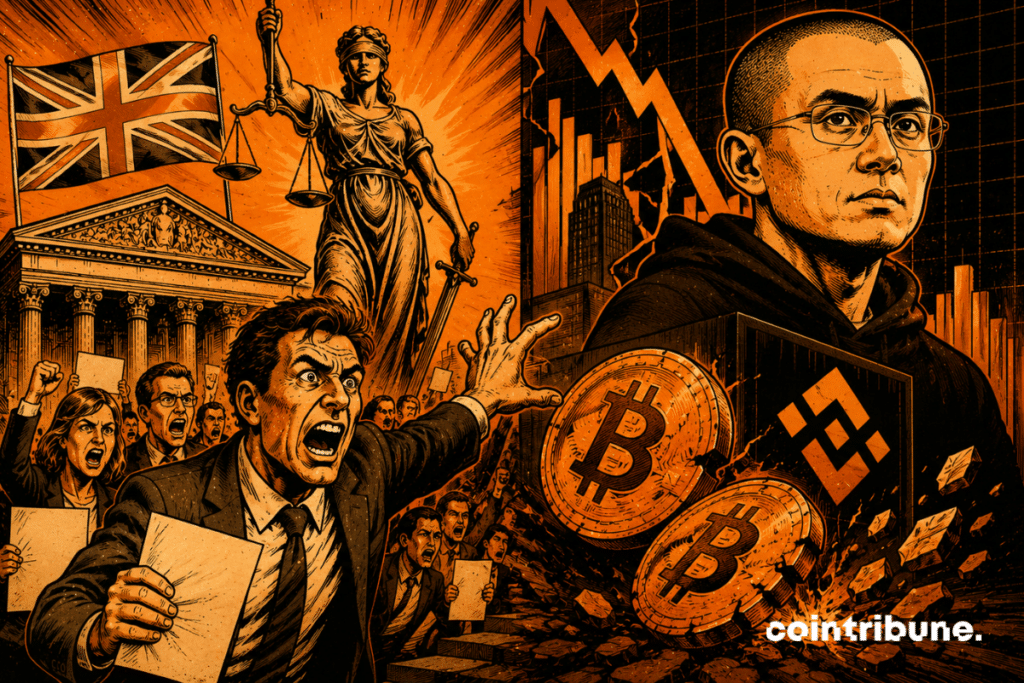
Binance founder Changpeng “CZ” Zhao, and the exchange are being sued in the UK as part of a class action, after US investors had already won a trial.
Indeed, the procedure is based on the following points:
- The number of plaintiffs: the legal action is formalized by a collective of nearly 1,700 British investors;
- The amount of compensation: the group of claimants are seeking massive compensation estimated at nearly $200 million, or around £150 million;
- The reason for the complaint: the action alleges that the platform offered sophisticated and particularly risky financial instruments, including leveraged trading products, without having the required regulatory approvals in the territory;
- The position of the defense: asked about its strategy in the face of this offensive, the firm declared : “the Binance platform is committed to its obligations towards users and to operating in accordance with applicable law”.
The complaints date from the end of 2019, when these highly speculative financial instruments were still freely accessible to British retail investors on the exchange platform. The plaintiffs argue that the lack of safeguards and proper oversight directly led to disastrous losses, with some seeing tens of thousands of dollars disappear in just a few trading sessions.
This group action aims to show that the offering of these financial services violated the local legal framework at the time, incurring the direct civil liability of the company and its historic founder, Changpeng Zhao, despite the group's subsequent restructuring.
The FCA's ax and the big clean-up of derivative products
Although the losses claimed by the plaintiffs occurred at the end of 2019, the Financial Conduct Authority (FCA) ruled in October 2020 by announcing a total ban on crypto derivatives for retail investors. This provision came into force in January 2021. The British financial watchdog then judged that these advanced products are structurally “ill-adapted” to non-professional investors due to their volatility and opacity.
In an update to its policy, the regulator has reaffirmed its firm doctrinal position by explicitly saying: “cryptos are high-risk investments and will remain so under our regime”. The FCA has softened its position by giving individuals access to certain exchange-tradable notes (ETNs), but it has still not moderated its ban on derivatives.
This situation shows the time gap between the unbridled commercial activity of the platforms and the institutional response. The plaintiffs see this as a retroactive recognition by the FCA of the dangerousness of the financial products offered by Binance from 2019. Thus, the issue in this part of the case will be whether the fact that there was no formal authorization at that time constitutes a clear violation of contract law and consumer protection in the United Kingdom, opening the way to systematic refunds.
European MiCA tightening and strategic impasse in Greece
This legal fragility on the British market coincides with other major setbacks for the Changpeng Zhao exchange on the European continent, particularly in terms of alignment with the Crypto Market Regulation (MiCA). The company has formally withdrawn its license application in Greece, a week after reports indicated that national authorities were preparing to refuse it.
This strategic withdrawal comes at a critical time, as the MiCA transition period expires this Wednesday 1er July 2026, definitively closing the window during which companies could operate under old national regimes. Without this approval, the platforms are no longer authorized to legally serve users in the European Union. Although Binance quickly communicated its intention to seek approval from another member state of the European Union, it has not yet provided any indication as to the targeted jurisdiction for this withdrawal.
The accumulation of these procedures, between the collective action of London and the de facto exclusion from the Greek market, outlines the contours of a complex future for centralized platforms backed by historically permissive business models. In the short term, the resolution of this $200 million dispute could create a formidable jurisprudential precedent, prompting groups of traders from other jurisdictions to seek compensation for similar acts committed before the waves of regulation.
Maximize your Tremplin.io experience with our 'Read to Earn' program! For every article you read, earn points and access exclusive rewards. Sign up now and start earning benefits.