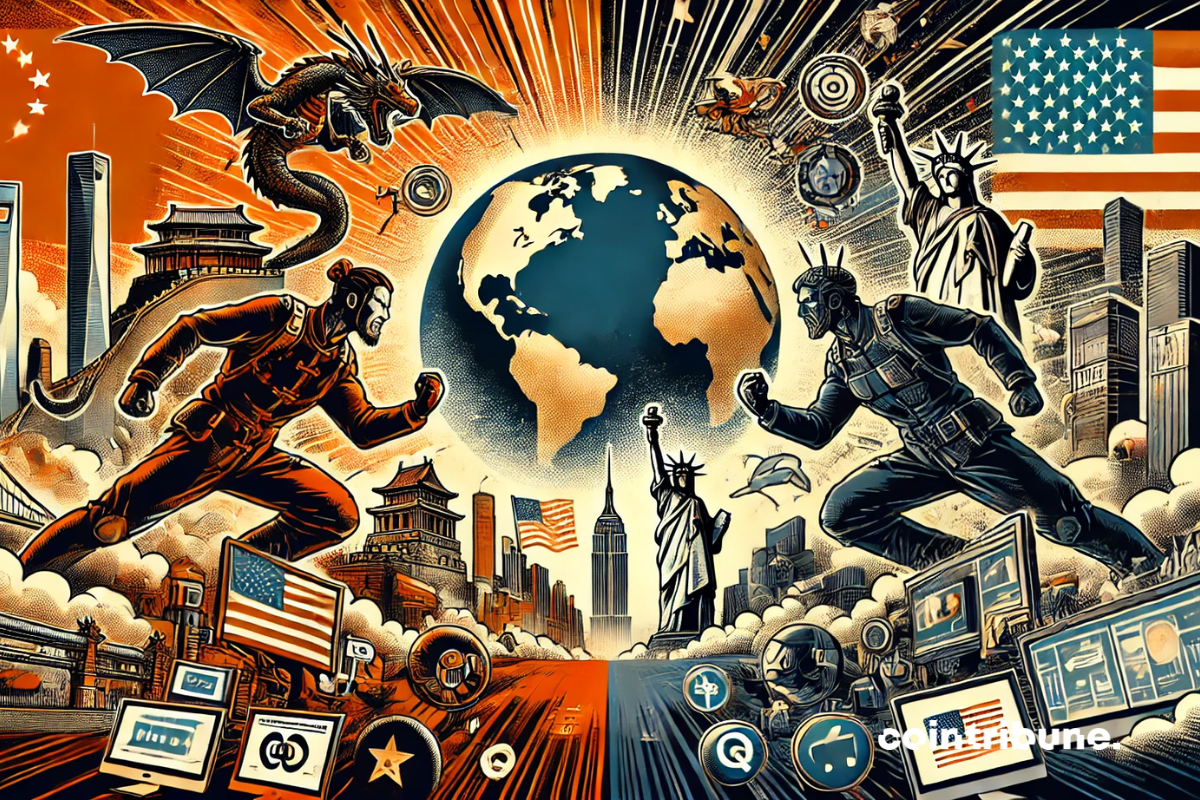
As China increasingly reveals its totalitarian face, Donald Trump and Kamala Harris are raising serious concerns about their ability to defend Western interests against Beijing. Are they about to capitulate to Xi Jinping and abandon Taiwan?
The Chinese file
The question of sino-us relations is emerging as a major issue in the next American presidential election.
While Joe Biden takes a hard line towards Beijingsome worry about the ability of his potential successors to maintain this firmness. Donald Trump and Kamala Harris are indeed raising doubts about their determination to stand up to China..
Although for different reasons, both candidates could fail protect American interests against Chinese ambitions.
A Trump U-turn on China?
Donald Trump has forged himself an image of an anti-Beijing hawk during his first term. He launched a trade war and took action against Chinese espionage. This reputation could paradoxically allow it to make a 180-degree turn without too much political damage.
There are several worrying signs that Trump might take a more conciliatory approach to China if he returns to power. His turnaround on TikTok last March, after a meeting with a billionaire with a stake in the company, illustrates his sensitivity to financial incentives.Will Trump give in to the temptation to sell American interests to the highest bidder?
Its record on export controls or trade negotiations already shows a tendency to back down in the face of Chinese pressure in exchange for symbolic victories. The “phase 1” trade agreement signed in 2020 is a perfect example. Trump settled for promises of Chinese purchases that were never kept, abandoning any real pressure on Beijing..
Even more worrying, Trump appears to question US commitment to Taiwan. In a recent interview, he criticized the island for its semiconductor industry and highlighted the difficulty of defending it militarily.
Republicans: All pro-China and pro-Putin?
Part of Trump's electoral base also appears to be shifting toward pro-Beijing positions.
Media figures like Tucker Carlson advocate a rapprochement with China in the name of the fight against “American leftists”.
If Trump adheres to this vision ofa global alliance of autocracies against the left, The consequences could be disastrous for American security and the international order.
Taiwan, soon to be abandoned to China?
Trump's attitude toward Taiwan is particularly worrying. His transactional approach to foreign policy could lead him to view the island's defense as an unnecessary burden. Such an abandonment would embolden Chinese expansionist ambitions and shake the confidence of American allies in the region..
The loss of Taiwan would have major strategic consequences. It would seriously compromise the security of Japan, a key U.S. ally, and would give China greater control over vital sea lanes in the region.
The island's semiconductor industry, crucial to the global economy, would fall into Beijing's hands.
Such a scenario would mark the beginning of Chinese domination in Asiachallenging the global balance of power. The United States would lose influence in a key region, with considerable economic and geopolitical repercussions.
Harris and the risk of a return to the Obama strategy
Concerns about Kamala Harris are less acute but should not be overlooked. The vice-president might be tempted to return to the “engagement strategy”advocated under the Obama eradespite its obvious failure.
His past criticism of tariffs as a national security tool raises doubts about his willingness to continue Biden’s economic policy toward China. His national security adviser, Philip H. Gordon, has also defended the merits of that strategy with Beijing as recently as late.
This view seems to ignore the changes that have taken place under Xi Jinping and the need to preserve American industrial capacities in the face of the Chinese threat. It also underestimates Beijing's desire to reduce its economic dependence on the United States.
The risk is that Harris will see Biden's tough policy not as a strategic necessity but as a Trumpist legacy to be abandoned..
While not as alarming as in the case of Trump, this scenario worries many people in Washington…
An increasingly authoritarian China
The geopolitics advocated by Obama with China, based on the hope of a progressive liberalization of the regime through economic exchanges, has shown its limits. Far from opening up politically, China has used its economic development to strengthen its authoritarianism and geopolitical ambitions..
To return to this approach would be a major strategic error: it would ignore the reality of a China has now become the main rival of the United States.
The engagement strategy has certainly brought mutual benefits, but it has also allowed China to catch up technologically and militarily. Continuing this policy would amount to strengthening a rival that is increasingly threatening to American interests!
A necessary strategic continuity
In the face of an increasingly authoritarian China, the United States must maintain a firm line economically, diplomatically and militarily. The aim is to deter Beijing from launching a devastating war in Asia.
Biden's policy, while imperfect, is a step in the right direction. It aims to strengthen U.S. alliances in Asia, support Taiwan, and limit economic dependence on China. To go back would be a major strategic error with potentially catastrophic consequences..
This approach does not mean a return to the Cold War. It aims to establish a new balance, a peaceful coexistence of the 21st century.
What challenges does China face?
The next American president will face considerable challenges in his policy towards China:
- Maintaining economic pressure while avoiding dangerous escalation
- Strengthening alliances in Asia without provoking an aggressive reaction from Beijing
- Effectively supporting Taiwan while maintaining cross-Strait stability
- Cooperate with China on global issues such as the fight against global warming
These delicate balances will require a clear strategic vision and great diplomatic skill.. Yet neither Trump nor Harris have yet demonstrated that they are up to this challenge….
Neither Trump nor Harris seem up to the challenge. The future of Asian security and the international order may well be at stake in this election.
American voters will need to be aware of this fundamental issue when making their choice. The next president will have the heavy responsibility of defending American (and Western) interests in the face of an increasingly threatening China.
The Sino-American relationship will shape the world in the coming decades. Finding the right balance between confrontation (between nuclear powers) and cooperation will be the great geopolitical challenge of our time. The success or failure of the next American administration on this China front will have global repercussions for generations to come. Will they rise to the challenge? I doubt it.
Maximize your Tremplin.io experience with our 'Read to Earn' program! For every article you read, earn points and access exclusive rewards. Sign up now and start earning benefits.