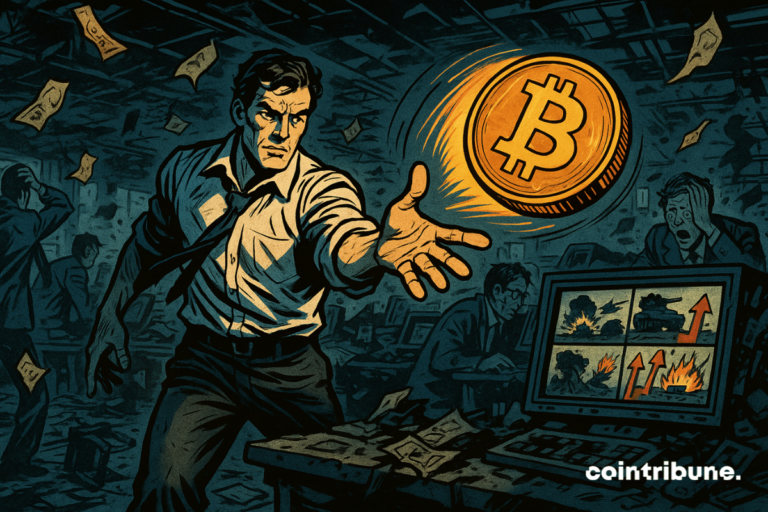
While the war in Ukraine enters a critical phase, Donald Trump throws a pavement in the diplomatic pond. The American president said that no new sanction against Moscow is taken as long as NATO countries continue to buy Russian oil. This declaration explodes persistent fractures within the Alliance and relaunches the question of its strategic coherence in the face of Russia.

In short
- Donald Trump conditions new sanctions against Russia at total oil purchases by NATO countries.
- Several Member States, including Hungary and Slovakia, continue to import Russian oil via the Droujba oil pipeline, despite European sanctions.
- Trump accuses these practices of weakening the position of the alliance against Moscow and calls for a coordinated response.
- In parallel, it proposes to impose massive customs duties on Chinese products to break their support for Russia.
Energy ultimatum: Trump threatens to block sanctions
In a message released this Saturday, September 13, on its Truth Social network, Donald Trump launched a detour warning to NATO members, while many observers predict an inevitable war between Europe and Russia. The American president says that he will not take any new sanction against Moscow as long as the Allied countries continue to import Russian oil.
“I am ready to take significant sanctions against Russia, from the moment all the NATO countries have also decided and when all NATO countries have stopped buying oil from Russia”he writing.
This declaration comes in a tense geopolitical context, marked by the resurgence of tensions in Eastern Europe. Despite the sanctions imposed by the EU since 2022, some countries still benefit from exemptions.
The tone used by Trump reveals a desire to force the strategic unity of the Alliance, by targeting the Member States which, according to him, have complied with their energy commitments to Ukraine. Among the notable facts:
- Hungary and Slovakia, two NATO member countries, continue to import Russian oil via the Droujba oil pipeline, still temporarily exempt from European sanctions;
- Trump said “Very unhappy” From this situation, during a telephone conversation in early September with European leaders from Paris, according to the words reported by the Ukrainian president Volodymyr Zelensky;
- He accuses these practices of weakening the position of NATO vis-à-vis Moscow, going so far as to qualify certain behaviors as “Shocking”without the appointment of the countries concerned;
- Trump calls on NATO to act collectively to maintain a credible negotiation lever, stressing that the continuous purchase of oil from Russia considerably weakens the alliance pressure capacity.
Through this outing, the American president considerably hardens the discourse vis-à-vis his allies, posing a real energy ultimatum. It conditions the diplomatic and economic action of the United States to a total alignment of European practices, an approach which could complicate the already fragile dynamics within NATO.
Economic weapon: China in Trump's viewfinder
Beyond the energy, Donald Trump intends to strike on another front: that of economic relations with China, an influential member of the BRICS block. Still on Truth Social, he proposed that NATO countries collectively impose customs duties of 50 to 100 % on Chinese products, while the Russian-Ukrainian conflict is resolved.
“China exercises important control, even a grip on Russia, and these powerful customs duties will break this grip”he assertive.
This positioning aims to mobilize NATO as a military alliance, but also as a commercial block capable of carrying out a structured economic war against the indirect support of Moscow.
By targeting Beijing, Trump seeks to weaken economic support flows that would allow Russia to bypass current sanctions, as did India or Turkey did. The logic is clear: isolate Moscow financially by limiting its oil outlets, while putting pressure on its strategic partners.
Trump's involvement in this file challenges the viability of his approach. Can we really consider a NATO customs coalition against China, in a context where European economies remain dependent on Chinese imports?
Trade tensions, as evidenced by the maintenance of prices on China by the United States, could further weaken global supply chains. Furthermore, the effectiveness of such a strategy depends largely on the capacity of the members of the Alliance to act in a coordinated manner, which remains uncertain. In the short term, this rhetorical escalation could above all accentuate geopolitical polarization and weaken the diplomatic efforts of de -escalation.
Maximize your Cointribne experience with our 'Read to Earn' program! For each article you read, earn points and access exclusive rewards. Sign up now and start accumulating advantages.