Everyone is impatiently waiting for the FED (American central bank) to start lowering its rates. This is what traders are betting on. That said, can we expect a pivot soon? What are the consequences that can be linked to a pivot? This is where we will see these details together.
What does a central bank pivot mean?
Before going any further, we will first define the principle of a pivot. Rates are used as a tool by central banks to manage monetary policy. These have two main mandates: price stability and full employment. They will subsequently maneuver their monetary policy according to the situation through these two mandates.
Example: when inflation is too high, it will increase key rates in order to slow inflation. In this case she becomes less accommodating. On another note, when the level of unemployment increases or the level of inflation is too low (deflationary pressure), it will lower its rates in order to stimulate growth again. Here is the example of the increase in unemployment and the reduction in the FED’s key rate:
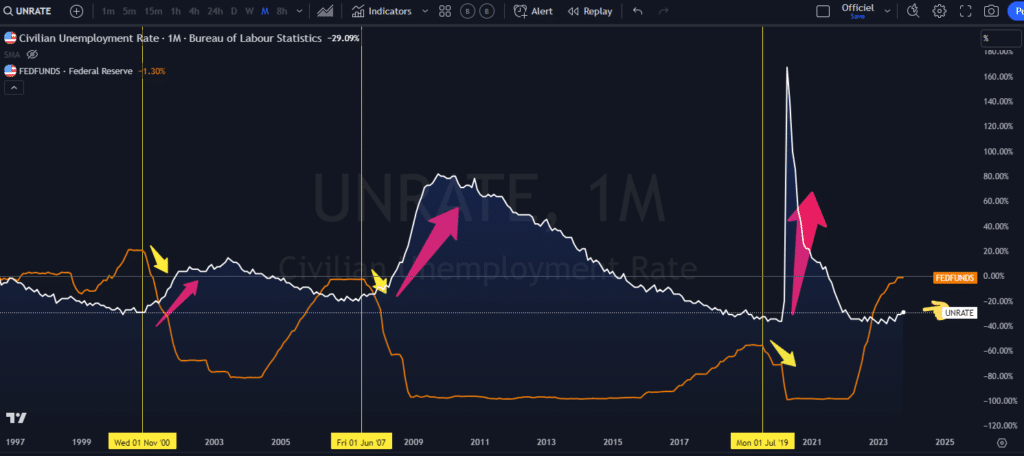
To this extent, the central bank can raise rates, cut rates (pivot), or pause. A pause is not a pivot but just a halt in rate increases for a period of time. A pivot is a significant change in monetary policy.
On another note, the central bank has other tools such as the quantitative tightening and quantitative easing program (liquidity injection) but we will focus more on rates in this article.
Traders’ bet on a FED pivot
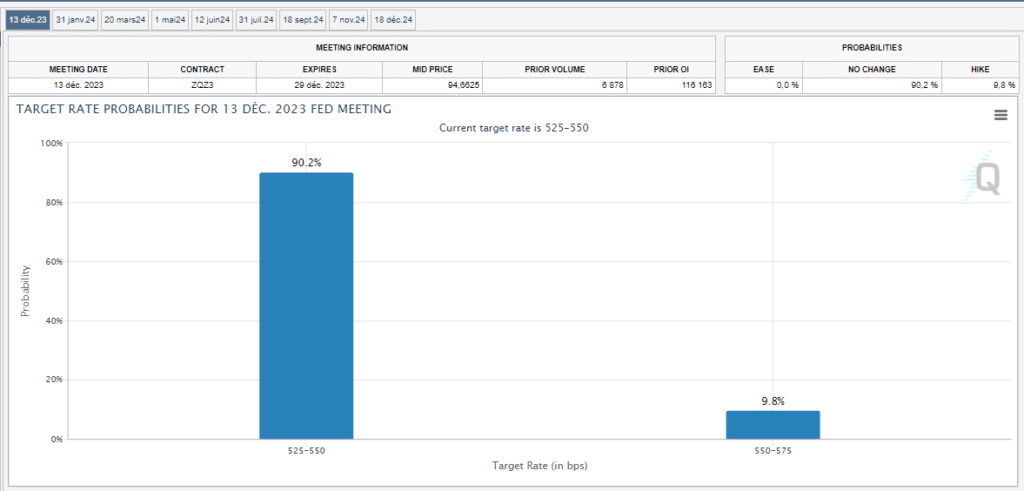
In terms of probability, the projections for the next FOMC (FED meeting) are on the side of a continuation of the pause. Moreover, the American central bank has maintained its rate at the same level for several months, which means that we are still on “pause”. .
It is in this same dynamic that we can see traders betting on a pivot from the FED, but also from the European Central Bank and the Bank of England. We can see this in the pricing of swaps:
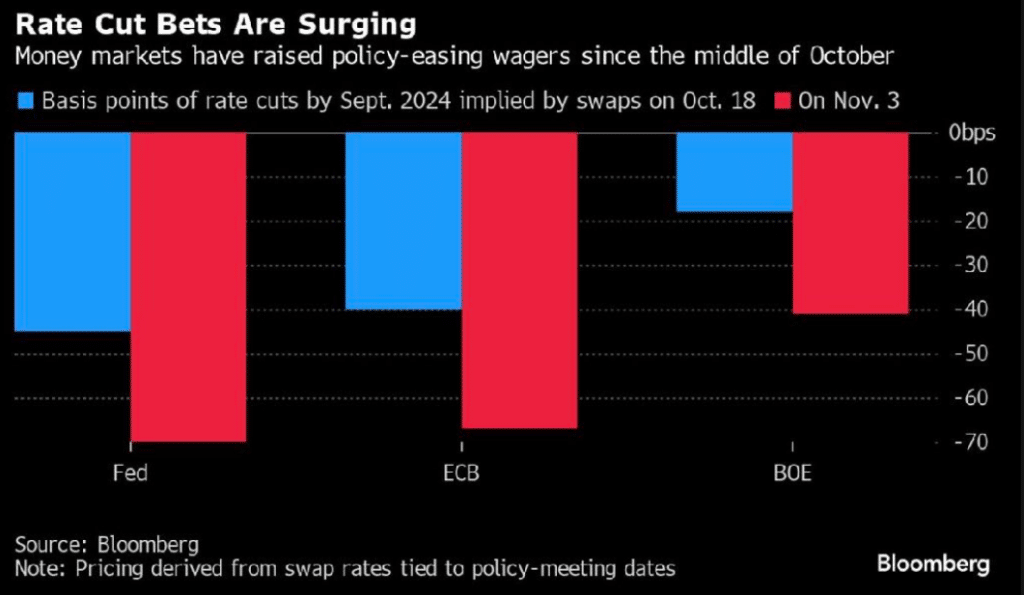
Why bet on a pivot?
In the past, a pivot that results in a rate cut is not always a sign that everything is going well and that we are going to have a soft landing. Generally, when betting on a pivot, it is because we think that either inflation will fall towards the target level supported by an economic slowdown or we are betting on a larger consequence of the cycle like an increase in unemployment. An increase in unemployment risks reawakening the second mandate of central banks, namely maintaining full employment. In the present case, we know that inflation remains resilient provided that the job market remains resilient. We will say that wage growth maintains a certain standard of living for consumers. For example, wage growth remains above the level of inflation, which fuels consumption
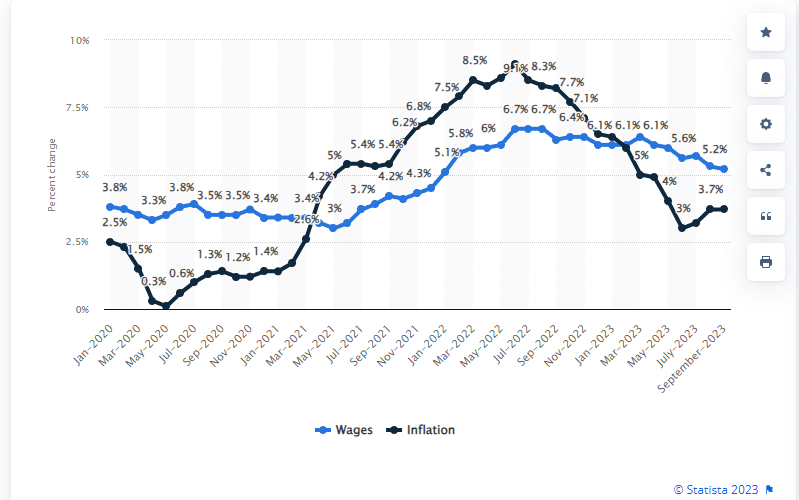
So, we want to know if we have a fragility in the job market which could in turn affect consumption. Unemployment figures have increased from 3.4% to 3.9% since the last lows, an increase of 0.5% in the last 6 months. From a technical point of view, this trend is not negligible because we can see a bullish acceleration through the momentum indicators. In the past, we can see that each acceleration has a greater probability of preceding a recession:
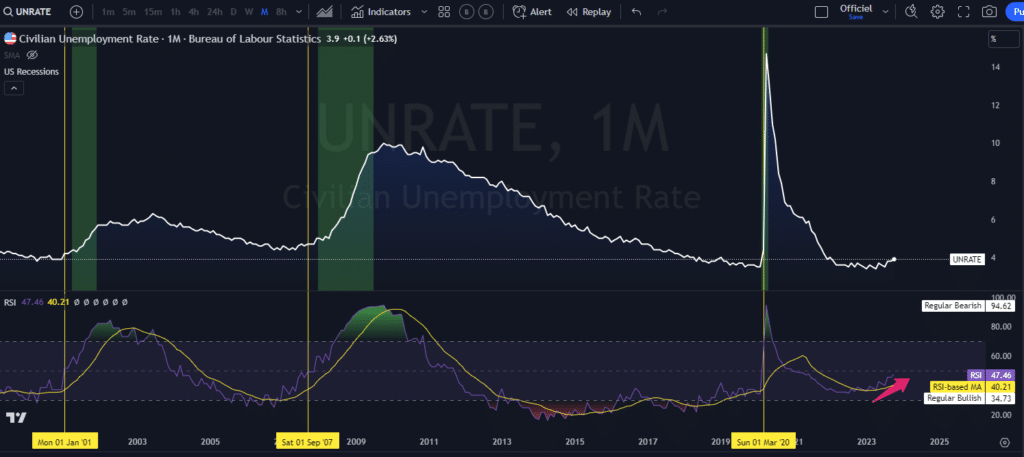
It is mainly for this reason that operators are starting to bet on a pivot for 2024. Maintaining high rates currently allows the central bank to remain restrictive since the key rate is higher than the inflation rate. However, the FED often recalls in its rather hawkish (restrictive) speech the “higher for longer”, which means keeping rates high for a long time. That said, as economic growth remains in “slowdown” mode, this capacity to absorb high rates will eventually run out without an economic rebound. We can see this in the exchange rate at the level of unemployment.
Market performance after a pivot
Historically, when the FED pivots, it is not always a good sign for financial markets. Given that there is an underlying reason for a pivot such as rising unemployment or liquidity crisis or deflationary process, this can have repercussions on financial markets. Here is the example taking the variation of the S&P500 as well as the variation of the key rate:
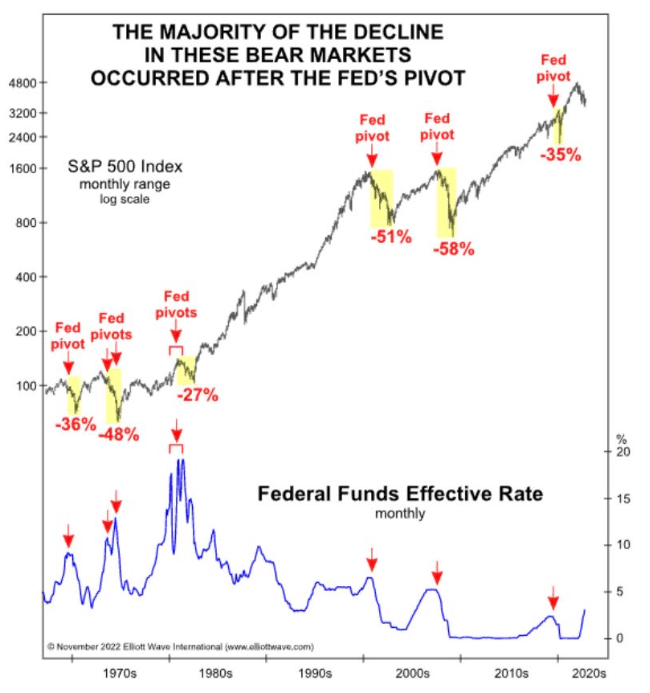
The S&P500 is a collection of companies. It is the most watched index since it includes all sectors. Therefore, this is supposed to represent the health of the economy. Even though we may face mismatches between the two, between the economy and the financial markets, this often eventually rebalances. For example, we know that the mega caps which have an important place within the index have significantly stimulated the performance of the S&P500 in 2023. The stock market is above all a market of supply and demand and like the mega caps hold a lot of cash, they served as a temporary defensive investment. Other mechanisms can also explain discrepancies such as operator sentiment, the structure and mode of operation of derivative products on options, significant flows of CTAs, etc.
Performance of the S&P500 during a pause
On the other hand, during a break from the central bank or simply the anticipation of a break, the performance of the financial markets is encouraging, hence the performance of the first half. A pause is likely when the central bank believes it has been sufficiently restrictive in raising rates. The pause allows it to wait and see the often delayed consequences of rate increases. Here is the example of the performance of the S&P500 after a break:
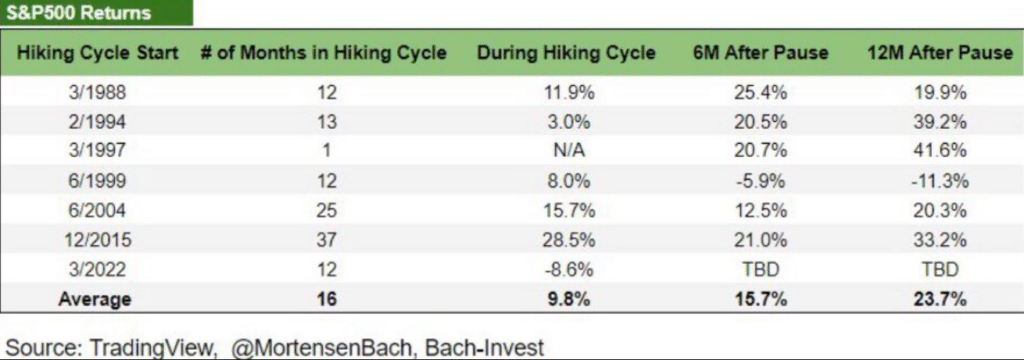
Financial markets tend to bounce back and react positively as soon as traders bet on a pause or rate cut next year. Until then, we were a bit like in the dynamic “buy the rumor of a pivot, and sell the news of a pivot”. That said, if traders bet on a real pivot, when the market realizes that it is no longer a question of rumor but of reality, it could react more negatively since in the past, a pivot is not always a good sign . Everything will depend on the job market.
The risks of recession in 2024?
We have several leading indicators that point to an increasing likelihood of recession. For example, we have the inverted yield curve. The reversal itself is not the most dangerous signal, rather it is when it bounces after the reversal that it becomes more problematic (see chart below). Here on the graph, the rebound of the curve since this summer. The curve is close to returning to the positive zone.
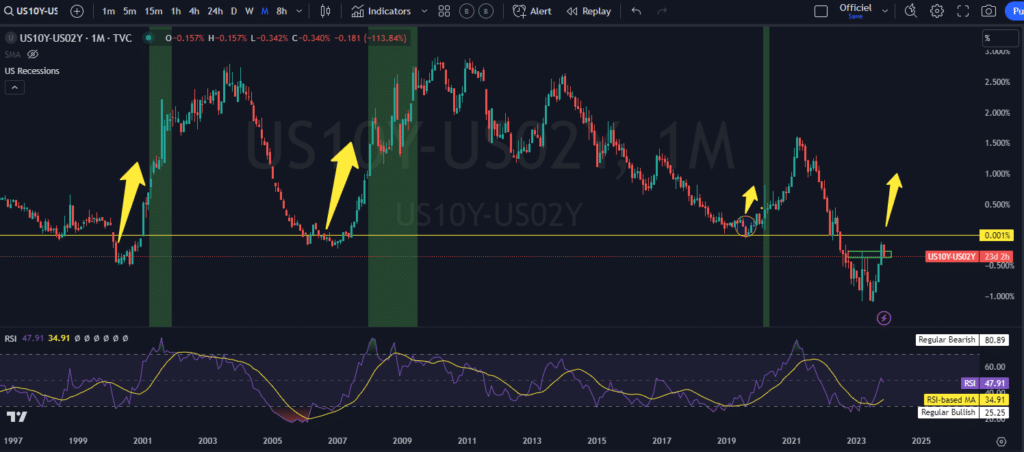
That said, the risks of recession are very often postponed until 2022. Wage growth as well as a fairly resilient job market until then have postponed these risks until later. Even if the probabilities remain high in theory based on leading indicators, trying to time a recession remains quite difficult in practice.
Conclusion
We know that we are still in an economic slowdown and this is likely to continue in the coming months. Just wanting to keep rates high while we’re in an economic downturn is a key to saying that this risks further weakening the economy. As explained previously, we are starting to have repercussions and weaknesses, particularly when we look at unemployment. Therefore, the dice are being rolled by traders to bet on a pivot in 2024.
Receive a summary of the news in the world of cryptocurrencies by subscribing to our new service daily and weekly so you don’t miss anything of the Tremplin.io essentials!