

For several weeks, on-chain data has drawn attention to an unusual phenomenon in the crypto market. Historical holders retain a growing share of available units, limiting movements on platforms. This situation revives questions around a possible Bitcoin supply crisis, while sales from patient investors remain weak. A recent study shows that long-term portfolios now control a record majority of the circulating supply. This data reinforces questions about market liquidity and future behavior.

In brief
- 79% of the circulating supply of Bitcoin is now held by long-term investors, an all-time high.
- Only 218,421 dormant BTC have been reactivated since the start of the year, the lowest level since 2012.
- Historical holders limit sales, which reduces the amount of Bitcoin available on the market.
- Declining trading volumes and slowing ETF outflows show lower investor activity.
- The market is now monitoring the evolution of demand to determine whether this scarcity of supply can support a new phase of stabilization.
Bitcoin: an available supply that is becoming rarer compared to historical holders
While the Bitcoin market is currently going through a decline phase marked by a slowdown in activity and a drop in short-term speculative interest, certain indicators nevertheless show a significant evolution in the structure of supply.
According to a study by K33 Researchlong-term holders retain a dominant share of the circulating supply. This accumulation reduces the amount of bitcoins available on the market and gradually changes the balance between buyers and sellers. Historical investors seem to favor the conservation of their assets rather than a rapid return to circulation.
Here are the main figures which illustrate this situation:
- 79% of the circulating supply of Bitcoin is held by long-term investors, an all-time high;
- 218,421 BTC dormant for at least two years were reactivated as of June 6, 2026, the lowest level since 2012;
- In comparison, 1.18 million BTC had regained activity in June 2024, during a larger distribution phase;
- Historical holders limit their movements, reducing the amount of bitcoins available for trading;
- Trading volumes are falling, while ETF outflows are at their lowest levels of the year.
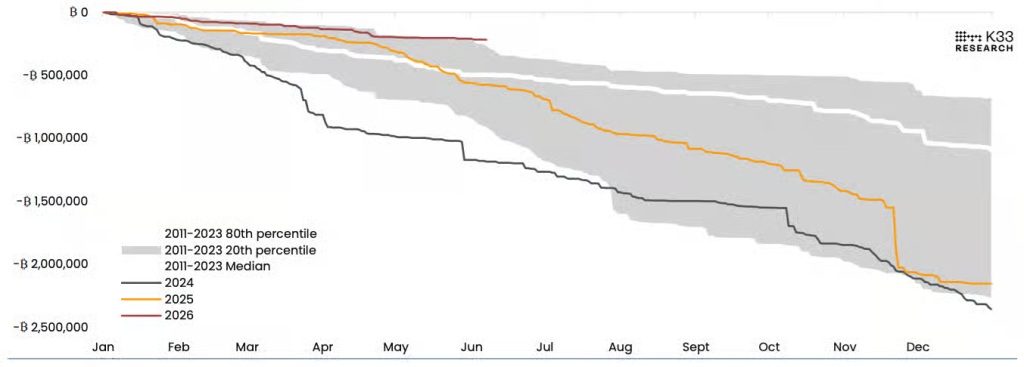
This development reflects a change in the behavior of former investors. Unlike previous periods marked by more sales, historical portfolios remain less active today. The market is thus observing a lower circulation of old units, with reduced selling pressure.
At the same time, general market activity is slowing. The decrease in trading volumes and the stabilization of ETF-related flows show a phase where investors are adopting a more cautious stance. This situation reinforces questions about the market's capacity to absorb new demand with a more limited available supply.
Record accumulation after a period of falling prices
These data appear after a difficult phase for the market. The price of BTC recorded around two weeks of marked decline at the beginning of June 2026 before regaining a certain stability. On June 17, it was hovering around $65,000, an increase of around 6% after its recent lows.
K33 points out that several current indicators often correspond to the last stages of a bearish phase. Bitcoin today combines a high concentration of supply in the hands of long-term holders, a weak reactivation of old coins and a drop in volumes. This configuration, however, remains linked to other factors that could influence future movements.
Among these elements, American monetary policy occupies an important place. The Federal Open Market Committee is to hold its first meeting under the chairmanship of Kevin Warsh. Decisions regarding interest rates and future directions from the Federal Reserve have already influenced crypto markets.
A reduced supply in the face of crypto market uncertainties
When holders retain 79% of available supplythe number of units accessible for exchange decreases sharply. New demand from institutions, individuals or ETFs could therefore encounter a market with less liquidity. Bitcoin thus remains at the center of observations linked to this tension between conservation and circulation.
However, slowing ETF outflows does not automatically mean a return of buying. The difference between a decline in sales and an actual recovery in demand remains key to assessing the direction of the market. Investors therefore monitor financial flows and the evolution of active portfolios.
The current situation combines several rare elements: a historic concentration of supply, low activity of old coins and a reduction in exchanges. Bitcoin could evolve in an environment where the availability of units plays a major role. The coming weeks will allow us to observe whether this accumulation accompanies a lasting stabilization or whether the market remains exposed to uncertainties.
In the short term, data on inactive portfolios and capital movements will remain indicators closely monitored by industry players. A shift in demand could shift the current balance between a limited supply of BTC and potential buyers. If investor interest builds, the low availability of bitcoins in circulation could accentuate price movements. The market will therefore have to confirm whether this phase corresponds to a new stage of consolidation or a prolonged period of waiting.
Maximize your Tremplin.io experience with our 'Read to Earn' program! For every article you read, earn points and access exclusive rewards. Sign up now and start earning benefits.


