
The predictive market is experiencing a new phase of expansion. According to the Financial Times, Kalshi is negotiating a new fundraising which could bring its valuation to 40 billion dollars (compared to 22 billion in May). If the operation is successful, the company founded by Tarek Mansour would multiply its value eightfold in less than a year. Enough to attract the attention of institutional investors, financial platforms and technology groups looking for new growth drivers.

In brief
- Kalshi is looking to raise money at a valuation of around $40 billion, according to the Financial Times.
- The predictive market platform recorded more than $17 billion in trading volumes last month, up from less than $5 billion a year earlier.
- Kalshi positions the regulated prediction market as a new class of financial infrastructure.
From 5 to 40 billion in eight months: what this rise hides
In October 2025, the valuation of the Kalshi predictive market platform amounted to $5 billion. In December, 11 billion. In May 2026, 22 billion after a billion-dollar Series F. According to information from the Financial TimesKalshi would today be in negotiations for a new raising of 40 billion dollars. This represents an 8-fold increase in less than a year.
According to expert analysts, these figures are not simply a fashion effect. They reflect a growing conviction on the part of the most selective investors in the world. We are referring to Coatue Management, Andreessen Horowitz (a16z), Sequoia Capital, Morgan Stanley and Ark Invest who all participated in the latest fundraising.
Decryption: the predictive market is on the way to becoming a financial infrastructure in its own right.
$17.9 billion per month: how did Kalshi turn the tables on predictive market giant Polymarket?
A year ago, Polymarket largely dominated the global predictive market in terms of volumes. The decentralized platform took advantage of the 2024 American presidential election to establish itself as the global benchmark.
But a strategic pivot by Kalshi changed everything. In September 2025, this predictive market giant entered into a partnership with Robinhood. The goal: to allow users to trade on the results of NFL and American university football matches. This shift toward mainstream sports has sparked an explosion in activity.
According to Token Terminal data cited by the Financial Times and CointelegraphTHE notional monthly volume of Kalshi reached $17.9 billion in May 2025 (compared to only $7.1 billion for Polymarket). Sports-related deals now account for around 65% of Kalshi’s total volume.
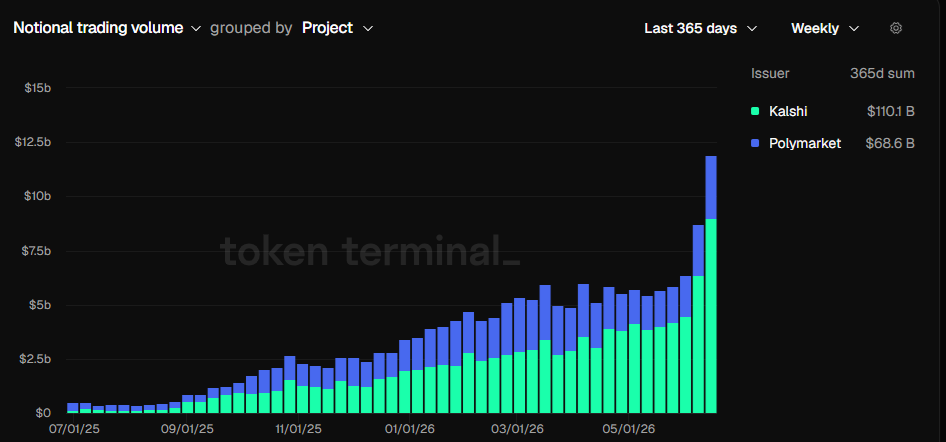
Combined multi-results contracts, introduced last year, have therefore become one of the main drivers of growth. In annualized terms, Kalshi volume exceeds $178 billion. This represents more than three times the level recorded six months previously. According to data, more than $2 billion committed to Kalshi and Polymarket on the eve of the 2026 World Cup.
Interest in Kalshi now extends beyond the crypto and fintech sphere
According to the New York Times, Mark Zuckerberg asked his teams to develop a predictive market mobile app called “Arena”. The latter would be designed to directly compete with Kalshi and Polymarket. True, Meta has not publicly confirmed this information. Nevertheless, the simple fact of mentioning such a project constitutes a strong signal: the prediction market is becoming a mainstream product.
That's not all! Cboe Global Markets also launched a predictive market platform called Cboe Predicts with binary contracts linked to the S&P 500. The entry of one of the world's largest financial market operators into this space changes the dynamic. In fact, it normalizes the concept among regulators, institutions and the general public.
In any case, Kalshi is rewriting the rules of the game for mainstream financial markets. It remains to be seen whether American regulators will support this development or choose to slow down its development. This question could decide the next chapter of the global prediction market.
Maximize your Tremplin.io experience with our 'Read to Earn' program! For every article you read, earn points and access exclusive rewards. Sign up now and start earning benefits.