
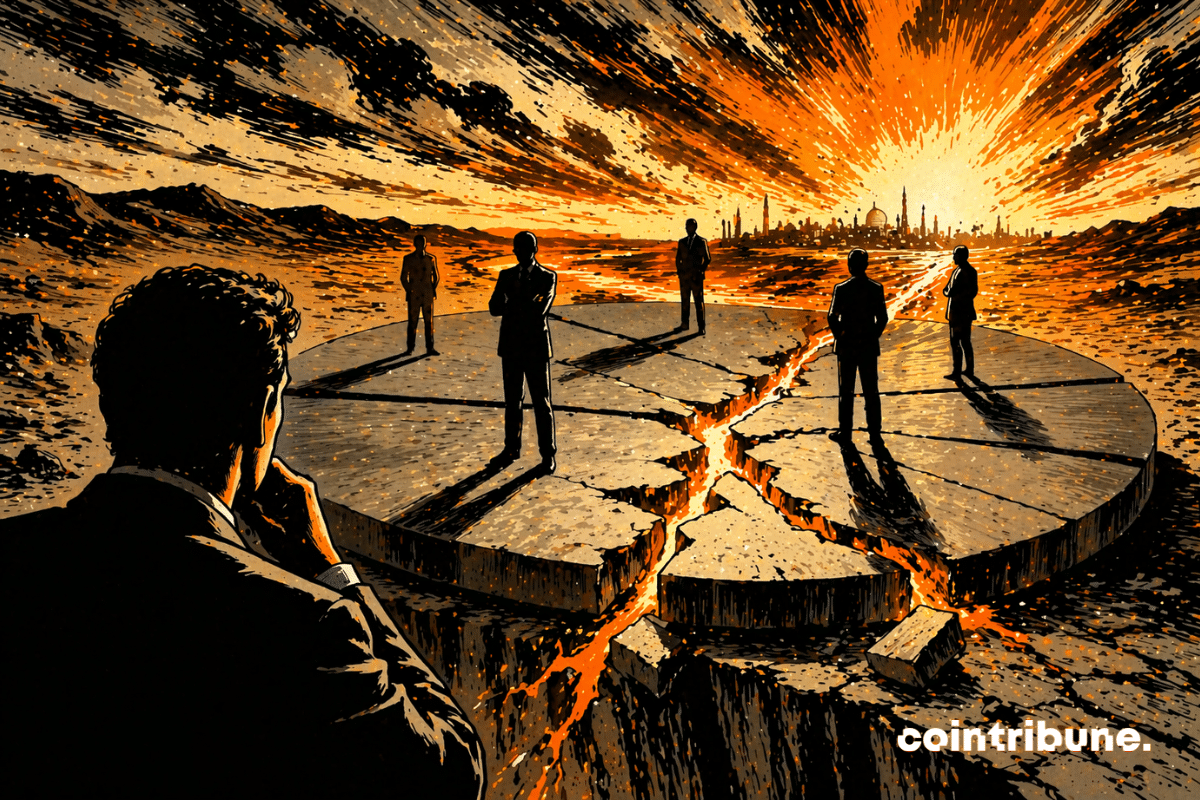
Great powers emerge in crises, and BRICS may have just missed their moment. While the war involving Iran could have marked a turning point, the bloc remained silent, unable to display a common position. This silence questions its real credibility in the face of its global ambitions. Behind the image of a counter-power to the West, this sequence above all exposes deep divisions and structural fragilities that rhetoric is no longer enough to mask.
In brief
- The war involving Iran acts as a major test for BRICS, revealing its inability to respond in a coordinated manner to an international crisis.
- Despite their ambition to influence the world order, the BRICS have failed to formulate either a common position or a credible diplomatic initiative.
- The deep differences between the members of the bloc prevent any unified strategy, each favoring its own national interests.
- This lack of coherence reveals the structural limits of a group that is more economic than truly geopolitical.
A block absent at the decisive moment
The war involving Iran, although a member of BRICS, did not give rise to any structured collective position. In fact, the bloc remained completely absent in the face of the crisis. Despite its ambition to influence the world order, no coordinated diplomatic initiative has emerged, which constitutes a strong signal of its inability to act in a context of major international tension.
In detail, several factual elements confirm this lack of common response:
- Attempts at a joint declaration were made, but were unsuccessful;
- No consensus was found among members on the line to adopt;
- The bloc has neither published a strong official position nor a visible collective initiative.
These blockages illustrate a structural inability to produce a coordinated response, even when the group's strategic interests are directly affected.
An alliance undermined by incompatible positions
Beyond the collective silence, the crisis reveals deep differences between the members of the bloc. The conflict “puts BRICS to the test and reveals its limits”by exposing national positions that are difficult to reconcile.
Some states maintain close relations with Iran, while others adopt more cautious, even opposing, postures. This diversity prevents the emergence of a common strategy and confirms that BRICS does not function as a coherent political alliance.
This fragmentation finds its origin in the very nature of the group. BRICS is not a structured geopolitical alliance, but a platform for economic cooperation. The recent enlargement of the bloc has accentuated these contradictions, by integrating countries with divergent strategic interests. In this context, each member favors its national priorities, which strongly limits the group's ability to act collectively in international crises.
If the bloc retains real economic weight, its inability to adopt a common position in a tense geopolitical context calls into question its capacity to structure an alternative order. For market observers, this situation is a reminder that multipolarity remains fragmented and unstable. In the medium term, this lack of coherence could slow down the bloc's ambitions, while reinforcing interest in assets perceived as independent of traditional political balances.
Maximize your Tremplin.io experience with our 'Read to Earn' program! For every article you read, earn points and access exclusive rewards. Sign up now and start earning benefits.


