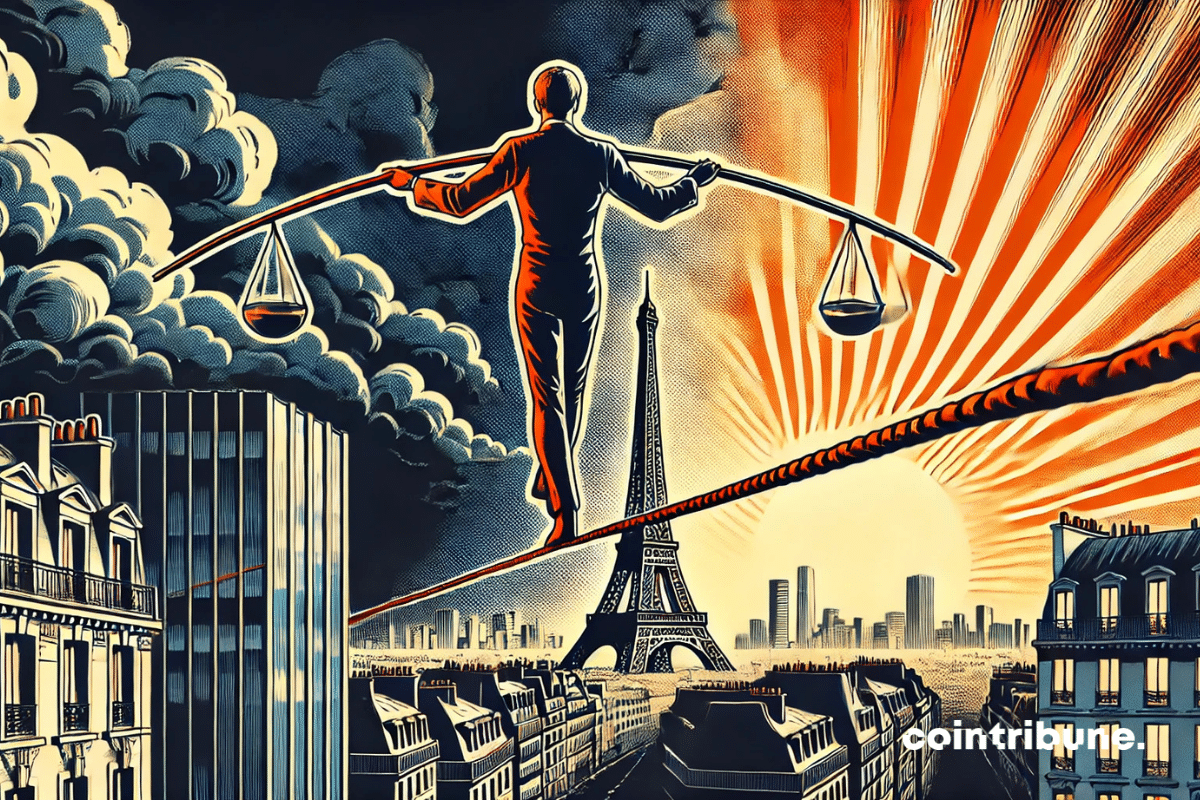
Despite the uncertainties weighing on the global context, the French economy surprises with its ability to maintain a precarious balance. While the zero growth forecast for the end of the year could have heralded dark days, several indicators suggest unexpected resistance. However, this picture is neither black nor rosy, in the words of the governor of the Bank of France, François Villeroy de Galhau.

An economy that is escaping recession, but under tension
The French economy is managing to avoid recession with annual growth projected between 0.8% and 1.1% in 2024, according to forecasts from INSEE and the Banque de France. These figures, although mixed, demonstrate a certain stability in a European context marked by prolonged recessions, particularly in Germany. Thus, as pointed out by Christopher Dembik, economist at Pictet Asset Management, this relative performance can be explained by an economy more focused on its domestic market, which makes it less vulnerable to external shocks. He precise also that “the reduced weight of industry in French GDP, often perceived as a weakness, here plays the role of a shock absorber in the face of the competitiveness crisis suffered by European industry”.
However, this resilience is far from homogeneous. While sectors such as aeronautics and the food industry are experiencing renewed activity, others, such as manufacturing, are struggling to recover. Factory closures, notably those announced by Michelin, and job cuts at Auchan, illustrate the difficulties of transformation to adapt to new market dynamics. François Villeroy de Galhau nevertheless tempers these observations and affirms that “the industry, overall, has held up relatively well”, according to the Banque de France surveys for October.
Consumption and employment: pillars under pressure
Household consumption remains a key point in the resistance of the French economy. Supported by an increase in purchasing power of 1.3% planned for 2024, this pillar remains stable, despite inflationary pressures. Furthermore, according to INSEE, this increase is explained by the improvement in real wages, with an increase of 0.9% in the average salary per capita. On the other hand, the job market reflects a more complex situation: 17,700 net job losses were recorded in the third quarter, and the unemployment rate could reach 8% by the end of 2025. Christopher Dembik recalls that “the “Current adjustments reflect a return to normal after years of massive support to businesses during the pandemic.”
In terms of outlook, the political climate and budgetary discussions weigh heavily on the economic future. The 2025 budget, with its forecasts for an increase in taxation, could slow growth by several tenths of a point. In addition, political tensions, amplified by geopolitical uncertainties and the specter of a trade war with the United States under the Trump administration, are fueling investor concerns. As Éric Dor, director of economic studies at IESEG, explains, “if a political blockage continues, the markets could end up reacting, which thus amplifies economic risks”.
The French economy is at a decisive turning point. If current resilience makes it possible to avoid an immediate crisis, it cannot hide the need to consolidate public finances and initiate structural reforms to respond to the challenges of tomorrow. However, current signals call for increased vigilance, while budgetary debates and geopolitical developments will be crucial to maintaining market confidence and supporting sustainable growth. The future rests on a delicate equation: preserving resilience and anticipating upheaval.
Maximize your Tremplin.io experience with our 'Read to Earn' program! For every article you read, earn points and access exclusive rewards. Sign up now and start earning benefits.